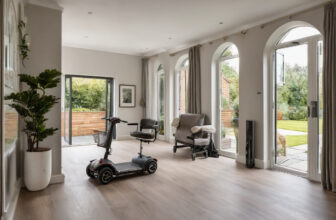
An electric mobility scooter is a seated, battery-powered vehicle that travels at a walking pace and recharges from an ordinary wall outlet. Its real value is not replacing walking but deciding where your energy goes: the scooter covers the distance to the store or the family gathering, so you arrive with something left for the visit itself.
An electric mobility scooter is a small, seated vehicle that carries you from place to place at a gentle, walking-friendly pace. It runs on a rechargeable battery and an electric motor, so there is no gas, no fuel to buy, and nothing to pull-start: you switch it on, and off you go.
What “electric” really means here
The word “electric” can sound technical, but the idea is simple. Inside the scooter is a battery, much like the one in a phone or a laptop, only larger. When you plug the scooter into a normal wall outlet, the battery fills back up. That stored power then feeds a quiet electric motor, and the motor turns the wheels. You steer with the handlebars, and you control your speed with a lever or thumb control near your hand.
Because it is electric, there is no engine noise, no exhaust, and no oily maintenance. You are not filling a tank or mixing fuel. The main habit to build is charging it, usually overnight, the same way you might charge a hearing aid or a tablet. When it is charged, it is ready. That is the whole idea in a sentence: battery in, motor out, no fuel in between.
How it helps you keep your independence
For many people, the hardest part of getting older or living with a health condition is not the big moments but the small ones: getting to the mailbox, moving through a large store, crossing a parking lot, or simply going out without needing to ask someone for a ride or an arm to lean on. A mobility scooter gives that back. You decide when to leave, where to go, and how long to stay.
That sense of “I can do this myself” matters. It changes an errand from something you dread into something ordinary. Instead of planning your day around who can help, you plan it around what you actually want to do.
Saving your energy for what matters
People who have never used a scooter sometimes worry it means “giving up” on walking. It is closer to the opposite. Many riders still walk perfectly well for short distances; they just do not want to spend all of their limited energy getting somewhere and have none left once they arrive.
Think of your daily energy like a battery of your own. If walking the length of a shopping center drains most of it, the scooter carries you there so you can spend that energy on the visit, the conversation, or playing with grandchildren instead. For people who tire easily, are short of breath, or have pain that builds up over a distance, this trade is the whole point. You are not doing less; you are choosing where your effort goes.
Staying social and connected
When getting around becomes difficult, it is easy to start saying no. No to the family gathering across town, no to the market, no to the walk in the park with friends. Each “no” is small, but together they can shrink a full life down to a few rooms.
A scooter quietly reverses that. You can join the group outing, browse the aisles at your own pace, sit comfortably while others stand, and come along on the flat paths at a park or fair. Staying in the mix is good for more than mood; regular contact with other people supports memory, motivation, and overall well-being. Being able to show up is often what keeps someone feeling like themselves.
Who tends to benefit most
Mobility scooters are not only for one type of person. They tend to help anyone whose legs or stamina no longer match the distances daily life asks of them. That includes people living with arthritis, heart or lung conditions, the lingering effects of a stroke, balance trouble, or general frailty that comes with age.
They also suit people recovering from surgery or an injury who need support for a season rather than forever. The common thread is simple: you can sit and steer safely, and you want to travel farther than your body comfortably allows on foot. If that sounds like you or someone you love, a scooter may be worth a closer look. As with any device that affects your health and safety, it is wise to talk with a doctor or therapist about whether it fits your situation and your body.
FAQ
Is a mobility scooter the same as a kick scooter?
No. A kick scooter is a stand-up toy or commuter device you push with your foot. A mobility scooter is a seated medical device built for comfort, stability, and daily support, designed for people who need help getting around rather than for recreation or speed.
Do I need to know anything about electronics to use one?
Not at all. If you can charge a phone and turn a key or press a button, you can operate a scooter. The controls are kept simple on purpose, and the only regular task is remembering to plug it in so the battery is ready when you are.
Will using a scooter make me weaker over time?
Used sensibly, it does the opposite for most people. By saving your energy for the trip itself, you often stay more active and social, not less. If you have specific concerns about staying mobile, your doctor or physical therapist can help you find the right balance for your needs.