
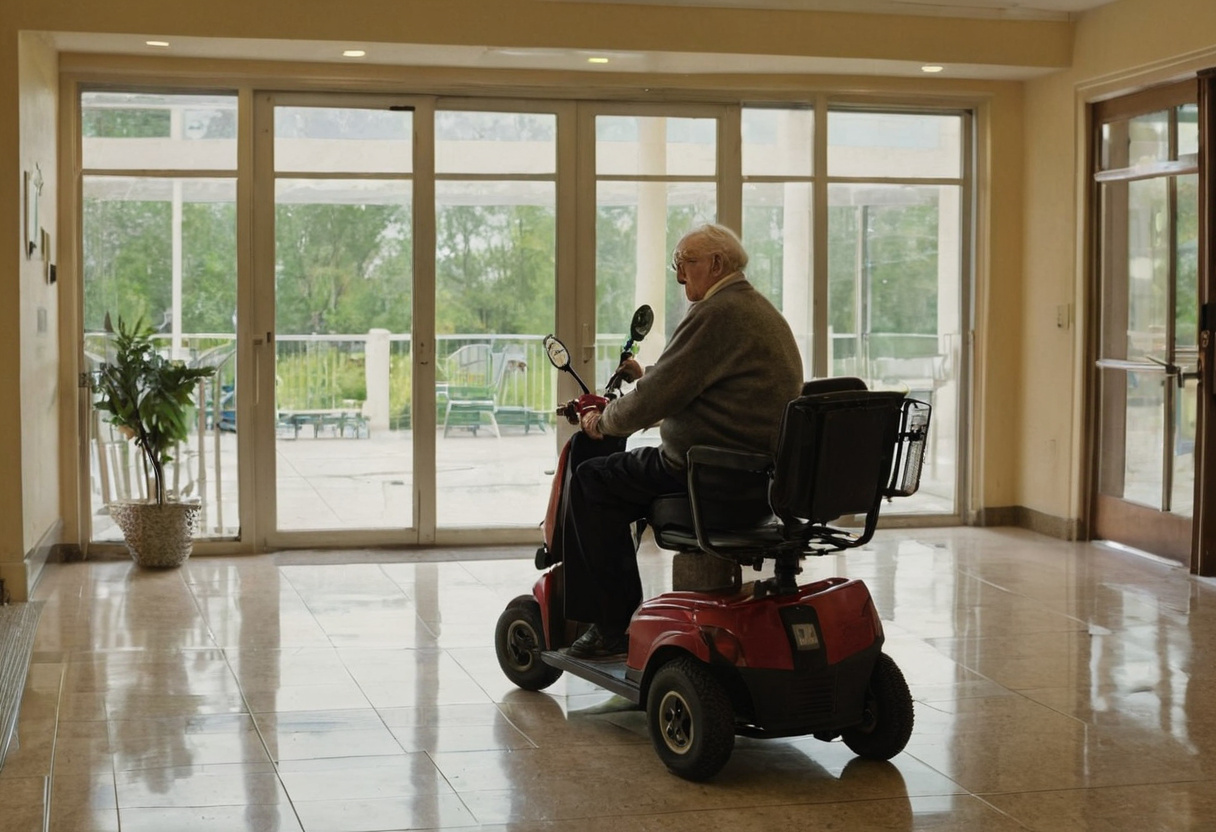
Every senior living community sets its own scooter policy and they vary widely, so ask before you buy and get the key points in writing: where it may be parked, where it may be charged, and whether there is an indoor speed rule. Living in a community does not by itself change Medicare eligibility. Communities can set reasonable rules about indoor use, but outright bans are less common and worth raising with the director.
- Medicare Part B covers a power scooter as durable medical equipment when it is medically necessary for use in the home, and you typically pay 20% after the deductible.
- In one recent Medicare year, 4,236 beneficiaries received a Group 1 power scooter (HCPCS K0800).
- 27.7% of Americans 65+ report a mobility disability, which is the population these benefits serve.
Sources: U.S. CMS Medicare Part B DME data; U.S. CDC DHDS (BRFSS 2021).
A mobility scooter can be the difference between staying in your apartment and getting to the dining room, the garden, or a friend’s door on your own terms. If you or a loved one lives in independent living, assisted living, or a retirement community, a little planning up front makes a scooter a welcome help rather than a source of friction.
Start with the community’s own rules
Every community sets its own policy, and those policies vary widely, so the first step is always to ask. Talk to the front desk, the executive director, or the resident handbook before you buy, and get the key points in writing.
- Where scooters are allowed: some permit them throughout indoor common areas, others restrict use in dining rooms, elevators, or narrow corridors.
- Registration: many communities ask you to register the scooter, show proof of insurance, or sign a use agreement.
- Speed and courtesy indoors: ask whether there is a walking-pace expectation in hallways and shared rooms.
- Storage and charging: confirm where the scooter may be parked and plugged in (more on this below).
Getting these answers early prevents the disappointment of buying a scooter that does not fit the community’s guidelines.

Ultra Lightweight Folding Mobility Scooter
Price: see current price on Amazon | Rating: 4.8/5
Perfect for senior living environments with its compact 37.5 lb weight and airport-approved design. Features 275 lbs capacity and easy folding mechanism. Cons: Higher price point, limited off-road capability.
Buy on AmazonStorage and charging inside your apartment
Batteries are usually charged overnight, so plan for a spot near an outlet where the scooter can sit out of walkways. Communities often prohibit blocking corridors, fire exits, or shared hallways because these must stay clear for safety and for staff during an emergency.
- Choose a parking spot inside your unit, or ask whether the community offers a dedicated charging area.
- Keep charging cords tucked away so they are not a trip hazard for you or visitors.
- Follow the manufacturer’s charging instructions and don’t leave a scooter charging unattended for long stretches if the manual advises against it.
- Ask the community whether it has any rules about charging in common areas.

Ecomobi MS02 Extended Range Scooter
Price: see current price on Amazon | Rating: 4.7/5
Excellent community scooter with 15-45 mile range, dual baskets, and rotating seat perfect for senior living activities. Features 350W motor and extended battery options. Cons: Larger size may limit indoor maneuverability, heavier weight.
Buy on AmazonChoosing a compact, indoor-friendly model
Indoor spaces reward a smaller, tighter-turning scooter over a large road-style one. Focus on how the scooter behaves in the real spaces you use every day.
- Turning radius: a small turning circle matters most in apartment doorways, bathrooms, and around dining tables.
- Width: measure your doorways and elevator, then compare against the scooter’s width so you know it fits with room to spare.
- Weight capacity: match the model to the rider’s weight for safe, stable use.
- Tight-space handling: a three-wheel design often turns more sharply indoors, while four wheels can feel steadier, so try both if you can.
- Battery range: think about the longest trip you actually make in a day, such as to the far end of the building and back.
If possible, test-drive the scooter in a space similar to your community’s hallways before committing.

Compact Travel Scooter with LED Lights
Price: see current price on Amazon | Rating: 4.8/5
Budget-friendly option perfect for daily community activities with LED lights, basket, and portable design. Ideal for dining room and activity area navigation. Cons: Basic features, limited battery range.
Buy on AmazonBeing a considerate rider around neighbors
Shared hallways mean shared responsibility. Many of your neighbors walk slowly, use walkers, or have limited eyesight or hearing, so a calm, predictable riding style keeps everyone safe.
- Keep to a slow, walking pace indoors and in crowded areas.
- Slow down at blind corners, doorways, and elevator entrances.
- Give people on foot the right of way and pause to let them pass.
- Use lights and any horn or bell where the community allows, especially in dim corridors.
- Park fully out of walkways so others can move freely.

Metro Folding Mobility Scooter
Price: see current price on Amazon
Practical folding design with 300 lbs capacity and integrated headlight, perfect for facility transportation and storage. Lightweight construction for easy handling. Cons: No user rating available, basic feature set.
Buy on AmazonHow coverage may apply
A mobility scooter (often classed as a power-operated vehicle) may be covered by Medicare Part B or other insurance in the United States when a doctor documents that it is medically necessary and needed for use in the home, and comparable medical-necessity rules apply through public and private plans in Canada. Living in a senior community does not by itself change medical eligibility, but the details of paperwork, suppliers, and what counts as “in the home” can be involved. For the full picture on qualifying, prescriptions, and paperwork, see our separate coverage guide. Confirm anything specific with the plan or a licensed supplier before you buy.

Heavy Duty 4 Wheel Electric Scooter
Price: see current price on Amazon | Rating: 4.7/5
Sturdy scooter with 330 lbs capacity and 20-mile range, ideal for larger residents and extended community activities. Reliable 4-wheel stability for outdoor pathways. Cons: Heavier weight, larger turning radius for tight spaces.
Buy on AmazonSenior living FAQ
Can a community ban my scooter outright?
Policies vary, and communities can set reasonable rules about where and how scooters are used indoors, such as speed, parking, and charging. Outright bans are less common, and rules that affect a resident’s ability to get around may involve accessibility considerations. Ask the community for its written policy, and if you have concerns, raise them with the director.
What size scooter fits best inside an apartment?
There is no single answer, because doorways, bathrooms, and elevators differ from building to building. The most reliable approach is to measure your own spaces, then pick the most compact model that comfortably fits the rider’s weight and daily travel needs. A test drive in a similar hallway is the best confirmation.
Where do I charge it without breaking the rules?
Usually inside your own unit near an outlet, with cords kept clear of walkways. Communities often prohibit charging or parking in shared hallways and near exits because those must stay clear. Ask the community whether it provides a designated charging spot.