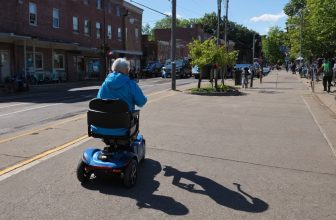
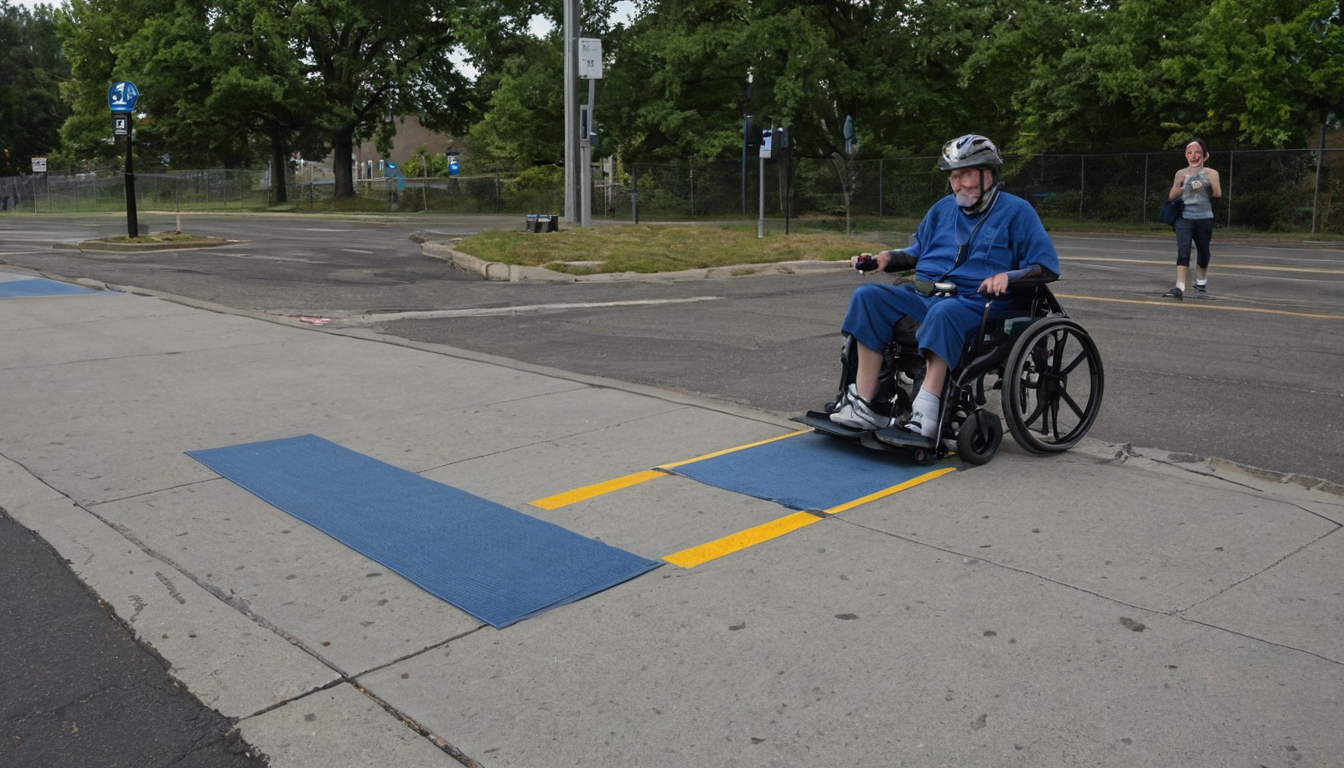
A mobility scooter fits a US passenger elevator built to the 2010 ADA Standards when its occupied length, feet and basket included, stays under the car’s depth from the back wall to the door, 54 inches in the two most common layouts, and its width clears a 36 inch door. Turning around inside is a harder question: a Zip’r Roo with a 31.5 inch turning radius sweeps a circle of about 63 inches, deeper than every minimum car except the 80 inch layouts, so most riders reverse out.
Will a mobility scooter fit in an elevator? The four ADA car sizes
Table 407.4.1 of the 2010 ADA Standards allows four minimum floor plans for a new passenger elevator car, and a scooter shorter than 51 inches fits all four by length while none of the four leaves room for a full pivot. Two shallow layouts put the door on the long wall: a centered door gets a 42 inch clear opening, an 80 inch wide car, 51 inches from the back wall to the front return and 54 inches to the inside face of the door; a side (off-centered) door gets a 36 inch opening, 68 inches of width and the same 51 and 54 inch depths. Two deep layouts put the door on the short wall: 36 inch door, 54 inches wide, 80 inches deep, or 36 inch door and a 60 by 60 inch car, with a minus 5/8 inch tolerance on the door and any other layout allowed if it gives a section 304 turning space with the door closed.
Read the last column first: the scooter’s rear must clear the door line before the doors close, and in the shallow layouts that line sits 54 inches from the back wall, 3 inches behind the front return that holds the buttons.
| Door position | Clear door width | Car width (side to side) | Depth to front return | Depth to inside of door |
|---|---|---|---|---|
| Centered on the long wall | 42 in | 80 in | 51 in | 54 in |
| Side (off-centered) on the long wall | 36 in | 68 in | 51 in | 54 in |
| Any position, narrow deep car | 36 in | 54 in | 80 in | 80 in |
| Any position, square car | 36 in | 60 in | 60 in | 60 in |
The 30 by 48 inch figure some scooter blogs print as an “ADA scooter size limit” is section 305.3’s clear floor space for one stationary wheelchair: a building minimum, not a scooter maximum.
Verified data
- Side-door ADA car: 36 in door, 68 in wide, 51 in to the front return, 54 in to the door. U.S. Access Board, 2010 ADA Standards
- Existing elevator exception: 16 sq ft of floor, 54 in clear depth, 36 in clear width. U.S. Access Board, 2010 ADA Standards
- Private residence elevator car: 36 by 48 in clear floor space, door at the narrow end. U.S. Access Board, 2010 ADA Standards
- Hall signal to door closing: T = D / 1.5 ft/s, 5 s minimum; doors fully open 3 s minimum after a car call. U.S. Access Board, 2010 ADA Standards
- Sill gap 1 1/4 in maximum, self-leveling within 1/2 in. U.S. Access Board, 2010 ADA Standards
- Zip’r Roo: 41 in long, 19.5 in wide, 31.5 in turning radius, 2 in ground clearance. Zip’r, 2026
- Pride Go-Go Ultra X 3-Wheel: 40.25 in long, 36.5 in turning radius, 1.25 in clearance at the motor. Pride Mobility brochure
Mobility scooter elevator dimensions in older buildings, LULA cars and home elevators
An elevator that predates the 2010 Standards stays compliant with only 16 square feet of clear floor, 54 inches of inside depth and 36 inches of clear width, far narrower than the 68 or 80 inches a new car must provide. Sixteen square feet over a 54 inch depth works out to a width in the low 40s (arithmetic, not a code figure): the scooter enters straight and can’t angle toward the buttons.
Limited-use, limited-application (LULA) elevators, common in churches and two-story retail, follow section 408.4.1 and are smaller: the car must be 42 inches wide and 54 inches deep with a 32 inch door at the narrow end, or 51 by 51 inches with a 36 inch door, and an existing LULA car may be 36 inches wide, 54 inches deep and 15 square feet.
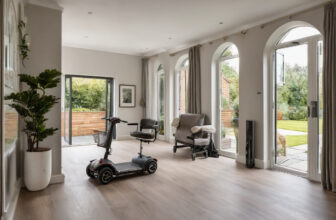
Private residence elevators under section 409.4.1 are the smallest: a 36 by 48 inch clear floor space with the door or gate at the narrow end. A 48 inch car is the only one where a travel scooter’s own length is in play: the Hoverfly T3 unfolds to 45.28 inches, leaving under 3 inches for toes, a rear bag and the gate.
In Canada, CSA B44 carries the same table as a nonmandatory Appendix E for National Building Code jurisdictions; in the 2016 edition (2018 reprint) the four layouts are 1065/2030/1295/1370 mm, 915/1725/1295/1370 mm, 915/1370/2030/2030 mm and 915/1525/1525/1525 mm with a minus 16 mm door tolerance. Which B44 edition each province enforces, and whether it makes Appendix E mandatory, could not be verified for this page.
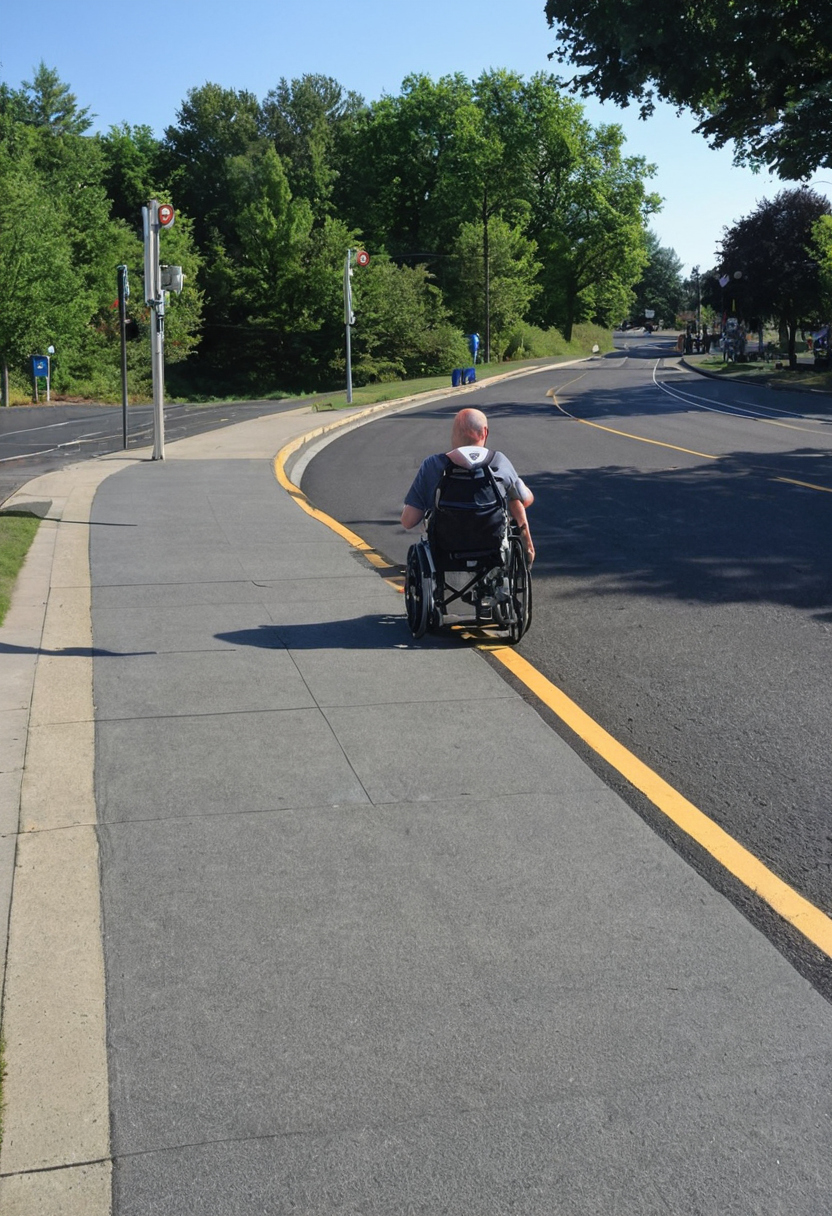
How to measure a mobility scooter for an elevator
Measure the scooter with the rider seated, the tiller set where you actually ride and every accessory mounted, then measure the car’s clear opening, depth to the door, depth to the control panel and width, and compare the two sets using the door line, not the back wall, as the reference. Spec sheets list the bare machine; a basket, a rear bag and your shoes add length the sheet ignores.
- Occupied length: floor-level tape from basket or front wheel to rear bag, bumper or your heels, whichever sticks out farthest.
- Occupied width: tape across armrests or mirrors, not the wheels. Pride lists the Go-Go Ultra X at 19.25 inches with a footnoted 3 percent variance on length, width, turning radius and ground clearance, so add a margin.
- Lowest point: usually the motor housing. Rascal lists the Venture 3-Wheel at 1.26 inches at the motor; Pride lists the Go-Go Ultra X at 1.25 inches at the motor, 3.23 inches at mid-deck.
- Elevator clear opening: doors fully open, tape between the door edges at floor level. A new car gives 36 or 42 inches; an old one may give 36 inches minus the 5/8 inch tolerance.
- Depth to door: back wall to the inside face of the closed door. Your occupied length must be shorter than this.
- Depth to the front return, car width and door position: a short-wall door on a 54 by 80 inch car means a long straight reverse; an off-center door on a 68 inch car lets you stop beside the panel.
Run the spec-sheet figures through the same checks and every one of the five scooters passes the bare-machine test, which is exactly why the occupied measurement matters: the Hoverfly T3 passes the 48 inch residence car with under 3 inches to spare before a single accessory is fitted.
| Scooter (spec length x width) | 32 in LULA door | 42 in LULA car width | 48 in residence car length | 51 in depth to return | 54 in depth to door |
|---|---|---|---|---|---|
| Rascal Venture 3-Wheel (38.5 x 22.5 in) | Yes | Yes | Yes | Yes | Yes |
| SuperHandy Passport (40 x 24 in) | Yes | Yes | Yes | Yes | Yes |
| Pride Go-Go Ultra X (40.25 x 19.25 in) | Yes | Yes | Yes | Yes | Yes |
| Zip’r Roo (41 x 19.5 in) | Yes | Yes | Yes | Yes | Yes |
| Hoverfly T3 unfolded (45.28 x 26.77 in) | Yes | Yes | Tight, under 3 in spare | Yes | Yes |
What a posted inspection certificate lists could not be verified for this page, so don’t rely on it for cab dimensions; measure the car.
Can a mobility scooter turn around in an elevator?
A spec-sheet turning radius is half the circle the scooter sweeps, so the Zip’r Roo’s 31.5 inch radius means a 63 inch swept circle, and no minimum ADA car offers 63 inches in both directions. The ADA turning space in section 304 is a 60 inch diameter circle, or a T-shape inside a 60 inch square with 36 inch arms and base, sized for a wheelchair that pivots on its rear wheels. A scooter steers with its front wheel and has no pivot point, which is why a 33 inch radius still needs 66 inches of clear floor.
The table puts each swept circle (twice the manufacturer’s radius, arithmetic rather than a measured test) against the three shallow car depths; every model exceeds all three, and the 80 inch deep car is only 54 inches wide, so the circle fails on the other axis.
| Scooter | Turning radius (source) | Swept circle (2 x radius) | Fits 51 in depth | Fits 54 in depth | Fits 60 in space |
|---|---|---|---|---|---|
| Zip’r Roo 4-Wheel | 31.5 in | 63 in | No | No | No |
| Rascal Venture 3-Wheel | 33 in | 66 in | No | No | No |
| SuperHandy Passport 3-Wheel | 35 in per the Amazon listing, June 2026 | 62 to 70 in | No | No | No |
| Pride Go-Go Ultra X 3-Wheel | 36.5 in | 73 in | No | No | No |
Any model whose maker publishes a turn angle in degrees rather than a radius in inches is left out of this table, because a degree figure cannot be compared with a car depth in inches. Whether a multi-point shuffle works in a 54 by 80 inch car depends on steering lock and rider skill, so plan on a straight entry and a reverse exit with the landing clear for the full occupied length. Riders who want a scooter that spins in a hallway should read the mobility scooters for apartments and tight spaces comparison, which ranks by turning radius.
Elevator door timing under the ADA: how many seconds a scooter rider gets
Section 407.3.4 sets the time from the hall signal to the doors starting to close as T = D / 1.5 ft/s with a 5 second minimum, where D is the distance from a point 60 inches in front of the farthest hall call button to the centerline of the hoistway door. Worked from the formula (arithmetic, not a measured trip): a button 7.5 feet or less from the door centerline gets the 5 second floor, 10 feet gives 6.7 seconds, 20 feet gives 13.3 seconds. Cars with an in-car lantern may start T when the lantern is visible from that 60 inch point and the audible signal sounds.
Two more clocks run at the door. After a car call, doors must stay fully open for 3 seconds minimum. The door reopening device must remain effective for 20 seconds minimum and must sense an obstruction at 5 inches and 29 inches nominal above the floor; an 8 inch tire spans the 5 inch beam, so a scooter in the opening reopens the doors without touching them. LULA power-operated swinging doors and private residence power-operated doors and gates stay open 20 seconds minimum. CSA B44 Appendix E in Canada uses the same clock: T = D / 455 mm/s from 1525 mm in front of the farthest button, 3 seconds fully open, and a reopening device at 125 mm and 735 mm.
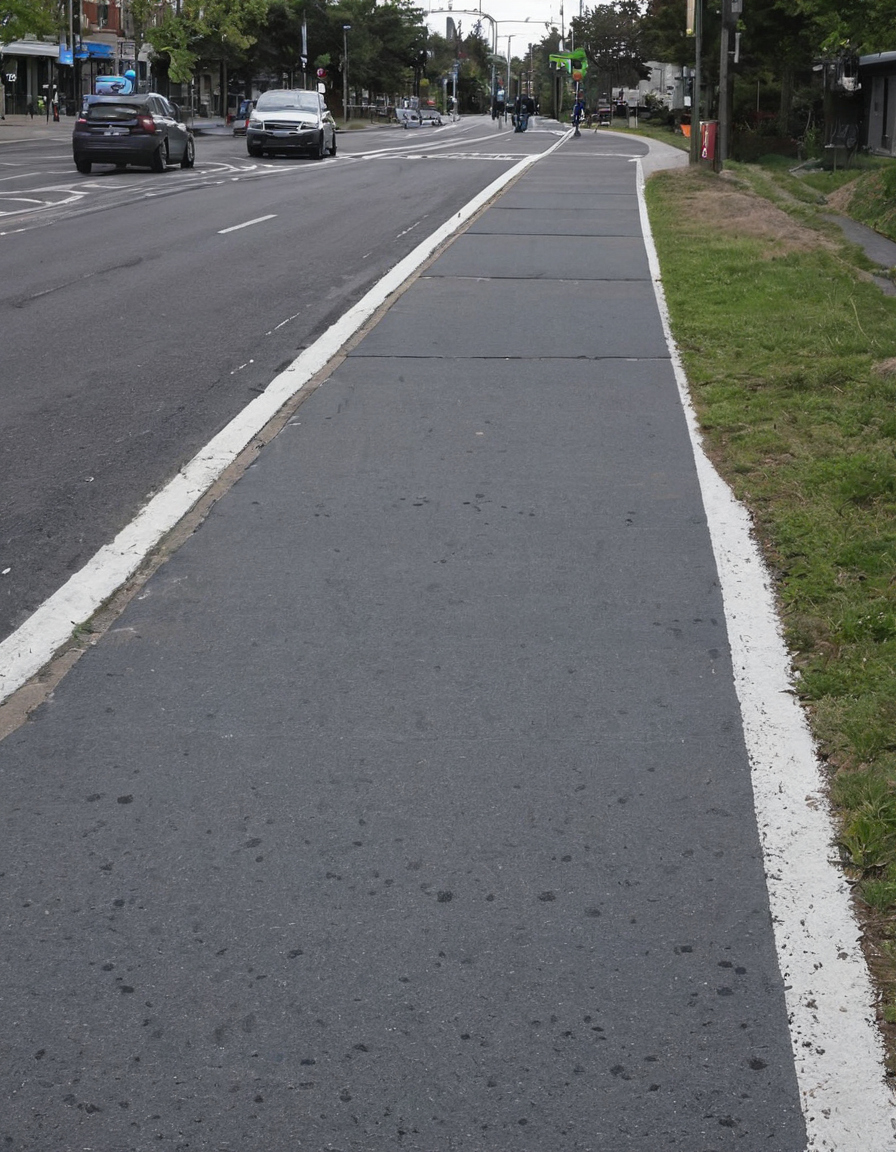
Sill gap, leveling and button reach from a scooter seat
The gap between the car platform sill and the landing may be 1 1/4 inch maximum in a passenger elevator and 1 1/2 inch in a private residence elevator, which must also level within 1/2 inch, while a passenger car’s self-leveling must hold the floor within 1/2 inch from zero load to rated load. The 8 inch tires on the Go-Go Ultra X, Rascal Venture and SuperHandy Passport roll over a 1 1/4 inch gap, the lowest clearances, 1.25 inches at the Go-Go’s motor and 1.26 inches at the Venture’s, sit above a 1/2 inch leveling step, so grounding on a sill points to a car out of level or a mat added after inspection, not to the scooter.
Car buttons must sit within the section 308 reach range, 48 inches high and 15 inches low for an unobstructed forward reach; the standard allows 54 inches where the panel serves more than 16 openings and a parallel approach is provided, and 54 inches in existing elevators with a parallel approach. Hall call buttons must be within a 308 reach range, with existing call buttons permitted at 54 inches. A parallel approach means pulling up sideways beside the panel, which a scooter with a 63 inch swept circle can’t do in a 68 inch car, so the 48 inch forward-reach figure is the one that counts, and in an older high-rise the top buttons may sit 6 inches above it. Seat height sets the rest: the Go-Go Ultra X seat is 21.5 to 23 inches off the ground, the Zip’r Roo seat 17 inches, the Rascal Venture seat 15.5 to 18 inches above the deck.
Which mobility scooters fit small elevators (verified dimensions)
Of the five scooters checked for this page, the Rascal Venture 3-Wheel is the shortest at 38.5 inches long and 22.5 inches wide and the Pride Go-Go Ultra X at 40.25 by 19.25 inches, and all of them clear the 54 inch depth of a standard car, the 42 by 54 inch LULA car and, by spec length alone, the 48 inch residence car.
| Scooter | Length x width | Turning radius | Ground clearance | Weight | Rider capacity | Amazon price, June 2026 |
|---|---|---|---|---|---|---|
| Rascal Venture 3-Wheel | 38.5 x 22.5 in | 33 in | 1.26 in at motor | 76.5 lb without batteries, 20 lb pack | 300 lb | $699.00 |
| SuperHandy Passport 3-Wheel | 40 x 24 in | 31 to 35 in (sources differ) | not published | 35 lb | 275 lb | $579.99 |
| Pride Go-Go Ultra X 3-Wheel | 40.25 x 19.25 in | 36.5 in | 1.25 in at motor, 3.23 in mid-deck | 95.75 lb with batteries, heaviest piece 29.5 lb | 300 lb per Pride; 260 lb on the Amazon listing | $1193.00 |
| Zip’r Roo 4-Wheel | 41 x 19.5 in | 31.5 in | 2 in | 90.2 lb, heaviest piece 29 lb | 265 lb | $649.99 |
| Hoverfly T3 folding (Amazon listing) | 45.28 x 26.77 in | not published as a radius | not published | 61 lb, heaviest part 50 lb | 264 lb on the Amazon listing | $467.49 |
The SuperHandy Passport at 35 pounds on its Amazon listing is the one to carry up a flight when the elevator is down; see lightweight mobility scooters one person can lift and, for riders who drive to the building, mobility scooters that fit in a car trunk. Prices and ratings are Amazon figures as of June 2026.
Frequently asked questions
What is the minimum elevator size for a mobility scooter?
No US standard names a scooter minimum; the 2010 ADA Standards set car minimums instead. The smallest new passenger car is 60 by 60 inches or 54 by 80 inches, the common side-door car is 68 inches wide and 54 inches deep to the door, and an existing car may be 16 square feet with 54 inches of depth and 36 inches of width.
Can a mobility scooter turn around in an elevator?
Almost never in a minimum-size car. A spec-sheet turning radius is half the circle the scooter needs: a 33 inch radius on the Rascal Venture means a 66 inch swept circle, and no ADA minimum car is 66 inches in both directions. The 60 inch ADA turning space is drawn for a wheelchair pivoting on its rear wheels, so plan on backing out.
How long do elevator doors stay open under the ADA?
Three clocks apply. From the hall signal, doors may not start closing before T = D / 1.5 ft/s with a 5 second minimum, D measured from 60 inches in front of the farthest hall button. After a car call, doors stay fully open 3 seconds minimum. The reopening device stays effective 20 seconds; LULA and private residence doors stay open 20 seconds.
Do I have to back a mobility scooter out of an elevator?
Yes, in any car with a door on one wall only, which covers the centered-door and side-door layouts, because the swept circle of a scooter with a 31 to 36 inch turning radius (62 to 73 inches) exceeds the 51 and 54 inch depths. Keep the landing outside the door clear for the scooter’s full occupied length before you start backing.
Will a mobility scooter fit in a home or residential elevator?
Section 409.4.1 requires a private residence elevator car of only 36 by 48 inches with the door at the narrow end, so length is the constraint. A Rascal Venture at 38.5 inches or a Zip’r Roo at 41 inches leaves room for feet and a bag; the Hoverfly T3 at 45.28 inches leaves under 3 inches. Measure the actual car, since builders often install larger ones.