
Mobility and Wheelchair Statistics in the USA and Canada (2026)
This page collects verified mobility and wheelchair statistics for the United States and Canada, drawn from government data sources and recorded in June 2026. Every figure below links to its primary source: the U.S. CDC, Statistics Canada, the U.S. Centers for Medicare and Medicaid Services, and the U.S. FDA. Researchers, journalists, and caregivers can cite these figures directly.
Disclosure: Polaris Mobility earns a commission on qualifying Amazon purchases through links on this page. The statistics below come from the named public sources, not from Polaris Mobility.
How common is mobility disability among U.S. adults?
Mobility disability, defined as serious difficulty walking or climbing stairs, affects 27.7% of U.S. adults aged 65 and older, according to the U.S. CDC Disability and Health Data System (BRFSS, 2021). The rate rises sharply with age and is higher among women than men.
| U.S. group | Mobility disability prevalence |
|---|---|
| Adults 18–44 | 4.5% |
| Adults 45–64 | 16.8% |
| Adults 65 and older | 27.7% |
| Women (age-adjusted) | 13.6% |
| Men (age-adjusted) | 10.5% |
Source: U.S. CDC Disability and Health Data System (BRFSS, 2021).
How common is mobility disability in Canada?
In Canada, 3,129,770 people aged 15 and older had a mobility disability in 2022, according to Statistics Canada and the Canadian Survey on Disability. Mobility disability is among the most common disability types in the country.
- 3,129,770 Canadians aged 15 and older have a mobility disability (2022).
- Mobility disability affects 39.2% of Canadian adults who report a disability.
- Among Canadian seniors aged 65 and older with a disability, 63% have a mobility disability.
Source: Statistics Canada, Canadian Survey on Disability 2022 (table 13-10-0376).
How many Americans get a mobility scooter through Medicare?
U.S. Medicare data shows that 4,236 beneficiaries received a Group 1 standard power operated vehicle (HCPCS K0800) in the reported period, at an average Medicare payment of $797. A further 502 beneficiaries received a Group 1 heavy-duty scooter (K0801) at an average payment of $1,413.
| Medicare scooter code | Beneficiaries | Average Medicare payment |
|---|---|---|
| K0800 (standard POV) | 4,236 | $797 |
| K0801 (heavy-duty POV) | 502 | $1,413 |
The relatively low counts reflect that Medicare covers far more power wheelchairs than scooters, so most buyers purchase a mobility scooter at retail rather than through Medicare. Source: U.S. CMS Medicare Part B DME data.
What does the FDA safety record show for mobility scooters?
The U.S. FDA MAUDE database holds 375 adverse-event reports for devices listed under the generic name “scooter” and 1,556 for “powered wheelchair”. The FDA enforcement database records 2 mobility-scooter device recalls. These reports cover a wide date range and do not represent an annual injury rate.
Source: U.S. FDA MAUDE adverse-event database and the FDA device enforcement database.
Top mobility scooters for 2026
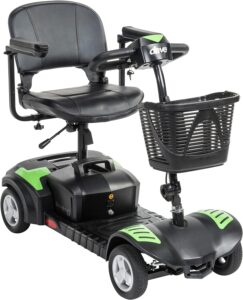
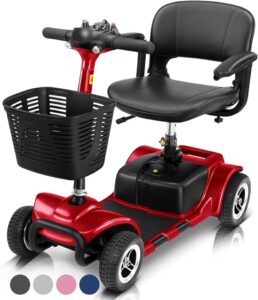
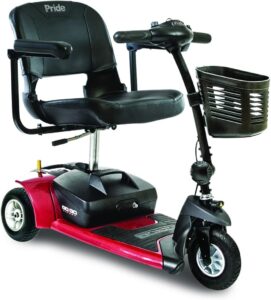
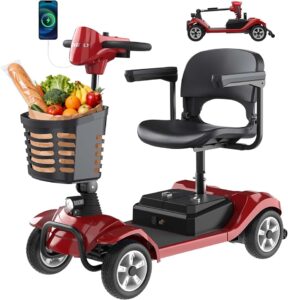
For buyers acting on these figures, the scooters below hold the strongest verified Amazon owner ratings as of June 2026. See every current model in the full mobility scooter catalog.
Key takeaways
- More than one in four U.S. adults aged 65 and older (27.7%) has a mobility disability.
- Over 3.1 million Canadians aged 15 and older have a mobility disability.
- Medicare pays an average of $797 for a standard scooter, so most buyers purchase at retail.
- Mobility disability is one of the most common disability types in both the United States and Canada.
Mobility statistics FAQ
What percentage of seniors have a mobility disability?
In the United States, 27.7% of adults aged 65 and older have a mobility disability (serious difficulty walking or climbing stairs), per the U.S. CDC DHDS (BRFSS 2021). In Canada, 63% of seniors who report a disability have a mobility disability.
How many people in Canada have a mobility disability?
3,129,770 Canadians aged 15 and older had a mobility disability in 2022, according to Statistics Canada and the Canadian Survey on Disability.
Does Medicare pay for mobility scooters?
Yes, for medically necessary Group 1 and Group 2 power operated vehicles. Medicare data shows 4,236 beneficiaries received a standard K0800 scooter at an average payment of $797; most other buyers purchase a scooter at retail.
Are mobility scooters safe?
The U.S. FDA MAUDE database records 375 adverse-event reports for scooter-type devices and 2 recalls. These figures cover many years and do not represent an annual rate, so mobility scooters are widely used with a small reported adverse-event volume relative to the millions of users.