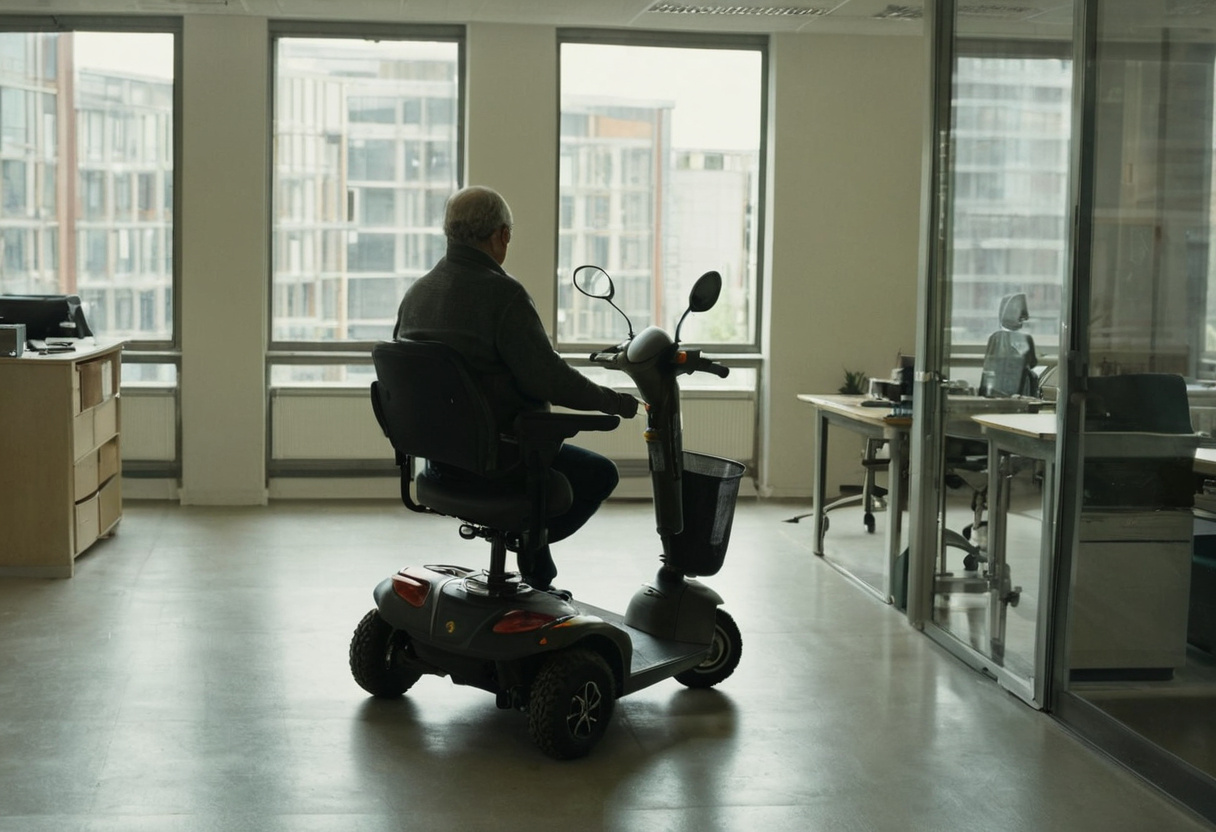
Asking for a mobility scooter accommodation at work goes better when you describe the need rather than the diagnosis. “I use a mobility scooter and need step-free access to my workstation” is usually enough, and you rarely have to share medical detail. Put the request in writing. Most of what a rider actually needs comes down to three things: a step-free way in, paths wide enough to turn in, and an outlet to charge from.
- In the U.S., 27.7% of adults 65+ and 16.8% of adults 45–64 report a mobility disability (serious difficulty walking or climbing stairs).
- In Canada, about 3.13 million adults live with a mobility-related disability, which is 63% of disabled seniors.
- Mobility disability is reported more often by women than men (13.6% vs 10.5%).
Sources: U.S. CDC Disability & Health Data System (DHDS), BRFSS 2021; Statistics Canada, Canadian Survey on Disability 2022.
If you use a mobility scooter, you have every right to stay active in your career. In most of the US and Canada, disability and accessibility laws are designed to help employees do their jobs with reasonable support, and a scooter is simply one of the tools that makes that possible.
Reasonable accommodations, in plain terms
A “reasonable accommodation” is a practical change to your job or workspace that lets you do your work comfortably and safely. Using a mobility scooter at work is a common example, and so are the small adjustments that go with it, like a clearer path to your desk or a place to charge the battery. Employers are generally expected to work with you on changes that don’t cause them major difficulty, and most workplace adjustments are simpler and less costly than people expect. Exactly what applies to you depends on where you live and work, so check the disability and accessibility rules for your country, state, or province, and confirm the details with your HR department or an official source. This guide is general information to help you get started, not legal advice.

Metro Electric Mobility Scooters for Adults and Seniors
Price: current price on Amazon
300 lbs max weight capacity with lightweight folding design perfect for office environments
Pros: Compact folding, headlight included, 4-wheel stability
Cons: Limited range for larger office complexes
Starting the conversation with your employer
You don’t need a formal script, and you usually don’t have to share your full medical history. Focus on what you need to do your job well.
- Decide who to talk to first. That may be your direct manager, an HR contact, or a workplace accessibility coordinator if your employer has one.
- Put your request in writing. A short, friendly email creates a clear record and gives everyone time to think it through.
- Describe the need, not the diagnosis. For example, “I use a mobility scooter and need step-free access to my workstation” is usually enough.
- Offer solutions. Coming in with a couple of practical ideas makes the conversation collaborative rather than a list of problems.
- Expect a back-and-forth. Employers often ask questions or suggest alternatives. That’s a normal part of finding a good fit, not a rejection.
Keep a simple record of what you asked for and what was agreed. If a request stalls, HR or an official accessibility resource for your area can help you understand your options.

Ultra Lightweight Folding Mobility Scooter
Price: current price on Amazon | Rating: ★★★★★ 4.8
37.5 lbs ultra lightweight with 275 lbs capacity, perfect for home office transitions
Pros: Airport approved, all-terrain capability, ultra-portable
Cons: Premium price point, smaller weight capacity
Practical office adjustments that make a difference
Most of what a scooter user needs comes down to space, access, and power. These are the adjustments worth raising early:
- Accessible entrances. A step-free way in and out, an automatic or easy-open door, and a reachable entry route, including a plan for busy times and emergencies.
- Clear internal paths. Aisles and hallways wide enough to turn in, kept free of boxes, cables, and clutter so you can move between your desk, meeting rooms, kitchen, and restroom without a struggle.
- Desk and workspace height. A desk you can roll under comfortably, with the surface, keyboard, and phone at a height that works while you’re seated on your scooter or in your regular chair.
- Parking and storage. A safe, out-of-the-way spot to leave the scooter if you transfer to an office chair, positioned so it isn’t blocking a walkway or exit.
- Charging. A conveniently located power outlet so you can top up the battery during the day, plus a tidy way to route the cable so it isn’t a trip hazard for others.
- Restrooms and shared spaces. Access to an accessible restroom and to common areas like the break room, so you’re included in the everyday life of the workplace.

23-Mile Extra Long Range Foldable Mobility Scooter
Price: current price on Amazon | Rating: ★★★★★ 4.9
Dual battery system with airport approval for business travel and large office complexes
Pros: Extended range, dual batteries, travel-friendly design
Cons: Longer charging time, moderate weight capacity
Remote and hybrid work options
Sometimes the best accommodation is flexibility about where and when you work. Remote or hybrid arrangements can remove commuting strain, cut down on time spent navigating a crowded office, and let you set up a home space that already suits your scooter. If full-time remote work isn’t a fit for your role, consider partial options: a few remote days each week, flexible start times to avoid rush-hour transit, or attending certain meetings by video. Frame these as ways to help you stay productive and reliable, and be open to a trial period so both you and your employer can see how it works in practice.

42lbs Lightweight Folding Electric Travel Scooter
Price: current price on Amazon | Rating: ★★★★☆ 4.7
22-mile range with airline approval and FSA/HSA eligibility for business travel
Pros: FSA/HSA eligible, includes dustproof cover, dual batteries
Cons: Moderate weight, limited color options
Workplace FAQ
Do I have to tell my employer about my disability to use a scooter at work?
You generally only need to share enough for your employer to understand and arrange the support you’re requesting. You usually don’t have to disclose a detailed diagnosis, and information about your health is typically kept private. The specifics vary by location, so check the rules for your area or ask HR how requests are handled where you work.
What if my employer says no or delays my request?
Ask for the reason in writing and offer to discuss alternatives, since a “no” to one idea isn’t always a “no” to the goal. Many disagreements come down to cost or logistics that a different solution can solve. If you’re still stuck, HR, a workplace accessibility contact, or an official disability-rights resource for your country, state, or province can explain what you’re entitled to and what steps to take next.
Who pays for workplace adjustments?
In many cases the employer covers reasonable adjustments, and a lot of them cost little or nothing. There are also public programs and resources in some regions that help with funding or advice. Because this differs from place to place, confirm the details through an official source or your HR team rather than assuming.

Ecomobi MS02 Extended Battery Professional Scooter
Price: current price on Amazon | Rating: ★★★★☆ 4.7
15-45 mile range with rotating seat and dual baskets for office productivity
Pros: Extended battery options, rotating seat, dual storage
Cons: Bulkier design, longer charging time