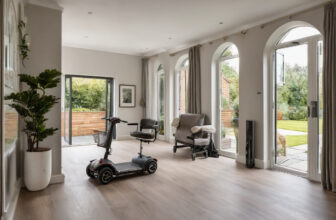
A mobility scooter works on a short chain: the battery feeds an electric motor, the motor drives the rear wheels through a small gear set, and the tiller steers the front pair. Releasing the throttle is the brake, because an electromagnetic brake engages the moment power stops and holds the scooter even on a slope. Free-wheel mode deliberately switches that brake off for pushing, which is why it is never ridden in.
A mobility scooter is a simple, dependable machine: a battery stores energy, a motor turns the wheels, and a set of easy controls lets you decide where to go and how fast. Once you see how these few parts work together, the whole scooter feels far less mysterious.
The battery and charger: your source of power
Everything on your scooter runs on the battery, which sits in a sealed compartment low in the frame so the weight stays balanced and close to the ground. Think of it like a phone battery: it holds a charge, you draw on that charge as you drive, then you plug it in to fill it back up. Most scooters use rechargeable batteries that ask little of you beyond regular charging.
The charger is a small box with a cord that plugs into a wall outlet on one end and into your scooter (or the removable battery pack) on the other. Usually you just connect it, let it run until the indicator says it’s full, then unplug. A good habit is to charge after each use rather than waiting until it’s nearly empty; keeping it topped up protects the battery and keeps your daily range predictable.
The motor and drive: how the wheels turn
When you press the control to go, the battery sends power to an electric motor. The motor’s job is to spin, and that motion is passed to the drive wheels through a small gear system. On most scooters the drive wheels are at the back, while the front wheels handle steering.
Because the motor is electric, there’s no engine to warm up, no fuel to pour, and very little noise. Power delivery is smooth: the harder you press the control, the more power the motor draws, so the scooter picks up gently rather than lurching. It’s also why a fully charged battery matters on hills, since climbing asks more of the motor.
The tiller and throttle: steering and speed
The tiller is the upright post and handlebar in front of you, and it’s the command center of the scooter. You steer by turning it left or right, just like the handlebars on a bicycle, and the front wheels follow. Most tillers tilt or adjust so the handlebar sits at a comfortable distance.
Speed is controlled by the throttle, usually a pair of paddles or a lever on the handlebar within easy reach of your thumbs or fingers. Press one side to move forward and the other to reverse. The moment you let go, the throttle springs back and the scooter begins to slow on its own. Nearby you’ll also find a key to switch it on, a dial to set a top speed that feels safe, and a battery gauge so you always know how much charge is left.
Braking, automatic stopping, and free-wheel mode
One reassuring thing about a mobility scooter is that you rarely have to think about braking. When you release the throttle, the scooter slows and comes to a complete, controlled stop by itself. This is often called automatic or electromagnetic braking: whenever the throttle is released, a brake holds the scooter firmly in place, even on a gentle incline, so it won’t roll away while you’re getting on or off.
There is one time this brake is deliberately switched off. Every scooter has a free-wheel mode, usually a lever near the rear wheels, that disengages the drive so the scooter can be pushed by hand, such as when someone needs to load it into a car while it’s powered down. This is meant for pushing only, never for riding, because in free-wheel mode the automatic brake no longer holds you. Always return the lever to the drive position before you climb back on; the scooter won’t run in free-wheel as a safety measure.
Tires and the seat: your ride and comfort
Tires come in two common styles. Solid or foam-filled tires never go flat and need almost no attention, which many riders prefer for peace of mind. Air-filled tires give a softer ride over bumps but, like bicycle tires, need the occasional top-up and can be punctured. Either way, keeping tires in good shape helps the scooter roll easily and stop reliably.
Most seats are padded and swivel to the side so you can get on and off without twisting awkwardly, and they usually adjust for height and slide forward or back to suit your legs. Armrests fold up out of the way and can often be positioned for support. Taking a minute to set the seat, armrests, and tiller to your body makes every trip steadier.
How-it-works FAQ
Do I need to brake myself, or does the scooter stop on its own?
In normal use, you simply let go of the throttle and the scooter slows to a smooth, complete stop and holds itself there. You don’t squeeze a brake lever the way you would on a bike. The automatic brake only releases in free-wheel mode, for pushing.
What does free-wheel mode do, and when should I use it?
Free-wheel mode disconnects the drive so someone can push the scooter by hand while it’s turned off, which is handy for loading it or moving it in a tight space. Use it only for pushing, on level ground, and never sit on the scooter while it’s engaged, because the automatic brake is off.
How often should I charge the battery?
Charging after each day’s use is the simplest routine and keeps the scooter ready to go. It’s easier on the battery to keep it topped up than to run it fully flat, and if it will sit unused a while, an occasional charge keeps it healthy.