There is no federal speed class for mobility scooters in the United States. The Class 1, 2 and 3 system people find online is British law and does not apply here. What federal law does cover is access: under the Americans with Disabilities Act a mobility scooter counts as a wheelchair, and businesses and government facilities must let one into every area the public can enter. Speed and where you may ride are set by your state and your city.
Rules for mobility scooters are set locally, which is why the same scooter can be treated differently in two neighbouring towns. That patchwork, rather than any single national speed limit, is what a rider actually has to navigate.
This guide explains how the rules are structured in the United States and Canada, and where to look up the ones that apply to you. It does not list speed limits state by state, because those come from state and municipal codes that change, and a stale number in an article is worse than no number at all.

- The U.S. FDA’s MAUDE database holds about 375 mobility-scooter adverse-event reports (vs ~1,556 for power wheelchairs), with only 2 scooter recalls, so serious device failures are rare.
- Most incidents involve tips, falls and curbs rather than mechanical failure, which is why stability, visibility and safe riding habits matter most.
Sources: U.S. FDA MAUDE adverse-event database.
The speed trap you never saw coming
A mobility scooter used by a person with a disability is generally treated as a pedestrian device rather than a motor vehicle, which is why no driving licence, registration or insurance is needed to use one. That does not mean no rules apply. Where you may ride, and how fast, is set locally rather than nationally, and it is the local rule that catches people out.
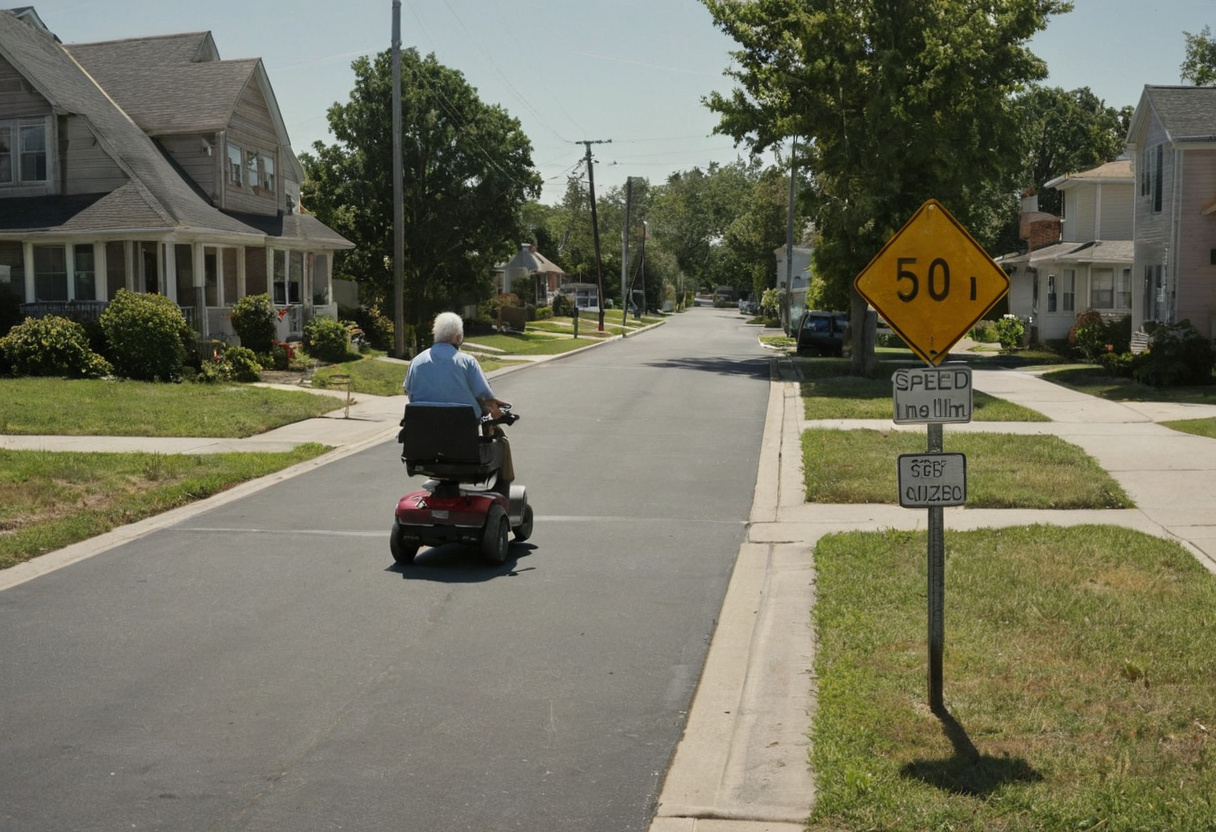
Federal guidelines in both countries establish baseline standards, but the real complexity lies in how individual states, provinces, and municipalities interpret and enforce these rules. A scooter that’s perfectly legal in one jurisdiction might violate speed limits just miles away in another. This patchwork of regulations creates a minefield for users who travel or relocate.
The confusion stems from the rapid evolution of mobility scooter technology. Modern scooters like the long-range mobility scooters available in 2025 can reach speeds that were unimaginable just a decade ago. Regulators are scrambling to keep pace, often resulting in inconsistent enforcement and unclear guidelines.
What federal law in the United States actually covers
Federal law governs access rather than speed. No federal agency sets a national speed limit for mobility scooters or issues a speed-based classification for them. What the Americans with Disabilities Act does is define where your scooter must be allowed to go.
The ADA defines a wheelchair as “a manually-operated or power-driven device designed primarily for use by an individual with a mobility disability for the main purpose of indoor or of both indoor and outdoor locomotion”. A mobility scooter meets that definition. The Department of Justice states the consequence plainly: covered entities “must allow people with disabilities who use wheelchairs (including manual wheelchairs, power wheelchairs, and electric scooters) … into all areas of a facility where members of the public are allowed to go”. Covered entities means state and local government under title II, and businesses and non-profits serving the public under title III. These rules took effect on 15 March 2011. Source: ADA.gov, ADA Requirements: Wheelchairs, Mobility Aids, and Other Power-Driven Mobility Devices.
Your scooter is not in the category that can be turned away
This distinction is worth knowing, because it is the one that gets misapplied against scooter riders. The ADA separates wheelchairs from “other power-driven mobility devices”, a category that covers golf cars and Segways. A business may weigh five assessment factors, including a device’s size, weight and speed, when deciding whether to admit an OPDMD. Those factors do not apply to a wheelchair, and a mobility scooter is a wheelchair under the rule. A store cannot run a size-and-speed assessment on your scooter and use it to keep you out.
The Class 1, 2 and 3 system is British, not American
Searches for mobility scooter speed limits often turn up a three-class system with 4 mph and 8 mph thresholds. That framework comes from United Kingdom road law and has no equivalent in the United States. If you are riding in the US or Canada, those class numbers do not describe your legal position, and a dealer or article that quotes them is describing another country’s rules.
Three Wheel Portable Mobility Scooter

Rating: 4.4/5 ⭐
Aircraft-grade aluminum construction with 5 mph top speed and 13-mile range. This airline-approved scooter offers excellent portability for travel enthusiasts.
Pros: Lightweight, foldable, airline approved
Cons: Limited weight capacity, may struggle on inclines
Buy on AmazonWhere the rules that bind you come from
Three layers decide what you may do. State vehicle codes define whether a mobility scooter rider counts as a pedestrian, which in most states is how a rider on a sidewalk is treated. Municipal codes govern sidewalks, paths and crossings, and they are where any local restriction is written. Individual property owners and transit systems then set their own rules for their own premises, such as size limits on a bus ramp.
Do you need a license, registration or insurance?
For an ordinary mobility scooter used as a mobility device, most places require none of the three, because the rider is treated as a pedestrian rather than as a motorist. Faster machines marketed for all-terrain use are where this can change, since a vehicle capable of higher speeds may fall under a different definition in some state codes. Confirm with your own state before assuming either way.
Can a business ask you to prove you need it?
Not about your scooter. The ADA allows a business to ask for “credible assurance” only when the device is an other power-driven mobility device, such as a Segway or a golf car, and even then the rules are narrow. A state-issued disability parking placard or card must be accepted on its face. A verbal statement that the device is used because of a mobility disability must also be accepted. In the Department of Justice’s own words, “a covered entity cannot ask people about their disabilities”.
One line in that guidance is worth carrying with you, because scooter riders are challenged over it more than anything else: “the fact that a person with a disability is able to walk for a short distance does not necessarily contradict a verbal assurance … many people with mobility disabilities can walk, but need their mobility device for longer distances or uneven terrain”. Being able to stand up and take a few steps is not evidence that you do not need the scooter. Source: ADA.gov.
How to look up the rules where you live
Because these rules sit in state and municipal code and are revised without notice, the reliable answer comes from the source rather than from a table. Four places cover almost every question a rider has.
- Your state’s department of motor vehicles or department of transportation, for how state law defines a mobility device rider.
- Your city or county clerk, for sidewalk, path and crossing rules.
- Your local transit authority, for size, weight and securement limits on buses and trains.
- A local disability or seniors’ organization, which usually knows the practical answer faster than the statute does.
This article is general information and not legal advice. Where a rule matters to you, confirm it with the office that issues it.
Related buying guides: Fastest Scooters, 4-Wheel Scooters, Long-Range Scooters, and the full catalog and mobility statistics.