
Mobility Scooters in Austin
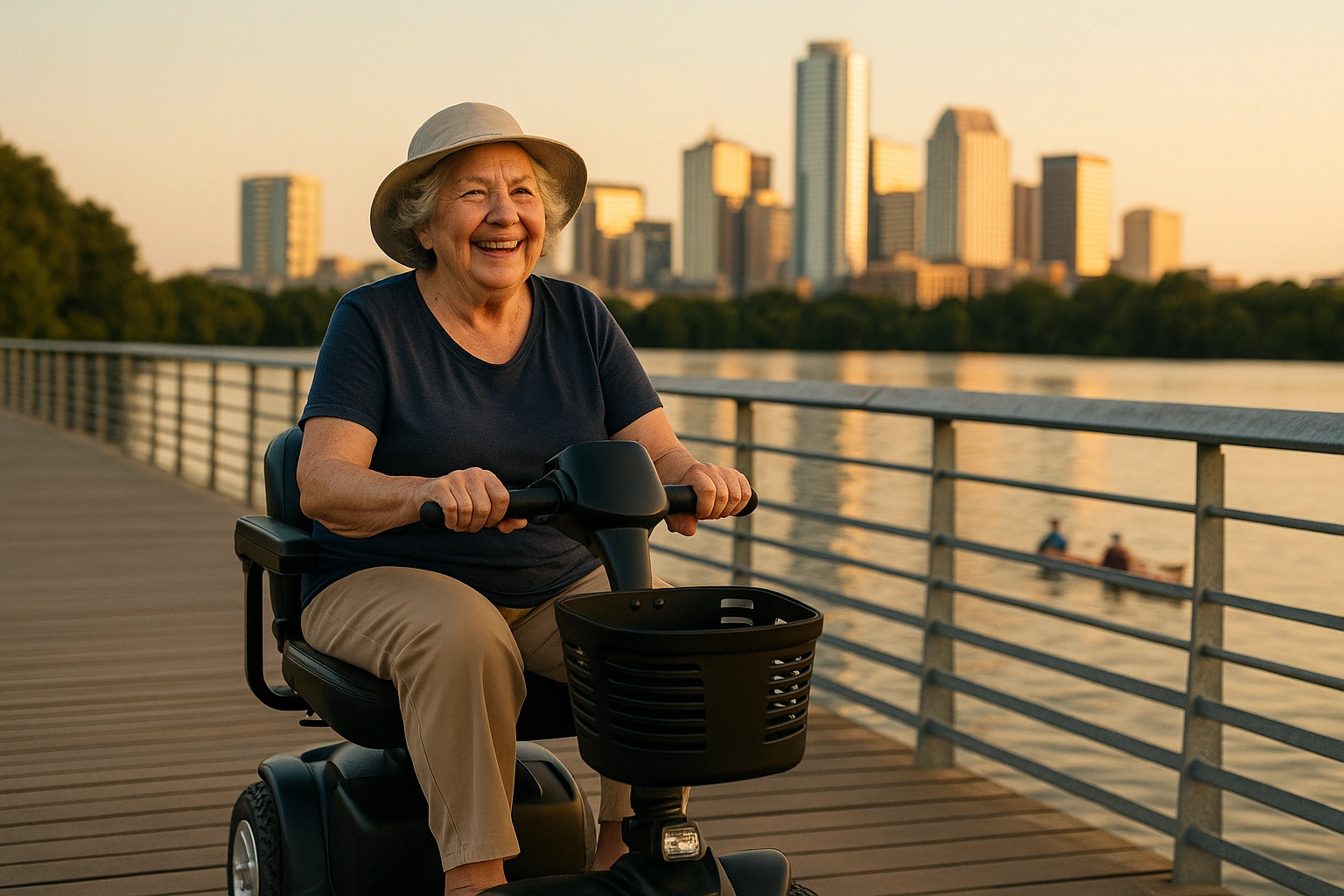
Looking for a mobility scooter in Austin, to buy or to rent? Austin is the youngest big city in this guide: just 10.1% of residents are 65 or older, and it has the lowest reported disability rate of any city we have covered. If you use a scooter here you are genuinely in a minority, which cuts both ways. The upside is real: Austin has one of the best trails in the country for riding, and some of the cheapest transit fares you will find anywhere: 60 cents a bus ride and $1.75 for door-to-door paratransit. The downside is the heat, and a light rail line that is voted and funded but not yet built. This guide covers our top pick, renting vs. buying, the trail and its surfaces, the fares, the heat, funding, and the models that fit Austin. Polaris Mobility earns a commission on qualifying Amazon purchases through links on this page.
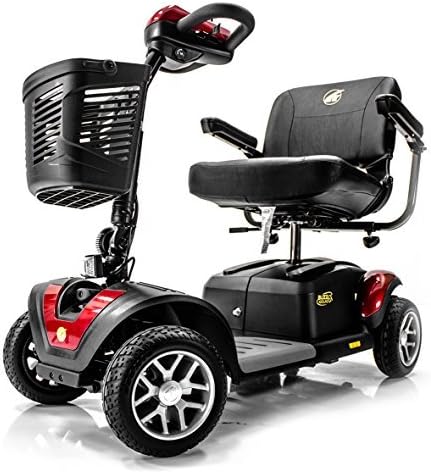
- Stable 4-wheel base
- Up to 330 lb
- Real brand service network
- ★ 4.7 rating
Austin’s riding is flat and smooth (the Butler Trail holds its grades under 8% and the Boardwalk is a wooden deck over the lake), so you do not need to muscle over rough ground here. What you need is to stay comfortable through long, hot afternoons, and to have someone to call when something goes wrong in a city with 29 days a year above 100°F. That points to the most comfortable seat, the highest weight capacity and the highest owner rating in this comparison, backed by a real service network. Want the biggest wheels and longest range for the crushed-granite stretches instead? See the Glashow S1 below.
On Medicare? Read the funding section before you pay out of pocket.
Renting vs. buying a mobility scooter in Austin
Austin has real local rental shops with published prices, which makes the maths unusually clear here. Austin Mobility Scooter Rentals lists a basic scooter at $45 a day, $180 a week or $350 a month, plus a $50 delivery fee, serving Austin and the suburbs from Round Rock and Cedar Park to Buda and Bee Cave. Put that next to a one-time purchase and the picture is straightforward.
- Keeps costing you. At Austin’s own advertised rates, $180 a week or $350 a month plus $50 delivery: a few months of regular use costs more than owning.
- You hand it back, and it never becomes yours.
- Not fitted or sized to you; you take whatever model is free.
- Delivery windows, deposits and return deadlines to plan around.
- Pays for itself fast. A one-time purchase; at $350 a month to rent, ownership is ahead within a season, and you keep the scooter.
- Always charged, sized to you and ready by the door.
- Spread the cost. Many scooters offer monthly payments at checkout or through your card, so it need not be one big hit.
- Comes with a manufacturer warranty and keeps resale value.
Where to rent locally
Alongside Austin Mobility Scooter Rentals, Martin Mobility rents scooters, power chairs and ramps out of Georgetown and Austin with a $30 delivery fee inside a 20-mile radius, and Rent My Roll offers doorstep delivery and pickup. The national services Scootaround (1-888-441-7575) and Cloud of Goods deliver to hotels and short-term rentals. Confirm current rates directly, as prices change.
Bottom line: rent for SXSW, ACL or a visit; buy if you or a family member will use a scooter most weeks.
Some of the cheapest fares you will find anywhere
- Everyone else pays $1.25 a ride or $2.50 for a day pass, which is still cheap by national standards.
- CapMetro Access is a shared-ride, door-to-door service running seven days a week. Call 512-852-7272 for the service, or 512-389-7501 for eligibility.
- Eligibility is functional, not medical. CapMetro is explicit that having a disability, by itself, does not make you eligible: only a disability that in combination with your functional abilities prevents you from using the fixed-route buses. The process involves an application, professional medical verification, and an interview and orientation, and may include a functional assessment.
The Butler Trail: ten miles, and a boardwalk over the lake
The surface is the thing to understand. The trail is not one material: it mixes crushed granite, concrete and boardwalk. That distinction matters more on a scooter than on foot. Crushed granite is loose, and small wheels work harder on it, especially after rain. The concrete sections and the Boardwalk are the easy, predictable riding, so plan your route around them rather than assuming the whole loop rides the same.
- The Boardwalk is the highlight. Opened in June 2014, it carries the trail 7,250 feet, about 1.3 miles, out over the water on more than 300 piers, closing what used to be a gap in the south shore. The $28 million structure has seven viewing areas, an ADA-accessible pier, 13,000 LED lights for the evening, and a trailhead restroom. It is a smooth deck with a rail and a skyline view, which makes it close to an ideal scooter ride.
- Amenities help. The trail has water fountains, restrooms and shady groves along the way, which in an Austin summer is not a small detail.
The heat is the real hazard
- Ride the edges of the day. Early morning and evening, not the afternoon. The Boardwalk’s LED lighting makes an evening ride practical.
- Heat is hard on batteries too. Do not leave a scooter baking in a closed car or in direct sun all afternoon, and charge it indoors.
- Carry water and plan restroom stops, and use the trail’s fountains and shady groves. In triple-digit heat a ten-mile ambition becomes a two-mile one, and that is the right call.
- The season is long at both ends. Austin recorded a 100° day as late as October 13 in 2024, so do not assume fall is automatically cool.
Light rail: voted, funded, not yet built
Austin voters approved Project Connect, and it is progressing, but it is important to be honest about the timeline. The light rail plan cleared its federal environmental review with a Record of Decision in February 2026, and Austin Transit Partnership expects to award the major contracts during 2026: the full route and its 15 stations, the operations and maintenance facility, and the train cars. Construction activities are expected to begin in 2027 (CapMetro).
So for now, buses are your transit. The Rapid 800 and 837 lines launched in February 2025 and reached full frequency in June 2026. All CapMetro buses are accessible, and at 60 cents a ride they are the cheapest way to skip a hot stretch of road.
How to pay: Medicare, Texas, and the county that built its own
If you are 65 or older, Medicare is your route. Part B may cover a scooter if a doctor confirms you need it to move around your home and you can operate one safely, through a supplier that accepts Medicare (Medicare.gov).
Two honest caveats. First, MAP is not health insurance and is not federally funded: it is a locally funded program, and you cannot be on it if you are eligible for or enrolled in Medicaid or Medicare, or hold private insurance. If you are 65 or older you are almost certainly on Medicare, so MAP is not your path; it exists for the under-65 uninsured who fall through the federal gaps. Second, MAP gets you to a doctor and to prescriptions rather than handing you equipment, but that first part matters, because a doctor’s documentation of medical need is the gateway to any equipment claim anywhere.
Because these programs work through approved suppliers, a scooter bought on Amazon is a separate out-of-pocket purchase, which is why many Austin buyers who do not qualify choose one for the lower price and immediate delivery. Confirm current criteria directly, as they change.
Comparing options across the state? Our Texas mobility scooter guide covers statewide Medicaid and Medicare details, the best models for the local climate and terrain, and how the picture changes from city to city.
Who needs mobility support in Austin
Austin is the youngest big city in this guide. About 10.1% of residents are 65 or older against 13.2% across Texas and 16.8% nationally, and just 9.5% report a disability, the lowest figure of any city we have covered and well under the 13.0% national rate (U.S. Census Bureau, ACS 2023). That is worth saying plainly rather than dressing up: fewer people around you will be using a scooter than in almost any comparable city.
It is also worth putting the percentage in proportion. 10.1% of Austin is roughly 97,400 people aged 65 or older, nearly a hundred thousand, and that number grows every year as the people who moved here for work in the 1990s and 2000s age in place. A city built young is now aging, which is exactly why the trail surfaces and the 60-cent fare matter more each year.
Best mobility scooters for Austin (2026)
Picks that suit a flat city with a long, mostly smooth lakeside trail and punishing summer heat: comfort and reliability first, with range and wheel size useful for the crushed-granite stretches. Specs are per manufacturer listings; confirm current details and price on Amazon.
| Model | Wheels | Max rider | Top speed | Owner rating |
|---|---|---|---|---|
| Golden Buzzaround EX ★ Top pick | 9″ (4-wheel) | 330 lb | 5.0 mph | 4.7★ (verified) |
| Glashow S1 Folding | 10″ (4-wheel) | 265 lb | 6.2 mph | 4.4★ (46) |
| Aotedor Lightweight | 7″ | 300 lb | 3.7 mph | 4.5★ (277) |
| Pride Go-Go Sport | 3-wheel | 325 lb | 4.7 mph | 4.4★ (109) |
4.7★ (verified owners) · 9″ wheels · up to 330 lb
Why Austin: comfort and stability for long Boardwalk evenings, the highest owner rating and weight capacity here, and a real brand service network for a city where heat is hard on equipment.
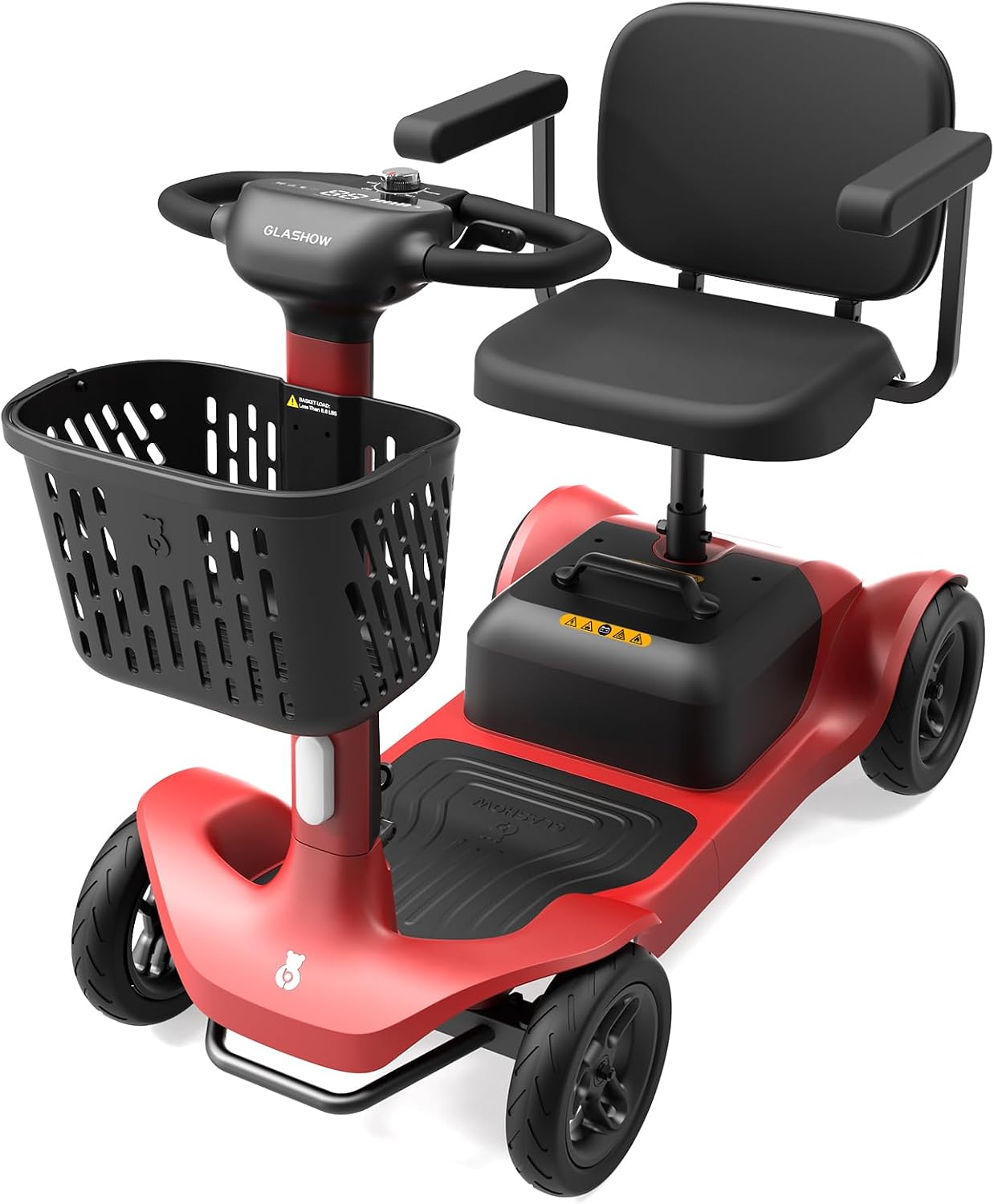
4.4★ (46 ratings) · 10″ wheels · rated ~25 mi range
Why Austin: the biggest wheels here handle the crushed-granite sections better, and the longest rated range covers a serious lap of the ten-mile trail. Folds into a car for the drive to a trailhead.
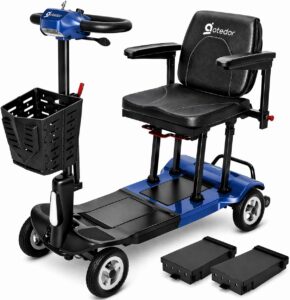
4.5★ (277 ratings) · folds compact · up to 300 lb
Why Austin: light to lift into a car and easy to roll onto a 60-cent bus: good for the concrete and Boardwalk sections, though its small wheels are the wrong tool for crushed granite.
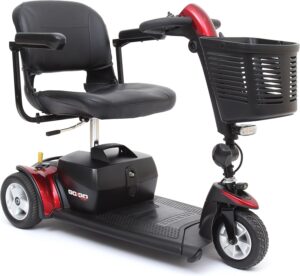
4.4★ (109 ratings) · compact · up to 325 lb
Why Austin: a tight turning circle for markets, venues and a busy trail on a spring weekend. Four wheels feel steadier over distance and on loose surfaces.
Watch: our top pick in action
An independent walkthrough of the Golden Buzzaround EX, our top pick above, showing the four-wheel frame, seat, controls and how it comes apart to transport.
Video: Golden Buzzaround EX review (YouTube). Polaris Mobility is not affiliated with the reviewer.
Compare more 4-wheel models · full catalog
Austin mobility scooter FAQ
Is Austin a good city for a mobility scooter?
Yes, with one big caveat. The Ann and Roy Butler Hike-and-Bike Trail gives you about ten miles of mostly flat riding around Lady Bird Lake with grades under 8%, including a 1.3-mile boardwalk over the water, and CapMetro fares are among the cheapest anywhere at 60 cents a ride for seniors. The caveat is the heat: Austin averages 29 days a year at or above 100°F, so summer riding happens early or late in the day.
Where is the best place to ride a mobility scooter in Austin?
The Butler Trail around Lady Bird Lake, and specifically its concrete and boardwalk sections. The Boardwalk carries the trail 7,250 feet out over the water on more than 300 piers, with an ADA-accessible pier, viewing areas and LED lighting for evening rides. Be aware the trail also has crushed granite stretches, which are loose and harder work on small wheels, so plan your route around the paved and decked parts.
What does it cost to use Austin transit with a mobility scooter?
Very little, by national standards. If you are 65 or older, hold a Medicare card or have a disability, a CapMetro bus ride is 60 cents and an all-day pass is $1.25. Door-to-door CapMetro Access paratransit is $1.75 a ride, $17.50 for ten rides, or $46.50 for a monthly pass. Call 512-852-7272 for Access, or 512-389-7501 for eligibility, which is based on functional ability rather than diagnosis.
Does Austin have light rail I can use with a scooter?
Not yet. Project Connect’s light rail cleared its federal environmental review with a Record of Decision in February 2026, and Austin Transit Partnership expects to award contracts for the route, its 15 stations, the maintenance facility and the train cars during 2026, with construction activities beginning in 2027. For now the accessible CapMetro buses, including the Rapid 800 and 837 lines, are your transit.
What is the best mobility scooter for Austin?
For flat, smooth riding in serious heat, comfort and reliability matter more than rough-ground ability. Our top pick is the Golden Buzzaround EX for its comfortable seat, 330 lb capacity, highest owner rating and real service network. The Glashow S1 is the alternative if you want the biggest wheels for crushed-granite stretches and the longest rated range for the full ten-mile trail.