
Mobility Scooters in Colorado Springs
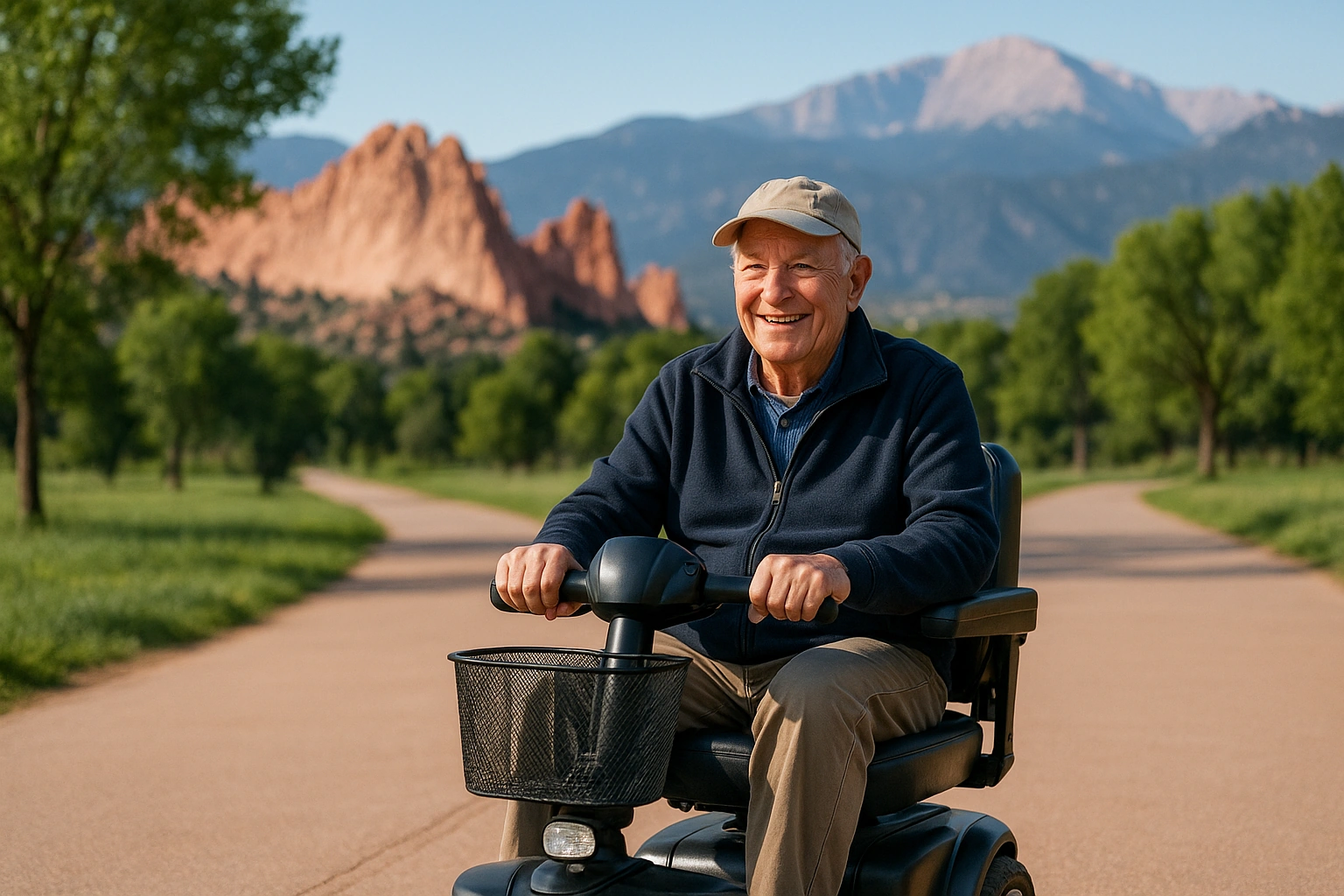
Looking for a mobility scooter in Colorado Springs, to buy or to rent? Two things here work differently from anywhere you may have ridden before. First, the transit agency does not decide who gets the disabled reduced fare, a charity does. Mountain Metro accepts, as proof of permanent disability, a Medicare card or a “Yellow Card” issued by the Independence Center, an independent living center downtown, and in a city with 51,969 veterans, one route to that card is a VA disability letter showing 50% or more. Second, the region’s most famous outing takes wheelchairs and scooters all the way to 14,115 feet, and the altitude up there is a real medical question, not a view. This guide covers the card, the fares, Pikes Peak, and the models that suit a high, dry, spread-out city. Polaris Mobility earns a commission on qualifying Amazon purchases through links on this page.
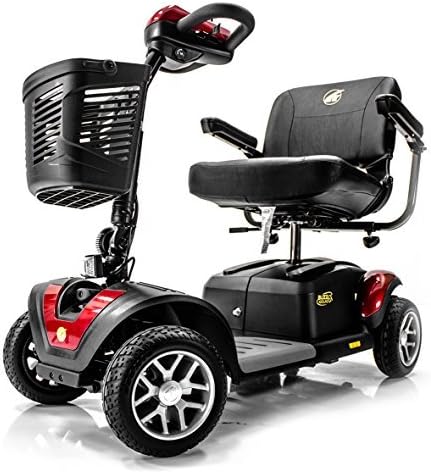
- Up to 330 lb
- Real brand service network
- Stable 4-wheel base
- ★ 4.7 rating
Colorado Springs is big, dry and spread out, and it sits at the foot of the mountains: flat on the east side, real grades as you go west. That mix rewards a scooter with a comfortable seat for distance and enough torque and stability for a slope, from a maker whose parts you can actually get in a city a long way from the next one. This has the highest owner rating of the four, the highest weight capacity, and a proper service network. If you live west, toward the foothills, and need maximum range and the biggest wheels for grades, look hard at the Glashow below instead.
A veteran, or on Medicare? Read the funding section before you pay out of pocket.
The Yellow Card: a charity decides, and your VA rating counts
Three things in that sentence will save you a wasted trip.
- Medicare yes, Medicaid no. The Center states it plainly: a Medicare card works, and Medicaid is not accepted. Those two are easy to confuse, and turning up with the wrong one means turning round.
- Your VA rating is a route in. A VA disability letter showing 50% or more is accepted proof. In a city built around five military installations, a great many people already hold exactly that letter and have never thought to use it for a bus card.
- Where and how much. The Independence Center is downtown; ring 719-471-8181 to check hours and address before you go. The card carries a $5 replacement fee if you lose it. And note the split: seniors aged 60 and over qualify for the reduced fare on age alone, so if you are over 60 you do not need the disability card at all, you need proof of age.
The fares, and one honest caveat
| Fare | Amount |
|---|---|
| Fixed-route one-way, standard | $1.75 |
| Fixed-route one-way: reduced (60+, disability Yellow Card, Medicare, youth 6–18) | $0.85 |
| Metro Mobility (ADA paratransit) | $3.50 one way · 10-ride $35 · 40-ride $140 |
| Route 3 (downtown Colorado Springs ↔ downtown Manitou Springs) | Zero fare, from 29 March 2026 |
- The reduced fare is genuinely low. Eighty-five cents against a standard $1.75 is one of the gentler senior fares you will find. The catch is the paperwork above, not the price.
- Metro Mobility is $3.50, four times the reduced bus fare. Door-to-door service costs more to run, and the pattern is familiar: the people who cannot use the fixed route pay the most. The 40-ride booklet at $140 works out at the same $3.50 a ride, so it saves you lining up, not money.
- Route 3 going free is a small, real gift if your world runs along the Colorado Springs–Manitou corridor. Confirm it held after the spring changes.
Pikes Peak: accessible to 14,115 feet, and that is the warning
Now the part that matters more than the view, and it is the reason this section exists. The summit is 14,115 feet. An attraction that is fully accessible is one that actively invites the people most vulnerable to altitude (older visitors, wheelchair and scooter users, people with heart and lung conditions) to a height where thin air is a genuine medical risk. The operator does not hide this. In its own words: “If you’re planning to go above 10,000 feet (like the summit of Pikes Peak), talk to your doctor first. If you start feeling sick in the mountains, descend to a lower elevation and seek medical help.”
One adult in seven is a veteran
The VA Prosthetic and Sensory Aids Service states that “General eligibility for prosthetic services/items is for Veterans enrolled in the VA health care system who have a medical need for a prosthetic service/item”: note that it does not require your disability to be service-connected. Its list of what it provides includes “Mobility aids, such as walkers and wheelchairs” (VA Rehabilitation and Prosthetic Services). Start with your VA primary care physician or specialty clinic, who refers you.
Renting vs. buying a mobility scooter in Colorado Springs
Weigh a scooter here against a $3.50 door-to-door van and a lot of distance, not against a cheap bus you may not live near.
- Keeps costing you. A travel scooter runs roughly $100 to $200 a week depending on model and city (Scootaround), so a month of regular use is several hundred dollars.
- You hand it back, and it never becomes yours.
- Not fitted or sized to you; you take whatever model is free.
- Reasonable for a visit built around the Peak and the Garden of the Gods.
- Pays for itself fast. A one-time purchase; after a few weeks of what renting costs you are ahead, and you keep the scooter.
- Ask the VA first if you served: a device on medical need beats any price here.
- It reaches the 85-cent bus once you have your card, which is the cheapest way to cover the city.
- Spread the cost. Many scooters offer monthly payments at checkout or through your card.
Bottom line: if you served, start with the VA and the Yellow Card. If not, an 85-cent bus fare plus your own scooter covers this city cheaply: the scooter for the distance, the bus for the miles, once your paperwork is sorted.
How to pay: Medicare, the VA, and Health First Colorado
If you are 65 or older, Medicare is your route. Part B may cover a scooter if a doctor confirms you need it to move around your home and you can operate one safely, through a supplier that accepts Medicare (Medicare.gov). Note the test is whether you need it to move around your home, not to cross a spread-out city.
If you served, read the VA section above first. In a city this military, it is the most under-used door on this page.
And if you are under 65 on a low income, Colorado expanded Medicaid, and Health First Colorado can pay for medically necessary equipment such as a power wheelchair or scooter when a doctor documents the need and it is supplied through an enrolled provider. Start with your primary care provider or your health plan and ask specifically about durable medical equipment. Because these programs work through approved suppliers, a scooter bought on Amazon is a separate out-of-pocket purchase. Confirm current criteria directly, as they change.
Comparing options across the state? Our Colorado mobility scooter guide covers statewide Medicaid and Medicare details, the best models for the local climate and terrain, and how the picture changes from city to city.
Who needs mobility support in Colorado Springs
14.7% of Colorado Springs residents are 65 or older (70,844 people out of 483,099) a little below the national 16.8% and close to Colorado’s 15.2%. On disability, 13.2% report one, near the national 13.0% and above Colorado’s notably low 11.2% (U.S. Census Bureau, ACS 2023, 5-year).
Those are ordinary numbers, and they hide the thing that makes this city unusual: the veterans. Fourteen percent of adults here served, many of them carrying service-related injuries that show up in the disability figure and, more to the point, in the VA disability letters sitting in people’s drawers. This is a city where a large share of the people who need a scooter have a route to funding it, and a route to a cheaper bus, that most Americans do not, and where the single most useful thing a guide can do is point at the door and say: it is already yours, go and use it.
Best mobility scooters for Colorado Springs (2026)
Picks weighted for suburban distance, intense high-altitude sun, dry air and grades toward the foothills. Specs are per manufacturer listings; confirm current details and price on Amazon.
| Model | Wheels | Max rider | Top speed | Owner rating |
|---|---|---|---|---|
| Golden Buzzaround EX ★ Top pick | 9″ (4-wheel) | 330 lb | 5.0 mph | 4.7★ (verified) |
| Glashow S1 Folding Best range & wheels | 10″ (4-wheel) | 265 lb | 6.2 mph | 4.4★ (46) |
| Pride Go-Go Sport | 3-wheel | 325 lb | 4.7 mph | 4.4★ (109) |
| Aotedor Lightweight | 7″ | 300 lb | 3.7 mph | 4.5★ (277) |
4.7★ (verified owners) · 9″ wheels · up to 330 lb
Why Colorado Springs: a comfortable seat for distance, 330 lb of capacity, and a real service network in a city far from the next one. The all-rounder for a big spread-out metro.
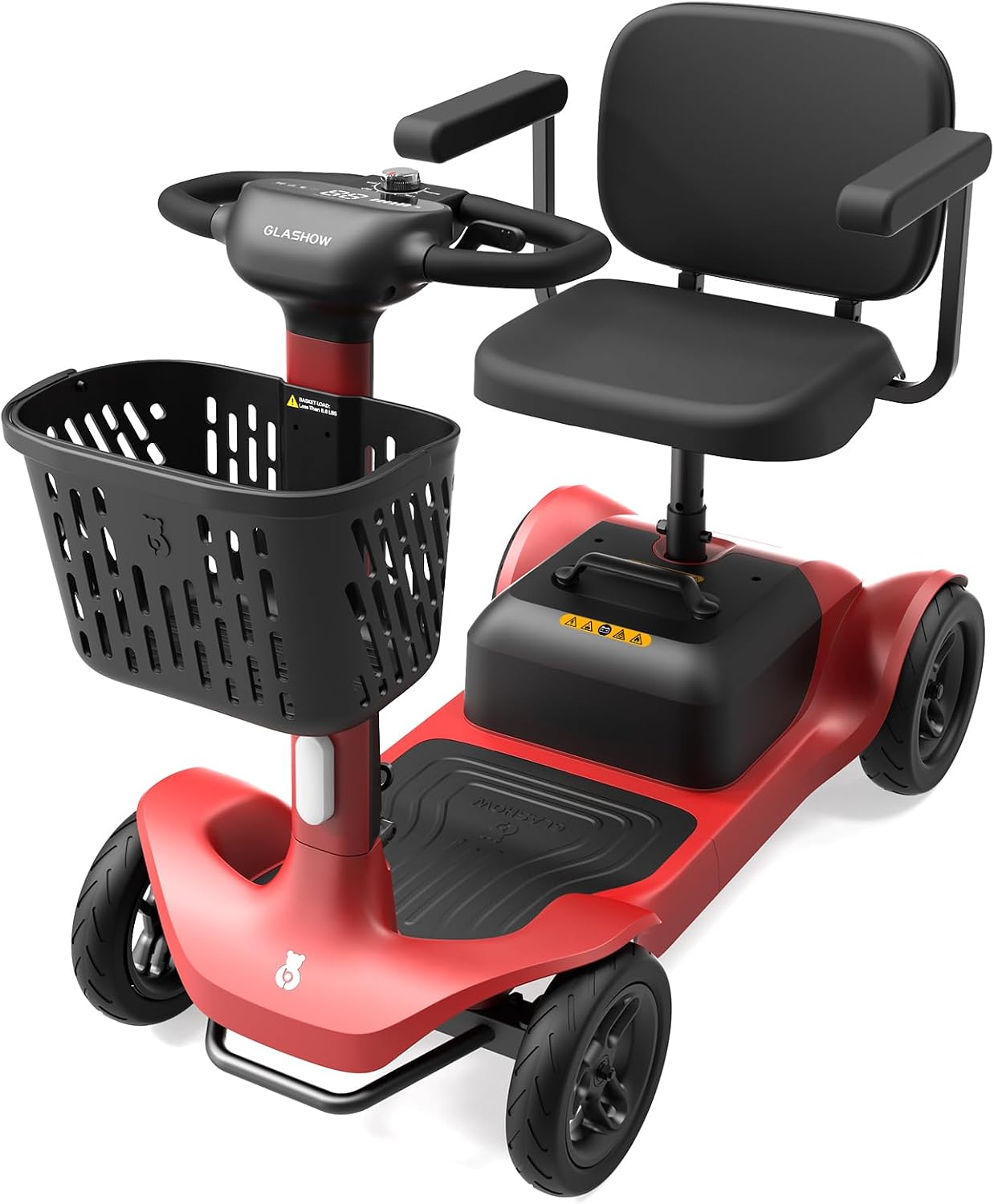
4.4★ (46 ratings) · 10″ wheels · rated ~25 mi range · 265 lb limit
Why Colorado Springs: the longest range and biggest wheels: the one to pick if you live west toward the foothills and face real grades and distance. Check the 265 lb limit, the lowest here.
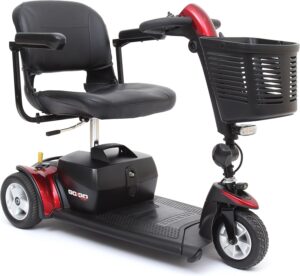
4.4★ (109 ratings) · compact · up to 325 lb
Why Colorado Springs: 325 lb and it comes apart for a car trunk: useful for driving to the Peak or the Garden of the Gods and riding at the other end.
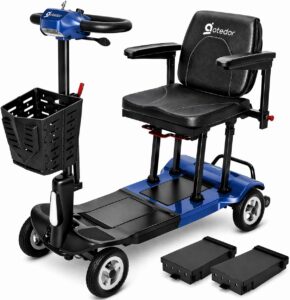
4.5★ (277 ratings) · folds compact · up to 300 lb
Why Colorado Springs: the most owner ratings and the easiest to lift into a car. The shortest legs and smallest wheels, though: best on the flat east side and for indoors, not for grades.
Watch: our top pick in action
An independent walkthrough of the Golden Buzzaround EX, our top pick above, showing the four-wheel frame, seat, controls and how it comes apart to transport.
Video: Golden Buzzaround EX review (YouTube). Polaris Mobility is not affiliated with the reviewer.
Compare more 4-wheel models · full catalog
Colorado Springs mobility scooter FAQ
How do I get the disabled reduced fare on Mountain Metro?
Mountain Metro accepts, as proof of permanent disability, a valid Medicare card or a “Yellow Card”, the Disabled Reduced Fare Authorization, issued by the Independence Center, a local independent living center rather than the transit agency. To get the Center’s Disability Picture ID Bus Card, bring a current state ID and one accepted proof of disability: an SSI or SSDI award letter, a Medicare card (Medicaid is not accepted), a Med 9 Form, or a VA Disability letter showing 50% or more. Call the Independence Center on 719-471-8181 to confirm hours and address; a replacement card costs $5. If you are 60 or over, you qualify for the reduced fare on age alone and do not need the disability card.
Can a veteran use a VA disability rating for the bus card?
Yes. The Independence Center lists “VA Disability letter showing a 50% or more disability” among the accepted proofs for its Disability Picture ID Bus Card, which Mountain Metro takes for the reduced fare. In a city with 51,969 veterans, many people already hold that letter without realizing it also qualifies them for an 85-cent bus fare.
How much is the bus and paratransit in Colorado Springs?
The fares reported on Mountain Metro’s pages are $1.75 for a standard fixed-route one-way and $0.85 reduced, with Metro Mobility ADA paratransit at $3.50 one way (a 10-ride booklet is $35 and a 40-ride booklet $140). Route 3, between downtown Colorado Springs and downtown Manitou Springs, was set to become zero fare from 29 March 2026. One honest caveat: the city’s own fares page would not load while we were writing, so confirm these by phone, especially after the spring 2026 service changes.
Is Pikes Peak accessible, and is the altitude a problem?
The summit is, in the operator’s words, “completely ADA accessible,” with an elevator and paved walkways at the Summit Visitor Center, and the Cog Railway is “fully handicap accessible” though you should call 719-685-5401 to reserve limited wheelchair space. But the summit is 14,115 feet, and the operator says plainly: “If you’re planning to go above 10,000 feet (like the summit of Pikes Peak), talk to your doctor first.” The American Lung Association says altitude sickness “only occurs at 8,000 feet or higher” and that “almost everyone who ascends to 11,000 feet or higher will develop altitude sickness,” so above 14,000 feet it is a medical question, not a matter of susceptibility. The city itself, at around 6,000 feet, is below that threshold: the altitude issue is about the mountain, not daily life.
What is the best mobility scooter for Colorado Springs?
Our top pick is the Golden Buzzaround EX. The city is big, dry and spread out, flat on the east side with real grades toward the western foothills, which rewards a comfortable seat for distance and enough capacity and stability for a slope, from a maker whose parts you can get. It has the highest owner rating of the four and 330 lb of capacity. If you live west toward the mountains and need maximum range and the biggest wheels for grades, the Glashow S1 is rated furthest, though its 265 lb limit is the lowest here.