
Mobility Scooters in Connecticut

Looking for a mobility scooter in Connecticut, to buy, to rent, or to understand what the state offers? Connecticut is an older New England state, prosperous and comparatively well-served, with real winters and a standout for riders: the Farmington Canal Heritage Trail, roughly 80 paved miles running much of the length of the state. This statewide guide explains whether a scooter is street-legal here, walks through how to get HUSKY Health or Medicare to pay (Connecticut expanded Medicaid and covers generously), and helps you plan around a New England winter and choose the right model. Polaris Mobility earns a commission on qualifying Amazon purchases through links on this page.
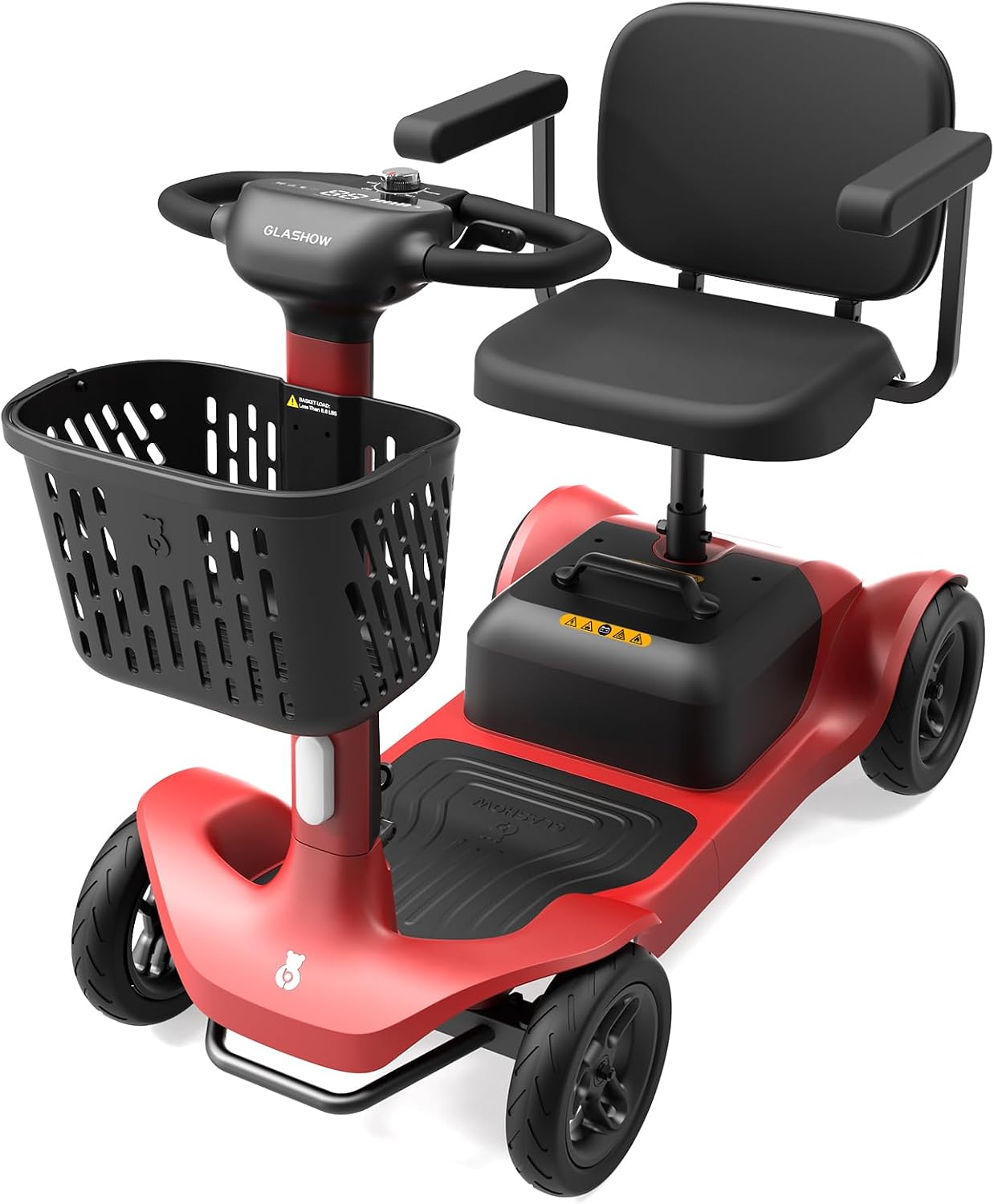
- Up to ~25 mi range
- 10″ wheels
- 6.2 mph
- Folds flat
If we had to name one scooter for Connecticut, it is the Glashow S1. The state’s great asset for a rider is its long paved trails, the 80-mile Farmington Canal path above all, and range, on bigger 10-inch wheels that fold flat for winter storage, is what lets you use them. For an older or heavier rider, the comfortable, higher-capacity Buzzaround EX is the alternative, and the light, value-priced Aotedor for a tight budget or a small apartment.
On HUSKY Health or Medicare? Read the funding steps below: Connecticut covers power mobility for eligible residents.
Is a mobility scooter street-legal in Connecticut?
Where to ride: a great long trail
- Farmington Canal Heritage Trail: roughly 80 paved miles from Suffield down to New Haven, flat and well kept, one of the longest paved trails in New England.
- Hartford Riverwalk (Riverfront Recapture): paved paths along the Connecticut River through the capital.
- Shoreline Greenway Trail: a growing paved path along the Long Island Sound coast east of New Haven.
- Air Line State Park Trail: a long former rail line across the eastern part of the state (surfaces vary, so check ahead).
A New England winter
How to get HUSKY Health, Medicare or the VA to pay
- See your doctor for a face-to-face exam. They must examine and document that you have real difficulty getting around inside your home, even with a cane or walker. That in-home need is the standard the program uses, so describe your daily trouble plainly.
- Get a written order (prescription). The doctor writes an order naming the device, your diagnosis and why it is medically necessary, and confirming you can operate it safely (or have someone who can help).
- Use an enrolled supplier. Get the scooter from a supplier enrolled with HUSKY Health, Medicare or the VA. A non-enrolled shop means no payment, even with a valid prescription.
- Let the supplier file for authorization. The supplier submits the paperwork; the program reviews and approves eligible devices. With Medicare you then pay 20% of the approved amount after your Part B deductible; HUSKY Health may cover more.
One honest note: because the programs judge in-home need, a scooter bought mainly for the trails or errands is often a separate, out-of-pocket purchase. Confirm the current rules with Medicare, the VA, or HUSKY Health.
Other help in Connecticut
Renting vs. buying a mobility scooter in Connecticut
Through the long green seasons, an owned scooter does real work on the trails, and buying within a couple of months is usually cheaper than renting.
- Keeps costing you. A travel scooter runs roughly $100 to $200 a week depending on model (Scootaround), so a month of regular use is several hundred dollars.
- You hand it back, and it never becomes yours.
- Not fitted or sized to you.
- Reasonable for a short visit or a one-off event.
- Pays for itself fast. A one-time purchase; after a few weeks of what renting costs you are ahead, and you keep the scooter.
- It is ready whenever you are, through the long green seasons, and on cleared paths in winter.
- It comes apart for a car trunk, for the Farmington Canal Trail, a clinic or a day out.
- And it may be funded. If your need is medical, HUSKY Health, Medicare or the VA may cover an approved device.
Bottom line: if you live in Connecticut, buy: a scooter that folds for winter and has the range for the long trails will serve you across the seasons. Check first whether HUSKY Health or Medicare will fund it.
Who needs mobility support in Connecticut
18.1% of Connecticut residents are 65 or older (650,772 people out of 3,598,348) above the national 16.8%. Its disability rate, 12.1%, runs below the national 13.0%. Connecticut is older than the country but, on average, healthier and better-off, a state that ages comfortably.
That does not make the need small: nearly 651,000 residents are seniors, and many move more easily with help. What sets the state apart is that when a scooter is needed here, it is unusually likely to be funded: between HUSKY Health, Medicare and the VA, the route to a covered device is well open, with an affordable model to fill the gap for those who buy for the trails.
Best mobility scooters for Connecticut (2026)
Picks weighted for range on the long trails, comfort for daily riders, and value. Specs are per manufacturer listings; confirm current details and price on Amazon.
| Model | Wheels | Max rider | Top speed | Owner rating |
|---|---|---|---|---|
| Glashow S1 Folding ★ Top pick | 10″ (4-wheel) | 265 lb | 6.2 mph | 4.4★ (46) |
| Golden Buzzaround EX Most comfort | 9″ (4-wheel) | 330 lb | 5.0 mph | 4.7★ (verified) |
| Aotedor Lightweight Best on a budget | 7″ | 300 lb | 3.7 mph | 4.5★ (277) |
| Pride Go-Go Sport | 3-wheel | 325 lb | 4.7 mph | 4.4★ (109) |
4.4★ (46 ratings) · 10″ wheels · rated ~25 mi range · 265 lb limit
Why Connecticut: the longest range of the four for the 80-mile Farmington Canal Trail, on bigger 10″ wheels, and it folds flat for winter storage. Check the 265 lb limit, the lowest here.
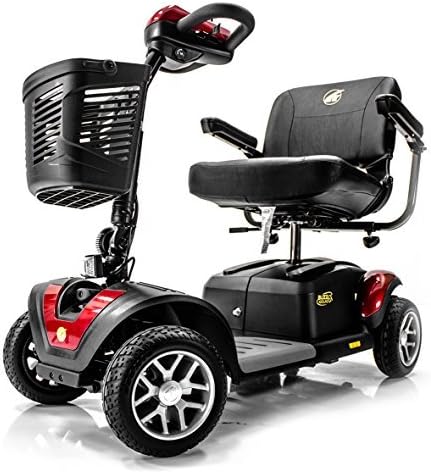
4.7★ (verified owners) · 9″ wheels · up to 330 lb
Why Connecticut: the highest rating and capacity here and four-wheel stability, the comfortable pick for an older or heavier rider. Comes apart for a car trunk.
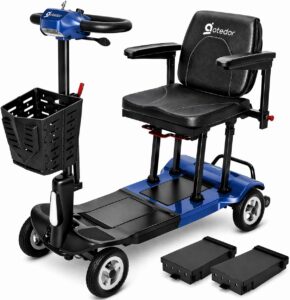
4.5★ (277 ratings) · folds compact · up to 300 lb
Why Connecticut: the cheapest and most owner-reviewed here, light to lift and folds compact for winter storage, the value pick.
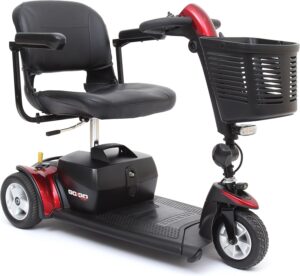
4.4★ (109 ratings) · compact · up to 325 lb
Why Connecticut: a tight turning circle for a historic town center or indoor use through the winter, and easy to bring along. Four wheels are steadier out on the trails.
Watch: the Buzzaround EX, our comfort pick
An independent walkthrough of the Golden Buzzaround EX, our comfort pick for older and heavier riders, showing the four-wheel frame, seat, controls and how it comes apart to transport.
Video: Golden Buzzaround EX review (YouTube). Polaris Mobility is not affiliated with the reviewer.
Still choosing? Our guide to the best four-wheel scooters ranks the stable models side by side, the full scooter catalogue lists every model we cover, and the city guide index links every city we have written.
Connecticut mobility scooter FAQ
Is a mobility scooter street-legal in Connecticut?
Yes, and the rules are light. A mobility scooter used because of a disability is treated under Connecticut law as a pedestrian device, not a motor vehicle, so you do not need a driver’s license, state registration or mandatory insurance. You may use sidewalks and pedestrian paths with ordinary care and a walking pace in crowds, plus the state’s many paved trails and low-speed streets. New England’s historic town centers have some brick, and a few towns add their own path rules, so check locally and pick your route.
Does HUSKY Health or Medicare cover a mobility scooter?
Either can. Connecticut expanded Medicaid, so HUSKY Health can cover medically necessary durable medical equipment, including a power scooter, for eligible residents of any age; everyone 65 and over has Medicare; and veterans have the VA. The path runs through your doctor: a face-to-face exam documenting difficulty moving around inside your home, a written order, an enrolled supplier, and prior authorization. With Medicare you then pay 20% after the Part B deductible. Because the standard is in-home need, a scooter bought mainly for the trails is usually an out-of-pocket purchase.
What is the best mobility scooter in Connecticut?
Our overall pick is the Glashow S1, because Connecticut’s standout is its long paved trails, the 80-mile Farmington Canal path above all, and range is what lets you use them: the Glashow has the longest rated range of the four, bigger 10-inch wheels, and folds flat for winter storage. The comfortable, higher-capacity Buzzaround EX is the alternative for an older or heavier rider, and the light, foldable Aotedor is the value pick.
Where can you ride a mobility scooter in Connecticut?
On the paved trails, above all: the Farmington Canal Heritage Trail runs roughly 80 paved miles down much of the state, Hartford has riverfront paths along the Connecticut River, and the Shoreline Greenway follows the coast east of New Haven. They are flat and mostly paved. Ride spring through fall, and keep to cleared paths in winter.
Do you have a Connecticut city guide?
Not yet: this is our statewide Connecticut guide, covering the law, funding and where to ride. We are adding city guides across the country each week, so check the city index for the latest, and this page for updates on Connecticut’s cities.