
Mobility Scooters in Des Moines

Looking for a mobility scooter in Des Moines, to buy or to rent? This city has an unusual asset for a scooter rider: 4.2 miles of enclosed, climate-controlled walkway connecting 40 downtown blocks, 55 buildings and 12 parking ramps, open around the clock. In an Iowa January, when the pavement outside is glass, that skywalk is not a novelty, it is a lifeline. But there is a catch that decides whether it works for you, and it is the one the tourist pages skip: the skywalk is one story up, so your real question is not whether it is accessible, but where the elevators are. This guide answers that, covers DART’s fares and its winter-friendly paratransit rule, and picks the scooter that handles ice outside and an elevator inside. Polaris Mobility earns a commission on qualifying Amazon purchases through links on this page.
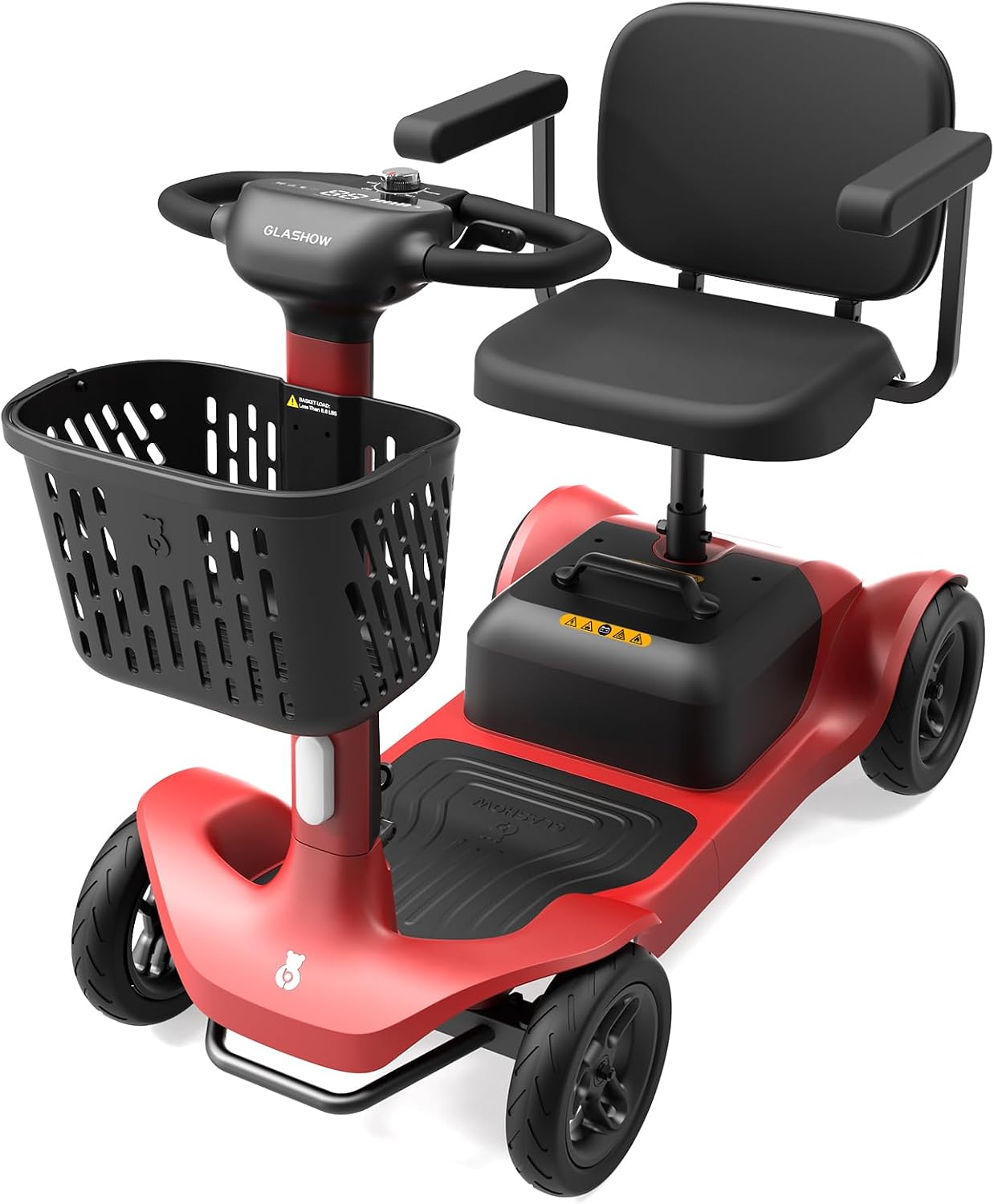
- 10″ wheels
- Rated ~25 mi range
- 4-wheel stability
- 265 lb limit
Des Moines asks a scooter to do two opposite jobs. Outside, it must handle packed snow and broken ice, which wants the biggest wheels and four of them: this has both, the largest here at 10 inches. Inside the skywalk, it must fit an elevator and turn in a corridor, which wants something that is not enormous, and this folds. A cold battery also gives you less than its rating, so the longest rated range here is the sensible buy. Check the 265 lb limit first; it is the lowest of the four, and a winter coat is not nothing.
On Medicare or Iowa Medicaid? Read the funding section before you pay out of pocket.
The skywalk: four miles indoors, one story up
Think about what that means in a state where winter is a serious adversary. Four miles of heated, dry, level path, never closed, linking most of downtown and a dozen parking lots. For a scooter rider, a downtown you can cross without ever meeting ice, wind or a curb is close to the best thing a cold city can offer. It is genuinely rare, and it is genuinely valuable.
- Learn two or three reliable elevators before winter, not during it. The buildings and parking ramps with elevators to skywalk level are your on-ramps. Once you know a couple that suit your usual trips, the whole four miles opens up.
- Building hours are the real limit, not the “24/7”. The exterior skywalk corridors stay open, but the elevators that get you up to them are inside buildings, and those keep their own hours. A route that works at noon on Tuesday may be sealed on Sunday morning. Have a backup.
- It is the reason a heavier winter scooter is still fine here. If a big share of your winter travel is on level, heated, indoor path, you are not fighting snow for those miles: the outdoor demands drop to getting from home to your first elevator.
DART: cheap buses, and a winter-shaped paratransit rule
The part worth dwelling on is the paratransit, because DART’s eligibility rule is written the way an honest winter city should write it.
That “under certain circumstances” is doing quiet, important work. A person who can roll to the bus stop on a dry October afternoon and cannot cross packed ice to it in January is describing exactly what that rule is for. Most people never apply, because they assume paratransit means never able to use a bus. In Des Moines it does not.
- Apply in the fall, not the ice. A 21-day review means the request you send when the first storm hits is answered after the worst of it. Sort it out in October if winter is the part that beats you.
- Bus Plus (paratransit) starts at $3.50 a trip in the base service zone. There is a higher fare for premium-zone trips beyond the core area; we could not verify the exact premium figure, so confirm it with DART on 515-283-8136 before you plan a long trip rather than trusting a number we have not seen.
- The van, like the bus, is not the whole answer in winter. Which is the argument for the skywalk and your own scooter together: indoors and level for the core, the van for the trips that leave it.
Renting vs. buying a mobility scooter in Des Moines
The skywalk changes this calculation in a way few cities can: a big share of your winter mileage can be indoors, level and heated.
- Keeps costing you. A travel scooter runs roughly $100 to $200 a week depending on model and city (Scootaround), so a month of regular use is several hundred dollars.
- You hand it back, and it never becomes yours.
- Not fitted or sized to you; you take whatever model is free.
- Little use in the season you most need it, unless you rent all winter.
- Pays for itself fast. A one-time purchase; after a few weeks of what renting costs you are ahead, and you keep the scooter.
- It turns the skywalk into your winter road: four heated miles you can use daily without arranging anything.
- It is charged and indoors on the morning the streets are ice.
- Spread the cost. Many scooters offer monthly payments at checkout or through your card.
Bottom line: buy if you live here. A scooter that handles ice for the short outdoor legs, plus 4.2 miles of heated skywalk and a 75-cent bus, is about as capable a winter setup as any cold American city allows, once you have learned your elevators.
How to pay: Medicare and Iowa Medicaid
If you are 65 or older, Medicare is your route. Part B may cover a scooter if a doctor confirms you need it to move around your home and you can operate one safely, through a supplier that accepts Medicare (Medicare.gov).
Iowa expanded Medicaid, so unlike some states in this guide there is no coverage gap trapping low-income adults: Iowa covers adults up to 138% of the federal poverty level. Iowa Medicaid can pay for medically necessary equipment such as a power wheelchair or scooter when a doctor documents the need and it is supplied through an enrolled provider. Iowa delivers most Medicaid through managed care, so the practical route runs through your health plan. Ask it directly what it requires for a mobility device, what documentation your doctor must provide, and which suppliers it will authorize. Start with your primary care provider.
Because these programs work through approved suppliers, a scooter bought on Amazon is a separate out-of-pocket purchase, which is why many buyers who do not qualify, or cannot wait out an authorization, choose one for the lower price and immediate delivery. Confirm current criteria directly, as they change.
Comparing options across the state? Our Iowa mobility scooter guide covers statewide Medicaid and Medicare details, the best models for the local climate and terrain, and how the picture changes from city to city.
Who needs mobility support in Des Moines
Des Moines breaks the usual pattern in this guide, and in a revealing way. Most cities are older than their state; Des Moines is much younger. Just 12.5% of Des Moines residents are 65 or older (26,644 people out of 212,464) against Iowa’s 17.8%, one of the older states in the country. Iowa’s elderly are spread across its small towns and farms; the capital is a young, working city.
But look at disability and the direction flips. 14.3% of Des Moines residents report a disability, against 12.4% across Iowa and 13.0% nationally. So Des Moines is younger than its state and more disabled than it: a working-age disability profile rather than an ageing one. The practical reading is that a large share of the people who need a scooter here are not retirees; they are working-age adults for whom a $0.75 bus, a heated four-mile skywalk and a job downtown fit together into something like independence, if the elevators cooperate.
Best mobility scooters for Des Moines (2026)
Picks weighted for packed snow and ice outside, an elevator and a corridor inside, and a cold battery. Specs are per manufacturer listings; confirm current details and price on Amazon.
| Model | Wheels | Max rider | Top speed | Owner rating |
|---|---|---|---|---|
| Glashow S1 Folding ★ Top pick | 10″ (4-wheel) | 265 lb | 6.2 mph | 4.4★ (46) |
| Golden Buzzaround EX If 265 lb is close | 9″ (4-wheel) | 330 lb | 5.0 mph | 4.7★ (verified) |
| Pride Go-Go Sport | 3-wheel | 325 lb | 4.7 mph | 4.4★ (109) |
| Aotedor Lightweight | 7″ | 300 lb | 3.7 mph | 4.5★ (277) |
4.4★ (46 ratings) · 10″ wheels · rated ~25 mi range · 265 lb limit
Why Des Moines: the biggest wheels here for ice and packed snow, four of them for stability, the longest range for a cold battery, and it folds to fit a skywalk elevator. The rare scooter that suits both jobs. Check the 265 lb limit.
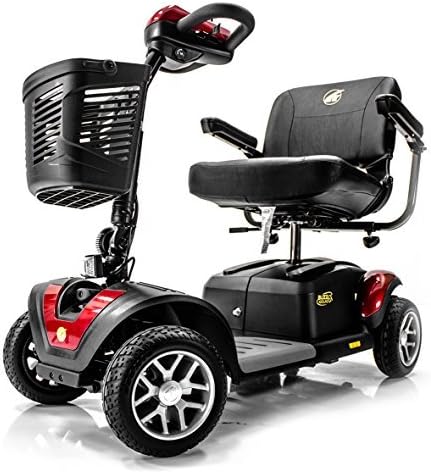
4.7★ (verified owners) · 9″ wheels · up to 330 lb
Why Des Moines: 330 lb for a winter coat, the highest owner rating here and a real service network. A touch less range than the Glashow, which a cold battery will notice.
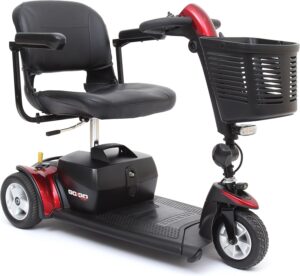
4.4★ (109 ratings) · compact · up to 325 lb
Why Des Moines: 325 lb and it comes apart to go indoors, where a battery should spend an Iowa January. Three wheels are less sure-footed than four on ice, the trade-off to weigh.
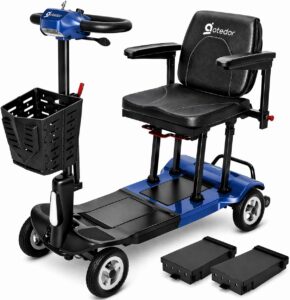
4.5★ (277 ratings) · folds compact · up to 300 lb
Why Des Moines: the easiest to fold into an elevator and the most owner-reviewed, superb for a skywalk-and-indoors life. The smallest wheels, though, which is the wrong end of an icy outdoor block.
Watch: the Golden Buzzaround EX reviewed
An independent walkthrough of the Golden Buzzaround EX, the higher-capacity alternative in the comparison above, showing the four-wheel frame, seat, controls and how it comes apart to transport.
Video: Golden Buzzaround EX review (YouTube). Polaris Mobility is not affiliated with the reviewer.
Compare more 4-wheel models · full catalog
Des Moines mobility scooter FAQ
Can you use a mobility scooter in the Des Moines skywalk?
The skywalk is 4.2 miles of climate-controlled, level, indoor path connecting 55 buildings and 12 parking ramps across roughly 40 downtown blocks, with 24/7 pedestrian access: a genuinely valuable winter route for a scooter. The catch is that it sits one story up, so you reach it by elevator from inside the connected buildings and parking ramps. The city describes the system as “accessible” but does not publish a full wheelchair-access specification, so get the skywalk map that marks the accessibility points, learn two or three reliable elevators near your usual trips, and plan your route by those rather than by the shortest line. Note that the elevators sit inside buildings that keep their own hours, so a route that works midweek may be closed on a Sunday morning.
How much is the bus for seniors in Des Moines?
A DART fixed-route single ride is $1.75 at full fare and $0.75 at half fare, with half fare available to qualifying riders including seniors, Medicare cardholders and people with disabilities. DART On Demand microtransit is $3.50 full or $0.75 reduced. Call DART Customer Service on 515-283-8100 to confirm the exact senior age and how to get the reduced-fare ID, as we could not load the full fare table to verify every detail.
Can you get DART paratransit just for the winter in Des Moines?
Effectively, yes. DART’s paratransit is for people “functionally unable to independently use the regular DART bus service all of the time, temporarily or only under certain circumstances”, so you do not have to be permanently unable to use a bus, and someone who can reach the stop in fall but not across January ice fits that “under certain circumstances” wording. Applications are reviewed and results mailed within 21 days, so apply in the fall rather than waiting for the first storm. Bus Plus paratransit starts at $3.50 a trip in the base service zone, with a higher fare for premium-zone trips. Confirm the premium figure with DART on 515-283-8136.
What is the best mobility scooter for Des Moines?
Our top pick is the Glashow S1 Folding, because Des Moines asks a scooter to do two opposite things. Outside, it needs the biggest wheels and four of them for packed snow and ice, and the longest range because a cold battery underdelivers, this has all three. Inside the skywalk, it needs to fit an elevator and turn in a corridor, and this folds. Check its 265 lb weight limit first, the lowest of the four and worth watching once you add a winter coat; if you are near it, the Golden Buzzaround EX takes 330 lb and has the highest owner rating.