
Mobility Scooters in El Paso

Looking for a mobility scooter in El Paso, to buy or to rent? Start with the two numbers that make this city different. The senior fare on Sun Metro is 50 cents. And if you are one of El Paso’s 40,341 veterans, or the spouse or dependent of one, you can currently ride free (buses, Brio, and LIFT paratransit) under a program that Sun Metro says is scheduled to end by 31 August 2026, or sooner if the funding runs out. If that is you, read the next section before you read anything else, because this is the kind of thing you find out about after it closes. Polaris Mobility earns a commission on qualifying Amazon purchases through links on this page.
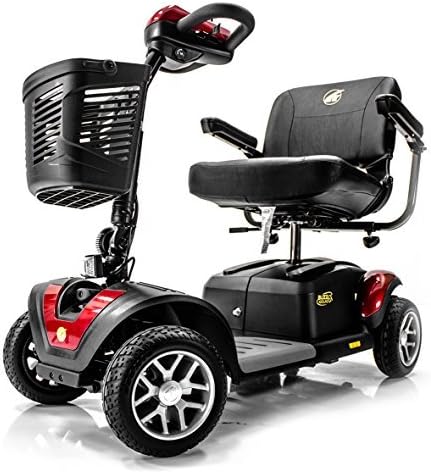
- Up to 330 lb
- Real brand service network
- Stable 4-wheel base
- ★ 4.7 rating
In some cities we pick a scooter to make up for transit that fails you. Not here. At 50 cents a ride (or nothing at all if you are a veteran) El Paso’s buses are worth using, so your scooter is doing a gentler job: the last few hundred yards at each end, in desert heat. That makes the seat and the build quality the deciding specs, not range or rescue. This has the highest owner rating here, the highest weight capacity, and a real manufacturer service network. If your days are mostly downtown, the lighter Aotedor below is a fair, cheaper alternative.
A veteran, or on Medicare? Read the funding section before you pay out of pocket.
Veterans ride free, and the clock is running
Read the middle line again, because it is the part people miss: it includes LIFT. LIFT is the door-to-door paratransit service, and it costs everybody else $2.50 a ride. For a veteran, or a veteran’s spouse, it currently costs nothing. There is no disability rating mentioned as a condition: the page says all veterans and eligible dependents and spouses.
- It is passes, not a swipe. The benefit comes as 30-day passes, and you may “request a new pass within one week of the current pass’s expiration date”. So it needs renewing, monthly, deliberately.
- Already enrolled? Sun Metro says previously enrolled people need only call to confirm their information rather than apply again.
- “First-come, first-served” means it can stop before the date. The scheduled end is 31 August 2026, but the program runs only “until funding is available”. Those are two different deadlines and the earlier one is invisible.
- What we cannot tell you is what happens on 1 September 2026, because Sun Metro does not say. If you rely on this, ring and ask what the plan is. Do not assume renewal, and do not assume cancellation either.
Fifty cents, and the letter they will turn away
Even without the veterans’ program, this is inexpensive transit.
| Fare | Price |
|---|---|
| Standard / Express (bus and Brio) | $1.50 |
| Seniors 65+ and persons with a disability | $0.50 |
| Military, students, children 6–18 | $1.00 |
| Children 5 and under | Free |
| Day pass / weekly / monthly (standard) | $3.50 / $12 / $48 |
| LIFT paratransit | $2.50 single · $12.50 five-ride pass |
- The card itself is free. Once you qualify, “the passenger is issued a Sun Metro Reduced Fare identification card at no charge”. A replacement costs $5.
- Seniors have it easier, and there is a lovely local wrinkle. You can show “a US or State government-issued photo ID card that displays date of birth”, or a valid Enhanced Library Card. Your library card gets you the fare.
- Who qualifies at all: people 65 and over, certified people with a disability (from “illness, injury, age, congenital malfunction, or other permanent or temporary incapacity”) Medicare card holders, military (“active duty, retirees and their dependents with a valid military ID”) and students (Sun Metro).
- Note the ladder. A senior pays 50 cents on the bus and $2.50 on LIFT: five times as much to use the service you need precisely because the bus is not an option. Unless you are a veteran, in which case, right now, LIFT is free.
The VA route, and the marketing you should ignore
If you are 65 or older, Medicare is one route. Part B may cover a scooter if a doctor confirms you need it to move around your home and you can operate one safely, through a supplier that accepts Medicare (Medicare.gov).
Two things follow from that sentence, and they matter. First: your disability does not have to be service-connected for general prosthetic services: the test is enrolment in VA health care plus medical need. Plenty of veterans assume the VA is only for injuries they got in uniform and never ask. Second: the way in is your VA primary care physician or specialty clinic, who refers you. It starts with an appointment, not a purchase.
And the Texas backdrop. Texas has not expanded Medicaid, so a low-income adult under 65 in El Paso who is not a veteran, not disabled by the SSA’s definition and not caring for a child can fall into the coverage gap: earning too much for Texas Medicaid and too little for marketplace subsidies. If that is you, ask about El Paso County’s hospital district and its assistance programs rather than assuming there is nothing. Because these programs work through approved suppliers, a scooter bought on Amazon is a separate out-of-pocket purchase: which, in a state with a coverage gap this wide, is exactly why many people here buy one outright.
Renting vs. buying a mobility scooter in El Paso
The sum here is unusual, because the transit is genuinely cheap and genuinely usable. You are not buying a scooter to escape a broken system.
- Keeps costing you. A travel scooter runs roughly $100 to $200 a week depending on model and city (Scootaround), so a month of regular use is several hundred dollars.
- You hand it back, and it never becomes yours.
- Not fitted or sized to you; you take whatever model is free.
- Delivery windows, deposits and return deadlines to plan around.
- Pays for itself fast. A one-time purchase; after a few weeks of what renting costs you are ahead, and you keep the scooter.
- It pairs with 50-cent buses: your scooter covers the last few hundred yards, the bus covers the miles, and the whole thing costs almost nothing.
- Ask the VA first if you served. If the VA will provide a device on medical need, that is a better answer than any price on this page.
- Spread the cost. Many scooters offer monthly payments at checkout or through your card.
Bottom line: if you served, start with the VA and get a Vets Ride Free pass this month rather than next. If you did not, a 50-cent bus fare plus your own scooter is about as cheap as getting around an American city gets, and the scooter is what turns a bus stop into a destination in desert heat.
Who needs mobility support in El Paso
13.9% of El Paso residents are 65 or older (94,405 people out of 678,147) a little above Texas’s 13.2% and below the national 16.8%. On disability the gap opens: 14.3% of El Pasoans report one, against 12.0% across Texas and 13.0% nationally (U.S. Census Bureau, ACS 2023, 5-year).
And then the number that shapes this page: 40,341 veterans live in El Paso, out of a civilian population aged 18 and over of 495,117, about one adult in twelve. That is Fort Bliss in a statistic, and it means a large share of the people reading this have a route to equipment and to free transit that their neighbours do not. It also means something less comfortable: in a state that did not expand Medicaid, whether you served is one of the biggest single predictors of whether anyone will help you pay for a scooter.
Best mobility scooters for El Paso (2026)
Picks weighted for desert heat, a spread-out city and buses worth catching: your scooter is the last few hundred yards, not the whole journey. Specs are per manufacturer listings; confirm current details and price on Amazon.
| Model | Wheels | Max rider | Top speed | Owner rating |
|---|---|---|---|---|
| Golden Buzzaround EX ★ Top pick | 9″ (4-wheel) | 330 lb | 5.0 mph | 4.7★ (verified) |
| Aotedor Lightweight Cheapest & lightest | 7″ | 300 lb | 3.7 mph | 4.5★ (277) |
| Glashow S1 Folding | 10″ (4-wheel) | 265 lb | 6.2 mph | 4.4★ (46) |
| Pride Go-Go Sport | 3-wheel | 325 lb | 4.7 mph | 4.4★ (109) |
4.7★ (verified owners) · 9″ wheels · up to 330 lb
Why El Paso: with buses at 50 cents you are not asking the scooter to do the whole journey, so buy the comfortable one. Highest rating and capacity here, and a real service network in a city a long way from most things.
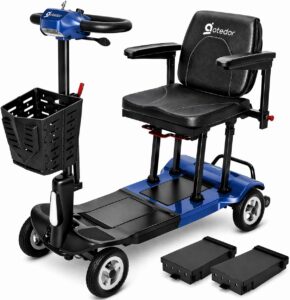
4.5★ (277 ratings) · folds compact · up to 300 lb
Why El Paso: the most owner ratings of the four and the easiest to fold onto a Brio bus or into a trunk. Short legs, but if the bus is doing the miles that matters less here than in most cities.
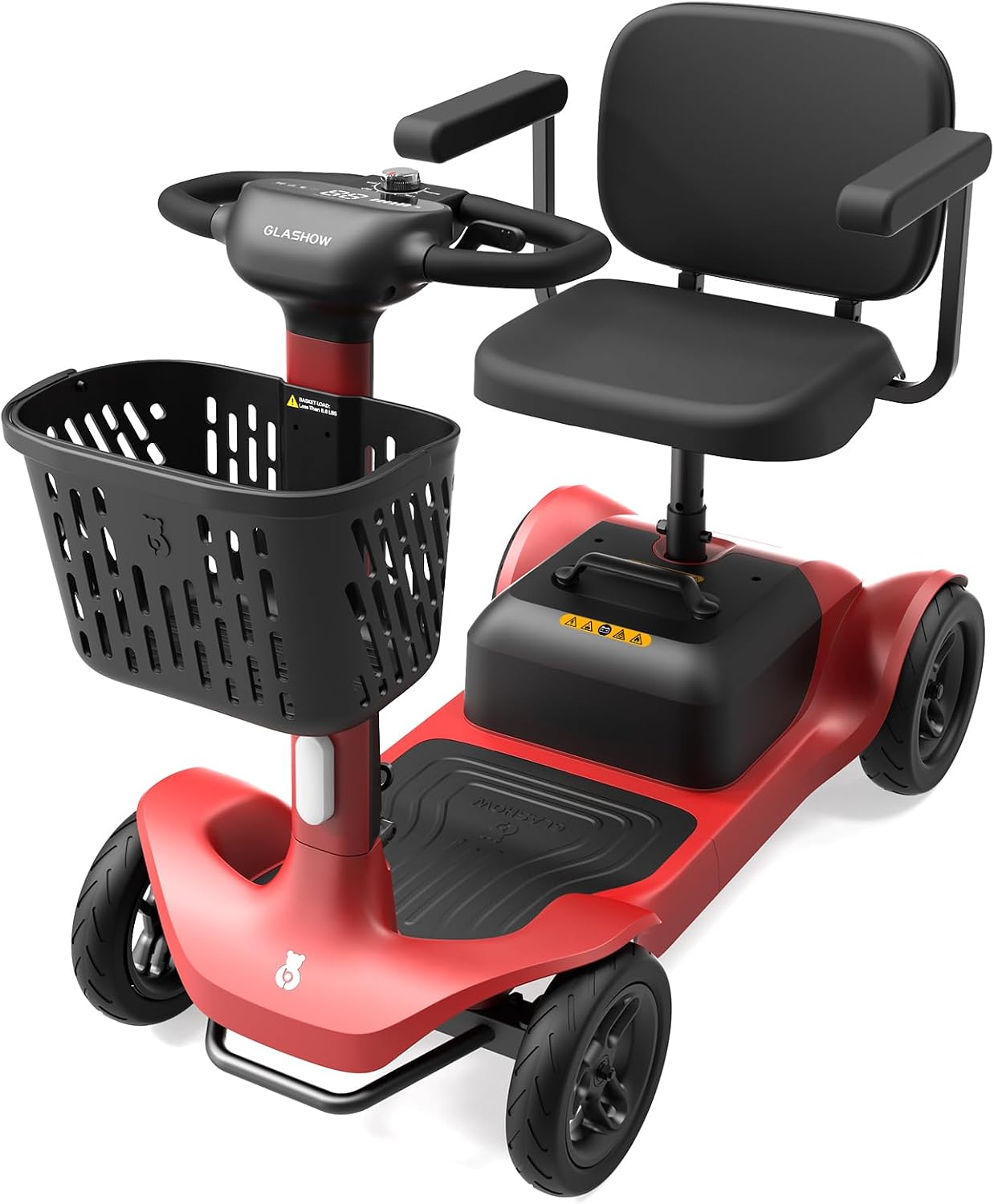
4.4★ (46 ratings) · 10″ wheels · rated ~25 mi range · 265 lb limit
Why El Paso: the longest range and biggest wheels, worth it if you live away from a Brio corridor and need to cover real distance yourself. Check the 265 lb limit, the lowest here.
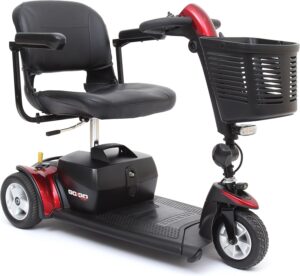
4.4★ (109 ratings) · compact · up to 325 lb
Why El Paso: 325 lb, a tight turning circle for plazas and markets, and it breaks down for a car trunk. Four wheels feel steadier if you are covering distance in the heat.
Watch: our top pick in action
An independent walkthrough of the Golden Buzzaround EX, our top pick above, showing the four-wheel frame, seat, controls and how it comes apart to transport.
Video: Golden Buzzaround EX review (YouTube). Polaris Mobility is not affiliated with the reviewer.
Compare more 4-wheel models · full catalog
Comparing options across the state? Our Texas mobility scooter guide covers statewide Medicaid and Medicare details, the best models for the local climate and terrain, and how the picture changes from city to city.
El Paso mobility scooter FAQ
Do veterans really ride free in El Paso, and until when?
Currently yes, and the date matters. Sun Metro’s Vets Ride Free program covers “All veterans and eligible dependents/spouses” and applies to “Fixed Route, Brio, and LIFT paratransit service in the form of 30-day passes”, so it includes door-to-door paratransit, which costs everyone else $2.50 a ride. Sun Metro states the program is “active July 1, 2025 and end by August 31, 2026 or until funding is available,” and that it is “subject to funding availability, with funds distributed on a first-come, first-served basis.” Those are two deadlines, and the funding one is invisible. The benefit comes as 30-day passes and you may request a new pass within a week of the current one expiring; if you have enrolled before, Sun Metro says you need only call to confirm your information. What happens after 31 August 2026 is not stated. Call and ask.
How much is the bus for seniors in El Paso?
Fifty cents. Sun Metro charges $0.50 for seniors 65 and over and for certified persons with a disability, against a standard fare of $1.50; military, students and children 6–18 pay $1.00, and children 5 and under ride free. Standard passes are $3.50 a day, $12 a week and $48 a month. LIFT paratransit is $2.50 a single ride, or $12.50 for a five-ride pass.
How do I get a Sun Metro reduced-fare card?
It depends which door you use. Seniors can show “a US or State government-issued photo ID card that displays date of birth”, or a valid Enhanced Library Card. Military show a valid military ID. For disability you must bring certification to a Sun Metro ticket office, and there is a catch worth knowing before you travel: Social Security disability letters are rejected. The card itself is issued at no charge; a replacement costs $5. Ring ahead and confirm exactly which document they will accept.
Will the VA pay for a mobility scooter?
Ask the VA, not a shop. The VA Prosthetic and Sensory Aids Service says “General eligibility for prosthetic services/items is for Veterans enrolled in the VA health care system who have a medical need for a prosthetic service/item,” and notes additional criteria may apply to specific programs, so your disability does not have to be service-connected for general prosthetic services. Its list of what it provides includes “Mobility aids, such as walkers and wheelchairs.” It does not mention scooters. You will find retailers advertising “VA-approved” and “100% covered” scooters; the VA’s own page does not say that, and those retailers are selling you something. Start with your VA primary care physician or specialty clinic, who can refer you.
What is the best mobility scooter for El Paso?
Our top pick is the Golden Buzzaround EX. In cities with unreliable or expensive transit we pick a scooter to compensate; El Paso does not need that, because the bus is 50 cents (or free if you are a veteran), so the scooter is doing the last few hundred yards in desert heat rather than the whole trip. That makes the seat and the build the deciding specs: this has the highest owner rating of the four, the highest capacity at 330 lb, and a real service network. If your riding is mostly downtown, the Aotedor is lighter and cheaper and folds onto a bus easily.