
Best Mobility Scooters for Heavy Adults

Looking for a mobility scooter for a heavier adult? Here one spec matters above all others: the weight capacity. A scooter loaded beyond its rated limit is unsafe: the motor strains, the battery drains fast, the frame and welds are stressed, and stability suffers. So the job is to match a genuinely stronger scooter to your weight, with margin to spare, and to pair that with a wide, comfortable seat and a stable four-wheel base. This guide explains what to look for, names an honest top pick, is honest about when you need a dedicated bariatric model, walks through how Medicare or Medicaid may pay, and answers the common questions.
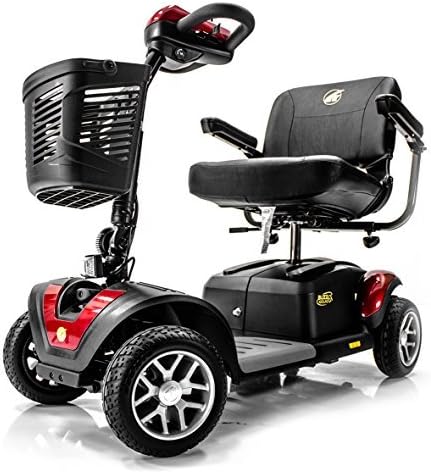
- Up to 330 lb
- Wide padded seat
- Four-wheel stability
- ★ 4.7 owner rating
Among our four, the Golden Buzzaround EX has the highest weight capacity (330 lb), a wide, padded seat, a sturdy frame and a stable four-wheel base, so for riders up to that limit it is the pick. It also has the highest owner rating of the four. The Pride Go-Go Sport (325 lb) is close behind on capacity, and both come apart for a car. Important and honest: if you weigh more than about 330 lb, none of the travel scooters here are right for you: you need a dedicated heavy-duty or bariatric scooter rated 400 to 500 lb, with a wider seat and a stronger motor. See the note below.
A scooter can be covered when it is medically necessary. Read the funding steps below.
What to look for in a scooter for a heavier rider
- A weight capacity above your weight, with margin. Never ride at or over the rated limit. Choose a scooter rated comfortably above your weight, remembering that anything you carry counts too.
- A wide, supportive seat. A cramped seat is uncomfortable and unstable; look for the widest seat you can, ideally 18 to 20 inches or more.
- A strong frame and motor. A heavier load asks more of the motor on slopes and the frame over time, so a sturdier, four-wheel build lasts and performs better than a light folding one pushed to its limit.
- A stable four-wheel base. Four wheels spread the load and resist tipping far better than three when a heavier rider leans or turns.
- Solid tires and good brakes. More weight means more stopping force needed and more strain on tires, so a well-braked, robust scooter is safer.
Match the rated capacity to your weight first, then compare seat width and stability. Everything else is secondary.
Seat width and comfort
Capacity keeps you safe; the seat keeps you comfortable enough to actually use the scooter. A heavier rider is best served by the widest seat available, so look at the seat dimensions, not just the weight limit: a scooter can be rated for your weight but still have a seat that feels narrow. The Buzzaround EX and Pride Go-Go Sport both offer generous padded seats among our four. Flip-up, width-adjustable armrests help you settle comfortably and give support getting on and off, and a firm, well-padded cushion spreads the load and prevents pressure points on longer rides. If in doubt, a mobility supplier can fit a wider aftermarket seat.
Will Medicare or Medicaid pay for a heavy-duty scooter?
- See your doctor for a face-to-face exam. They must examine and document that you have real difficulty getting around inside your home, even with a cane or walker. That in-home need is the standard the program uses.
- Get a written order (prescription). The doctor writes an order naming the device (including the weight rating you need), your diagnosis and why it is medically necessary, and confirming you can operate it safely.
- Use an enrolled supplier. Get the scooter from a supplier enrolled with Medicare, your Medicaid program or the VA: especially useful for a heavy-duty model they can fit to you. A non-enrolled shop means no payment.
- Let the supplier file for authorization. The supplier submits the paperwork; the program reviews and approves eligible devices. With Medicare you then pay 20% of the approved amount after your Part B deductible; Medicaid may cover more.
One honest note: coverage is judged on in-home need, so a scooter bought mainly to get out and about is often a separate, out-of-pocket purchase. Confirm the current rules with Medicare, your state Medicaid, or the VA.
Renting vs. buying
For a lasting need, an owned scooter sized to your weight does far more good over time, and buying within a couple of months is cheaper than renting. Be sure any rental is rated for your weight too.
- Keeps costing you. A travel scooter runs roughly $100 to $200 a week (Scootaround), so a month is several hundred dollars.
- Check the weight rating carefully, not every rental is heavy-duty.
- Reasonable only for a trip or a one-off event.
- Sized to you: the right capacity and seat width, set up once.
- Ready every day and safe, with margin above your weight.
- It comes apart for a car trunk (the travel models): heavy-duty models are larger, so plan transport.
- And it may be funded if a condition makes it medically necessary.
Best mobility scooters for heavier adults (2026)
Ranked by weight capacity and stability, the things that matter most here. Above 330 lb, see a supplier about a dedicated heavy-duty model. Specs are per manufacturer listings; confirm current details and price on Amazon.
| Model | Wheels | Weight capacity | Seat | Owner rating |
|---|---|---|---|---|
| Golden Buzzaround EX ★ Top pick | 9″ (4-wheel) | 330 lb | Wide padded | 4.7★ (verified) |
| Pride Go-Go Sport High capacity | 3-wheel | 325 lb | Padded | 4.4★ (109) |
| Aotedor Lightweight Best on a budget | 7″ | 300 lb | Folding | 4.5★ (277) |
| Glashow S1 Folding | 10″ (4-wheel) | 265 lb | Folding | 4.4★ (46) |
4.7★ (verified owners) · 330 lb · wide padded seat
Why heavier riders: the highest capacity of the four at 330 lb, a wide padded seat, sturdy four-wheel frame and the best owner rating: the pick for riders up to its limit. Comes apart for a car trunk.
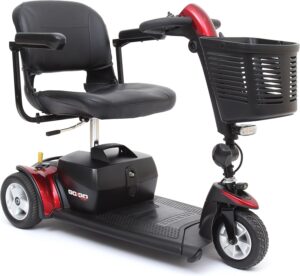
4.4★ (109 ratings) · 325 lb · padded seat
Why heavier riders: 325 lb capacity, close behind the Buzzaround, with a comfortable seat and a tight turning circle for indoors. Three wheels turn tighter but are a little less steady than four when leaning.
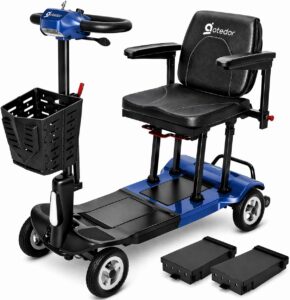
4.5★ (277 ratings) · 300 lb · folds compact
Why heavier riders: rated to 300 lb and the value pick, light to transport: suitable for riders comfortably under that limit who want the lowest price.
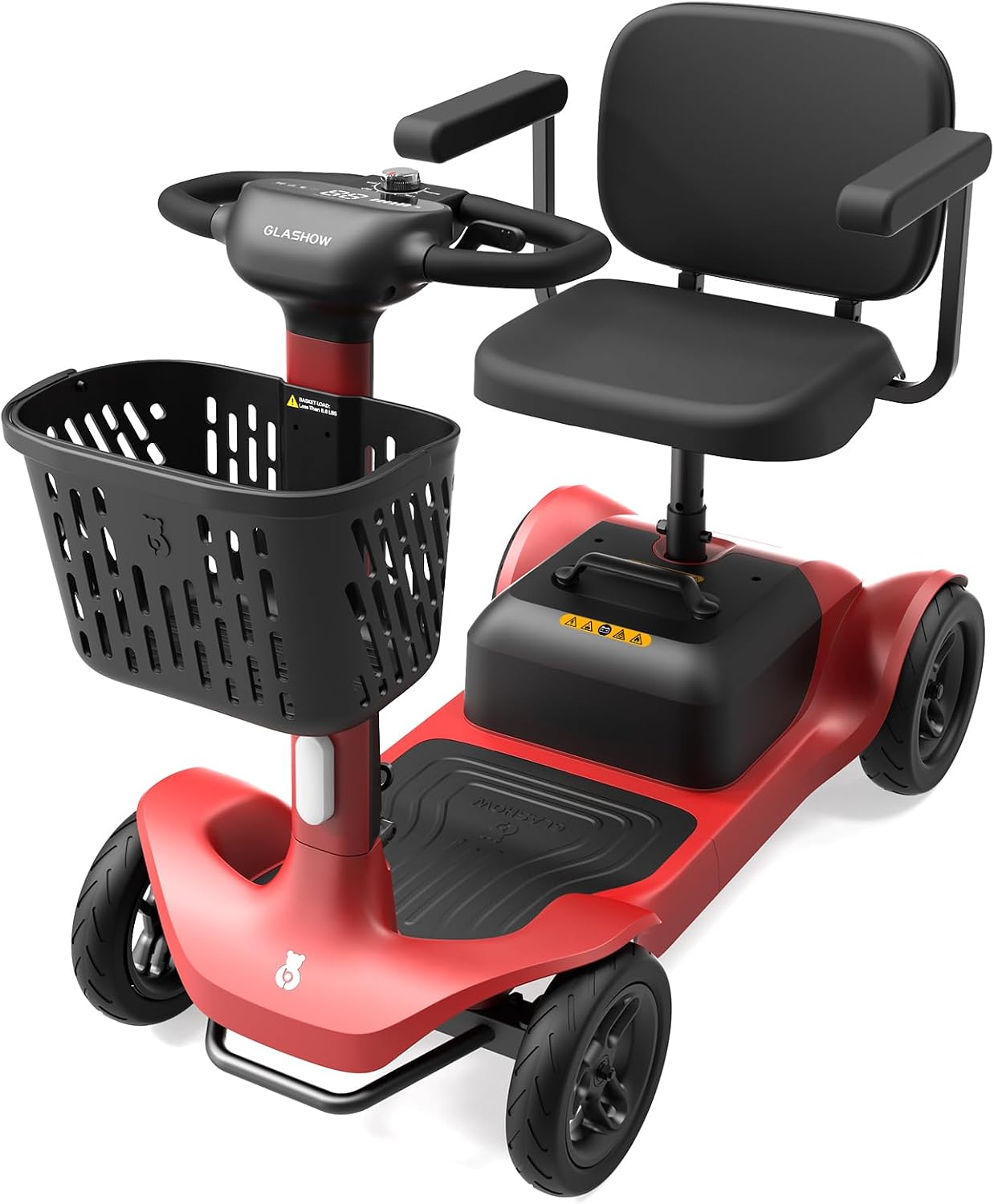
4.4★ (46 ratings) · 265 lb · folds flat
Why heavier riders: a great range-and-folding scooter, but its 265 lb capacity is the lowest of the four, so it suits lighter riders, not the choice if weight is your main concern.
Watch: the Buzzaround EX, our top pick
An independent walkthrough of the Golden Buzzaround EX, our top pick for heavier riders up to 330 lb, showing the wide seat, frame, controls and how it comes apart to transport.
Video: Golden Buzzaround EX review (YouTube). Polaris Mobility is not affiliated with the reviewer.
Still choosing? Our guide to the best four-wheel scooters ranks the stable models side by side, the full scooter catalogue lists every model we cover including higher-capacity options, and the city guide index links local guides with funding details for your area.
Heavy-duty mobility scooter FAQ
What is the best mobility scooter for a heavier adult?
Among our four, the Golden Buzzaround EX is the pick for riders up to its 330 lb limit: it has the highest weight capacity, a wide padded seat, a sturdy four-wheel frame and the best owner rating. The Pride Go-Go Sport is close behind at 325 lb. But if you weigh more than about 330 lb, none of these travel scooters is safe: you need a dedicated heavy-duty or bariatric scooter rated 400 to 500 lb, which a mobility supplier can fit to you.
What weight capacity mobility scooter do I need?
Choose a scooter rated comfortably above your weight, with margin: never at or over the limit, and remember anything you carry counts too. The rated capacity is a safety limit: exceed it and the motor strains, the battery drains fast, the frame is stressed and stability suffers. If you are near 330 lb, the Buzzaround EX (330 lb) is the top of our range; above that, move up to a purpose-built heavy-duty model rated 400 lb or more.
Is a three-wheel or four-wheel scooter better for a heavier rider?
Four wheels are usually safer for a heavier rider. They spread the load across a wider base and resist tipping far better than three wheels when you lean or turn, which matters more the heavier you are. A three-wheel scooter like the Pride Go-Go Sport turns tighter for indoors and still carries 325 lb, so it is a reasonable choice if space is tight, but for outright stability with weight, four wheels win.
Does Medicare cover a heavy-duty mobility scooter?
It can, on the same basis as any scooter: a diagnosed condition that limits how you move around your home. Your doctor examines and documents that in-home difficulty and writes an order specifying the weight rating you need; an enrolled supplier (who can fit a heavy-duty model) files for approval. With Medicare you then pay 20% of the approved amount after your Part B deductible; Medicaid or the VA may cover more. Because coverage is judged on in-home need, a scooter for getting out and about is usually out of pocket.
How wide a seat do heavier riders need on a mobility scooter?
As wide as you can comfortably get. Look at the seat dimensions, not just the weight limit, because a scooter can be rated for your weight and still feel narrow. Aim for a seat around 18 to 20 inches or wider, with a firm padded cushion to spread the load and prevent pressure points, and width-adjustable armrests. The Buzzaround EX and Pride Go-Go Sport have generous seats among our four, and a mobility supplier can fit a wider aftermarket seat if you need one.