
Mobility Scooters in Fort Worth

Looking for a mobility scooter in Fort Worth, to buy or to rent? Fort Worth gets treated as half of Dallas-Fort Worth, but for a scooter rider it is a different city with a different answer. It has its own transit agency, its own county-funded health safety net, and one of the largest urban trail systems in the country: the Trinity Trails run more than 100 miles and link 31 neighborhoods to 21 parks. It also has the Stockyards, which is the most famous place in the city and, honestly, one of the hardest to ride. This guide covers our top pick, the trails and their surfaces, the Stockyards problem, Trinity Metro fares, the Tarrant County health district, and the models that fit Fort Worth. Polaris Mobility earns a commission on qualifying Amazon purchases through links on this page.
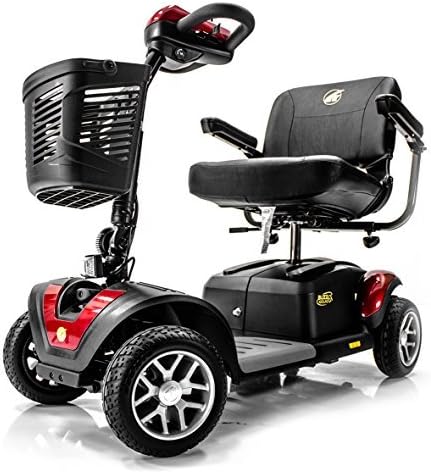
- Stable 4-wheel base
- Up to 330 lb
- Real brand service network
- ★ 4.7 rating
Fort Worth riding is long and hot rather than technical. The Trinity Trails are paved and gentle, and the days you will actually spend out there are North Texas summer afternoons, so the seat matters more than an extra inch of wheel. This has the most comfortable ride and the highest weight capacity in this comparison, the highest owner rating, and a real service network across a very large metro. Want the extra wheel size and more range for the far ends of a hundred-mile trail system? See the Glashow S1 below.
On Medicare, or uninsured in Tarrant County? Read the funding section first.
The Trinity Trails: over 100 miles
- Mind the surface. The system is not one material: it mixes asphalt, concrete and gravel. Asphalt and concrete are what you want. Gravel is loose, it drains badly after rain, and small wheels work noticeably harder on it, so check what a segment is made of before you commit to it.
- Ride it in pieces. A hundred miles is a network, not a route. Pick a trailhead, ride out and back within your battery range, and note where the shade and restrooms are: that matters more here than the distance does.
- Expect construction near the river downtown. Work on Panther Island’s 1.5-mile bypass channel is expected to begin in 2026 near the Main Street Bridge and to take about three years. Detours and closures around that stretch are likely, so check before you plan a downtown riverside ride.
The Stockyards: the honest warning
- Do not let that stop you. Plan it. The district is open 24 hours and is reachable by train, bus and car. Go on a quiet morning rather than a packed evening, keep your speed down, and cross rails as close to square as you can rather than at a shallow angle, which is how a wheel gets caught.
- One reliable stop: the John Wayne: An American Experience exhibit is ADA compliant and keeps courtesy wheelchairs, free and first come first served, for use inside the building.
- Set expectations honestly. Individual venues vary a lot, and plenty of the old buildings simply do not work. Ring ahead to the specific places you care about rather than assuming.
Getting around: Trinity Metro
- Buses cost $2 a ride or $4 for a day pass, but if you are 65 or older, have a disability, are a veteran or hold a Medicare card, you pay $1 a ride and $2 for a day pass with valid ID. Riders 65 and older get a lifetime reduced-fare photo ID card rather than having to requalify (Trinity Metro).
- TEXRail runs commuter rail to DFW International Airport, at the same $2 fare, or $1 reduced. That is a genuinely cheap, step-free way to reach the airport with a scooter.
- On-Demand Paratransit vans cost $4 one way, or $40 for a ten-ride book. It is for people whose verified disability prevents them from riding the regular bus.
- Apply early. You must apply and be certified, and processing takes up to 21 days, so do not leave it until you need a ride. Call 817-215-8600 to have an application sent to you.
North Texas heat, and the ice that follows it
- Summer: ride the early morning or the evening, carry water, and use the trail’s shaded stretches. Heat is also hard on batteries, so do not leave the scooter in a closed car or in direct sun for hours.
- Winter: mostly fine, and the trails are pleasant. When an ice storm comes through, stay off it entirely and wait for dry pavement: ice is a far worse surface for a scooter than snow, because you cannot read it.
- After rain: the gravel trail sections stay soft and rutted for a while. Stick to asphalt and concrete for a day or two.
Renting vs. buying a mobility scooter in Fort Worth
With a hundred miles of trail on your doorstep, the maths tilts towards owning. For regular use, renting adds up quickly and buying is usually cheaper within a season.
- Keeps costing you. A travel scooter runs roughly $100 to $200 a week depending on model and city (Scootaround), so a month of regular use is several hundred dollars.
- You hand it back, and it never becomes yours.
- Not fitted or sized to you; you take whatever model is free.
- Delivery windows, deposits and return deadlines to plan around.
- Pays for itself fast. A one-time purchase; after a few weeks of what renting costs you are ahead, and you keep the scooter.
- Always charged, sized to you and ready by the door.
- Spread the cost. Many scooters offer monthly payments at checkout or through your card, so it need not be one big hit.
- Comes with a manufacturer warranty and keeps resale value.
Bottom line: rent for a visit; buy if you or a family member will use a scooter most weeks, and in a city with this much trail, most weeks is likely.
How to pay: Medicare, Texas, and Tarrant County’s own answer
If you are 65 or older, Medicare is your route. Part B may cover a scooter if a doctor confirms you need it to move around your home and you can operate one safely, through a supplier that accepts Medicare (Medicare.gov).
Two honest caveats, the same ones that apply to every county program like this. JPS Connection is for the uninsured: if you are 65 or older you are almost certainly on Medicare, so this is not your route. And it gets you doctors and prescriptions rather than equipment. That still matters: a doctor’s documentation of medical need is the gateway to any equipment claim, anywhere, and having a clinic you can actually get into is the first step.
Because these programs work through approved suppliers, a scooter bought on Amazon is a separate out-of-pocket purchase, which is why many Fort Worth buyers who do not qualify choose one for the lower price and immediate delivery. Confirm current criteria directly, as they change.
Comparing options across the state? Our Texas mobility scooter guide covers statewide Medicaid and Medicare details, the best models for the local climate and terrain, and how the picture changes from city to city.
Who needs mobility support in Fort Worth
Fort Worth is one of the youngest big cities in this guide. About 10.5% of residents are 65 or older and just 10.2% report a disability, against 13.2% and 12.0% across Texas and 16.8% and 13.0% nationally (U.S. Census Bureau, ACS 2023). That is a young, fast-growing city, and it shows in how little of it was built with wheels in mind.
The proportion hides the number, though. 10.5% of Fort Worth is roughly 98,500 people aged 65 or older out of about 941,000: a small share of a very big city is still a lot of people, and a city growing this fast will have many more of them soon.
Best mobility scooters for Fort Worth (2026)
Picks that suit a hot, spread-out city with a huge paved trail network and a historic district of brick and rails: comfort and reliability first, with wheel size and range useful at the edges. Specs are per manufacturer listings; confirm current details and price on Amazon.
| Model | Wheels | Max rider | Top speed | Owner rating |
|---|---|---|---|---|
| Golden Buzzaround EX ★ Top pick | 9″ (4-wheel) | 330 lb | 5.0 mph | 4.7★ (verified) |
| Glashow S1 Folding | 10″ (4-wheel) | 265 lb | 6.2 mph | 4.4★ (46) |
| Aotedor Lightweight | 7″ | 300 lb | 3.7 mph | 4.5★ (277) |
| Pride Go-Go Sport | 3-wheel | 325 lb | 4.7 mph | 4.4★ (109) |
4.7★ (verified owners) · 9″ wheels · up to 330 lb
Why Fort Worth: comfort and stability for long, hot trail afternoons, the highest owner rating and weight capacity here, and a brand service network across a huge metro.
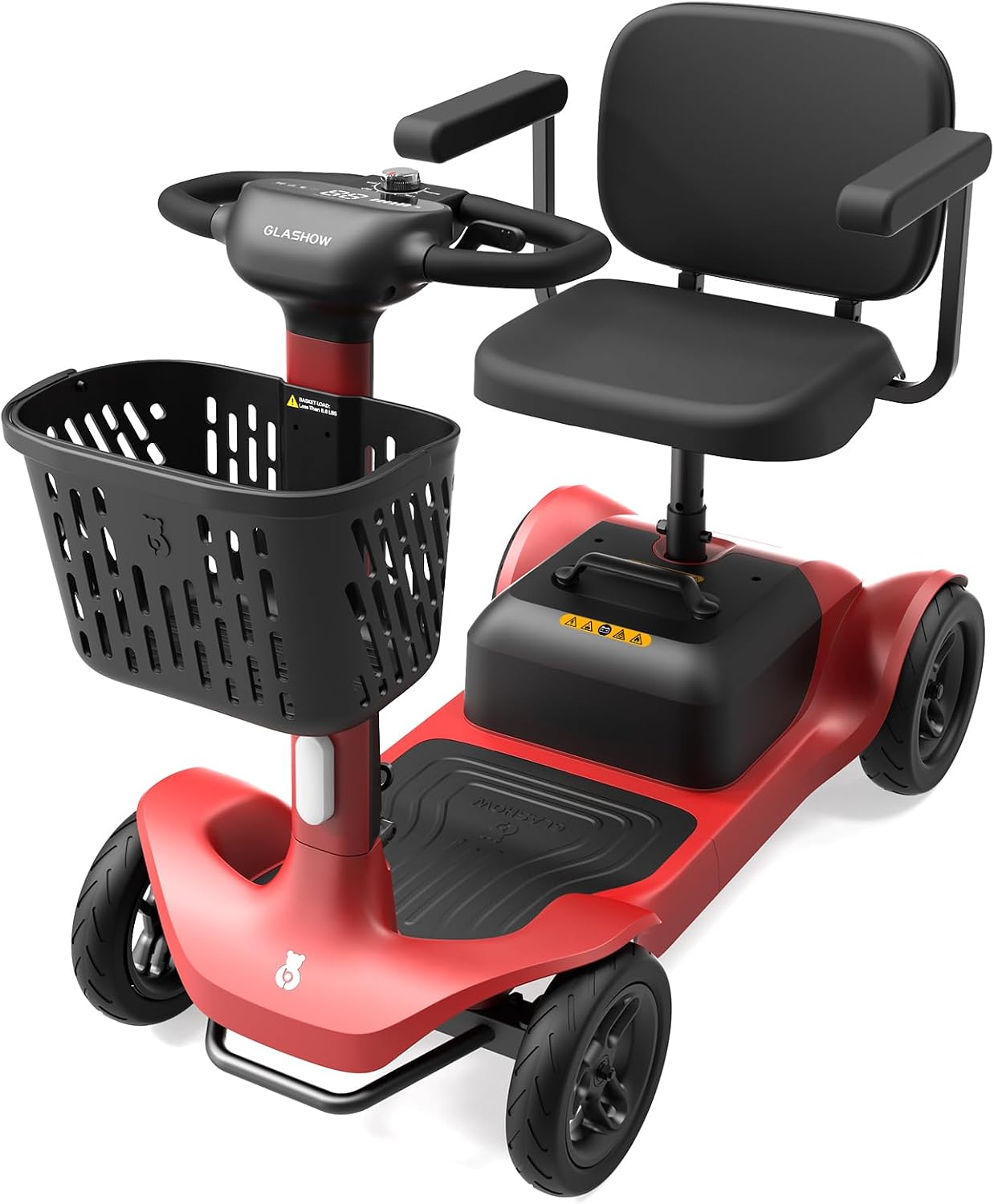
4.4★ (46 ratings) · 10″ wheels · rated ~25 mi range
Why Fort Worth: the longest rated range for the far ends of the Trinity Trails, the biggest wheels for gravel stretches and Stockyards brick, and it folds into a car for the drive to a trailhead.
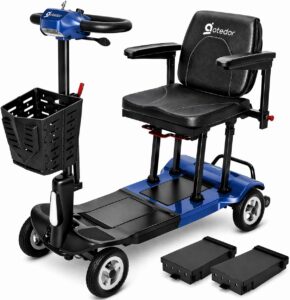
4.5★ (277 ratings) · folds compact · up to 300 lb
Why Fort Worth: light to lift into a car and easy to take on TEXRail to the airport. Its small wheels are the wrong tool for gravel or Stockyards brick, so keep it to paved trail and errands.
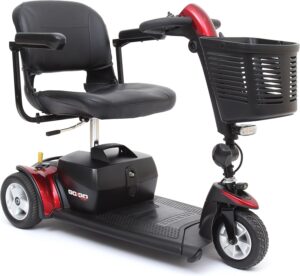
4.4★ (109 ratings) · compact · up to 325 lb
Why Fort Worth: a tight turning circle for Sundance Square shops and indoor venues. Four wheels feel steadier over trail distance and on uneven brick.
Watch: a compact travel scooter in action
An independent walkthrough of the Pride Go-Go Sport, the compact three-wheel option in the comparison above, showing the seat, tiller, disassembly and driving.
Video: Pride Go-Go Sport review by Marc’s Mobility (YouTube). Polaris Mobility is not affiliated with the reviewer.
Compare more 4-wheel models · full catalog
Fort Worth mobility scooter FAQ
Is Fort Worth a good city for a mobility scooter?
For trail riding, it is one of the best. The Trinity Trails run more than 100 miles of paved pathway along the river, linking 31 neighborhoods and 21 parks. The city is spread out and hot in summer, so a scooter here works alongside a car rather than replacing it, and the historic Stockyards district is genuinely difficult on wheels.
Can you ride a mobility scooter in the Fort Worth Stockyards?
You can get there, but set your expectations. The district is paved in historic brick with train rails set into the streets, and visitors using wheels report that the brick and rails make traveling in a straight line hard work and that many of the old buildings are difficult or impossible to enter. Wheelchairs are not available to rent in the district. Go on a quiet morning, keep your speed down, cross rails square rather than at a shallow angle, and ring ahead to the specific venues you care about.
What does it cost to use Fort Worth transit with a mobility scooter?
Trinity Metro buses are $2 a ride or $4 a day, but if you are 65 or older, have a disability, are a veteran or hold a Medicare card, it is $1 a ride and $2 a day with valid ID, and riders 65 and older get a lifetime reduced-fare photo ID card. TEXRail to DFW Airport is the same $2, or $1 reduced. On-Demand Paratransit vans are $4 one way or $40 for ten rides, and certification takes up to 21 days, so apply early on 817-215-8600.
Does Medicaid pay for a mobility scooter in Fort Worth?
Usually not directly. Texas has not expanded Medicaid, so most adults under 65 have no Medicaid route, and Medicare Part B is the usual path for those 65 and older. Tarrant County funds its own system through property tax: JPS Health Network’s Connection program gives uninsured county residents low-cost access to doctors, specialists and prescriptions, with income tiers up to 250% of the federal poverty level. It is for the uninsured rather than Medicare enrollees, and it covers care rather than equipment, but a doctor’s documentation is the first step in any equipment claim.
What is the best mobility scooter for Fort Worth?
For long, hot days on gentle paved trails, comfort and reliability matter most. Our top pick is the Golden Buzzaround EX for its comfortable seat, 330 lb capacity, highest owner rating and real service network. The Glashow S1 is the alternative if you want the biggest wheels for gravel and brick and the longest rated range for the far ends of the trail system.