
Mobility Scooters in Honolulu

Looking for a mobility scooter in Honolulu, to buy or to rent? Here is the thing worth knowing before anything else: Honolulu puts a ceiling on your fares. Most cities charge you per ride and keep charging, forever. Honolulu caps it. The City’s published TheHandi-Van fares include a monthly cap of $6.00 (after that, “fares will no longer be charged for that month”), and an annual pass of $35.00 for door-to-door paratransit. For comparison, Louisville charges $4.50 for a single one-way paratransit trip and caps nothing. This guide covers those fares (including the increase that landed on 1 July 2026, and a discrepancy you should know about), a rail system built accessible from day one, and the two things nobody tells you about owning a scooter on an island. Polaris Mobility earns a commission on qualifying Amazon purchases through links on this page.
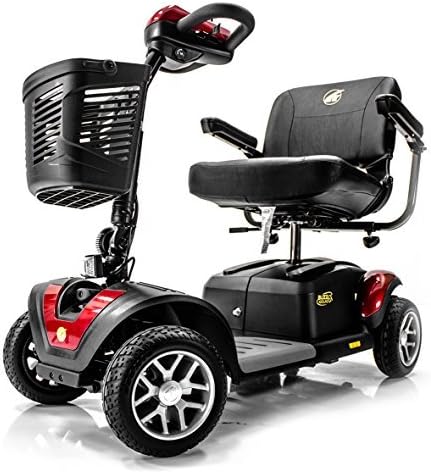
- Up to 330 lb
- Established manufacturer
- Stable 4-wheel base
- ★ 4.7 rating
On an island, the question is not which scooter is best: it is which one you can still get a part for. You are about 2,500 miles from the mainland. If something fails, a well-known manufacturer’s spares and warranty are a very different proposition from a small brand’s. Golden is an established name and this has the highest owner rating of the four here, plus the highest weight capacity. Before you order anything, read the shipping and returns terms for a Hawaii address: that advice applies to every scooter on this page, including this one.
On Medicare or Med-QUEST? Read the funding section before you pay out of pocket.
The fare has a ceiling, and that is genuinely rare
Sit with the annual pass for a second. Thirty-five dollars buys twelve months of door-to-door paratransit. That is about three dollars a month. In Louisville, two round trips a week on the equivalent service costs roughly seventy-two dollars a month, every month, with no cap at any point. Both of those are real, published fares for the same category of service. The difference is not the price of a ride: it is that Honolulu decided there should be a point at which you stop paying.
TheBus and Skyline: the senior fare
- Seniors 65 and older pay $1.25 with a Senior HOLO Card, and that includes 2.5 hours of unlimited transfers. Reporting on the July change indicates single-ride fares paid with a HOLO card were left unchanged; cash payers pay more, at $1.50 for reduced fares and $3.25 for a standard adult ride.
- The card is the thing to sort out first. A Senior HOLO Card requires proof of age and a government-issued photo ID, and is issued at Satellite City Halls or the Transit Pass Office. Replacement cards cost $2.00.
- Caps here too, for residents. For kamaʻāina (resident) seniors, TheBus lists a Month Cap of $20.00, a Month Pass at $20.00, and an Annual Pass at $45.00 (TheBus).
- Do the arithmetic once. If you are 65+ and living here, $45 a year on the bus and $35 a year on Handi-Van is the whole transport budget. That is the number that should be shaping your decision about buying a scooter, not the price of a single ride.
Skyline: built accessible, not retrofitted
Older systems were built long before anyone thought about a wheelchair, and it shows: New Orleans runs three accessible streetcars on a historic line with twelve stops that will take you. Skyline is the other case entirely: a new system where level boarding, lifts to every platform and fare gates wide enough for a mobility device were designed in rather than bolted on. There is nothing to arrange and nobody to ask.
- For sight and hearing too: braille signage with tactile raised letters in large print, texture changes and tactile platform edges at gate openings, audio announcements, electronic message signs, and visual system and neighborhood maps.
- Connections: the City lists connections with TheBus, Handi-Van, and passenger drop-off and pickup points. It does not publish a Handi-Van service radius around stations on that page, so ask when you book rather than assuming.
- Mobility device size and weight limits are not stated on the accessibility page. If your scooter is on the large side, ring before your first trip.
Two things nobody tells you about a scooter on an island
First: the ocean is trying to eat your scooter. Salt air and constant humidity are hard on metal, bearings and electrical contacts in a way they simply are not in Denver. That is not a reason to avoid a scooter here: it is a reason to treat it like something that lives by the sea. Keep it indoors rather than on a lanai. Wipe it down after beachfront rides. Keep the charging port and connectors dry and clean. Look at the frame fixings and under the seat every few months rather than waiting for something to seize. None of that is exotic; it is just not optional here.
Second, and more important: check the shipping before you fall in love with a model. You are 2,500 miles from the mainland. Before ordering any scooter to a Hawaii address, check what the seller actually charges to ship here, whether they ship at all, what a return would cost you, and, the one people forget, what the warranty means in practice when the nearest service center is an ocean away. A warranty you can only use by freighting a scooter to California is a different product from the one advertised.
That is the honest reason our top pick leans on brand rather than specification here. On the mainland you can weigh range against wheel size and let the service network be an afterthought. In Honolulu, the question that will actually bite you in year two is whether a part exists and whether anyone will send it. That favors the established manufacturer with the most satisfied owners, and it favors asking the questions above before you buy, not after.
Renting vs. buying a mobility scooter in Honolulu
Honolulu has a large visitor rental market, so renting for a trip is genuinely easy here, and given the shipping question above, renting is a more reasonable option for visitors than it is in most cities.
- Keeps costing you. A travel scooter runs roughly $100 to $200 a week depending on model and city (Scootaround), so a month of regular use is several hundred dollars.
- You hand it back, and it never becomes yours.
- Not fitted or sized to you; you take whatever model is free.
- But: nothing to ship, and the salt air is somebody else’s problem.
- Pays for itself fast if you live here; after a few weeks of what renting costs you are ahead, and you keep the scooter.
- Pairs with the cheapest fares you will find: $45 a year on the bus, $35 a year on Handi-Van, if those published prices hold.
- Sized to you, charged, and ready without a booking.
- Check shipping, returns and warranty for a Hawaii address first.
Bottom line: if you are visiting, rent: this is one of the few cities where we would say that without hedging, because shipping a scooter across an ocean for a fortnight makes no sense. If you live here, buy, and buy the one you can still get parts for in three years.
How to pay: Medicare and Med-QUEST
If you are 65 or older, Medicare is your route. Part B may cover a scooter if a doctor confirms you need it to move around your home and you can operate one safely, through a supplier that accepts Medicare (Medicare.gov). In a city where more than one resident in five is 65 or over, this is the main road.
Hawaii’s Medicaid program is the Med-QUEST Division, and its managed care program is called QUEST Integration (Med-QUEST). Medicaid can pay for medically necessary equipment such as a power wheelchair or scooter when a doctor documents the need and it is supplied through an enrolled provider.
What we are not going to do is tell you what Med-QUEST covers. Its members and applicants page does not publish eligibility criteria, income limits, covered benefits or a phone number, it links out to them. Rather than paraphrase a page we have not verified, we will tell you the honest thing: contact Med-QUEST directly, ask specifically about durable medical equipment, and ask which suppliers your plan will authorize. Because these programs work through approved suppliers, a scooter bought on Amazon is a separate out-of-pocket purchase. Confirm current criteria directly, as they change.
Comparing options across the state? Our Hawaii mobility scooter guide covers statewide Medicaid and Medicare details, the best models for the local climate and terrain, and how the picture changes from city to city.
Who needs mobility support in Honolulu
Honolulu is old, and not by a little. 21.7% of Urban Honolulu residents are 65 or older (75,262 people out of 346,323) against Hawaii’s 19.9% and a national 16.8%. More than one resident in five (U.S. Census Bureau, ACS 2023, 5-year).
And then the number that makes Honolulu genuinely unusual: only 12.5% of residents report a disability: the same as Hawaii as a whole, and below the national 13.0%. Read those two facts together. This is a strikingly old population that is also, by this measure, a notably healthy one. Age and disability normally travel together; here they come apart. Whatever the reason, the practical upshot for a reader is encouraging: being 65 in Honolulu does not carry the same odds it carries in Kentucky, where 17.7% of the state reports a disability.
Best mobility scooters for Honolulu (2026)
Picks weighted for island reality: parts you can actually get, salt air, flat beachfront paths and a rail system you roll straight onto. Specs are per manufacturer listings; confirm current details, price and Hawaii shipping on Amazon.
| Model | Wheels | Max rider | Top speed | Owner rating |
|---|---|---|---|---|
| Golden Buzzaround EX ★ Top pick | 9″ (4-wheel) | 330 lb | 5.0 mph | 4.7★ (verified) |
| Pride Go-Go Sport Also a major brand | 3-wheel | 325 lb | 4.7 mph | 4.4★ (109) |
| Aotedor Lightweight | 7″ | 300 lb | 3.7 mph | 4.5★ (277) |
| Glashow S1 Folding | 10″ (4-wheel) | 265 lb | 6.2 mph | 4.4★ (46) |
4.7★ (verified owners) · 9″ wheels · up to 330 lb
Why Honolulu: an established manufacturer and the highest owner rating here, which on an island matters more than any specification, because the real question is whether a part will ever reach you.
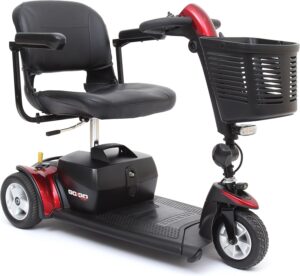
4.4★ (109 ratings) · compact · up to 325 lb
Why Honolulu: Pride is another well-established name, so the same parts argument applies. It breaks down into pieces, which also makes it the easiest of these to store indoors away from the salt air.
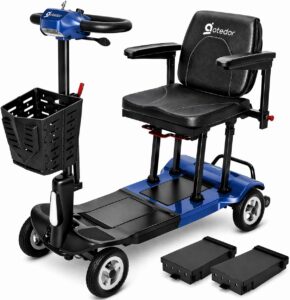
4.5★ (277 ratings) · folds compact · up to 300 lb
Why Honolulu: the most owner ratings of the four and the easiest to fold and carry indoors, which is exactly what salt air asks of you. Flat beachfront paths mean you never miss the bigger wheels.
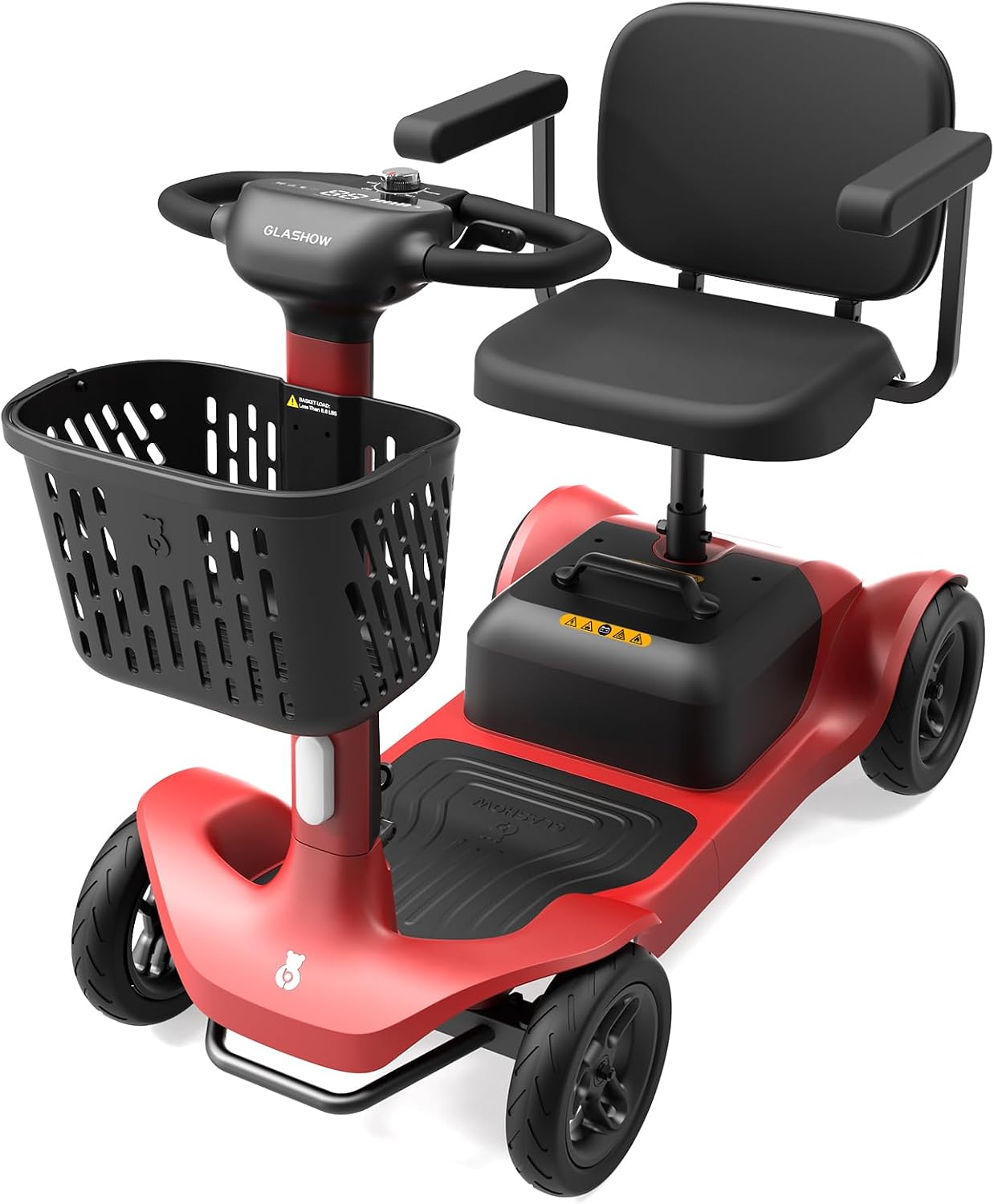
4.4★ (46 ratings) · 10″ wheels · rated ~25 mi range · 265 lb limit
Why Honolulu: the longest range here, though on a compact flat island you may never need it. With the fewest owner ratings of the four, ask hardest about parts and warranty before shipping this one across an ocean. Check the 265 lb limit.
Watch: our top pick in action
An independent walkthrough of the Golden Buzzaround EX, our top pick above, showing the four-wheel frame, seat, controls and how it comes apart to transport.
Video: Golden Buzzaround EX review (YouTube). Polaris Mobility is not affiliated with the reviewer.
Compare more 4-wheel models · full catalog
Honolulu mobility scooter FAQ
How much does TheHandi-Van cost in Honolulu?
The City publishes a single fare of $2.25 paid at boarding with a valid TheHandi-Van HOLO Card, a Month Cap of $6.00 (after which “fares will no longer be charged for that month”) a Monthly Pass at $6.00, an Annual Pass at $35.00 valid for 12 months or until your eligibility expires, and a Single Low Income Fare of $2.00. Note a discrepancy: the Honolulu Star-Advertiser reported that fare increases approved by the City Council on a 6-3 vote in January 2026 took effect on 1 July 2026, taking TheHandi-Van’s one-way fare from $2.25 to $2.50, but the City’s own fares page still showed $2.25 at the time of writing. Confirm current prices on 808-768-4656 before relying on them.
How much is the bus for seniors in Honolulu?
Seniors 65 and older pay $1.25 with a Senior HOLO Card, including 2.5 hours of unlimited transfers; reporting on the July 2026 increase indicates single-ride fares paid with a HOLO card were unchanged, while cash payers pay $1.50 for reduced fares and $3.25 for a standard adult ride. The Senior HOLO Card needs proof of age and a government-issued photo ID and is issued at Satellite City Halls or the Transit Pass Office, with replacement cards costing $2.00. For kāmaʻāina seniors, TheBus lists a Month Cap and Month Pass of $20.00 and an Annual Pass of $45.00.
Is Skyline accessible for a mobility scooter?
Yes, and it was designed that way rather than retrofitted. The City describes level boarding with a standard ADA compliant 3-inch gap between platform and train door, elevator access from ground level to each elevated platform with large-cab glass-walled elevators, designated areas in train cars reserved for wheelchair users, and ADA accessible fare gates for mobility devices at all stations. There are also braille signage with tactile raised letters, tactile platform edges, audio announcements and electronic message signs. Mobility device size and weight limits are not stated on the accessibility page, so call ahead if your scooter is large.
Should I ship a mobility scooter to Hawaii or rent one?
If you are visiting, renting usually makes more sense here than in most cities: there is a large rental market, nothing to ship, and the salt air is somebody else’s problem. If you live here, buying wins quickly, but check three things before you order: what the seller charges to ship to a Hawaii address and whether they ship at all, what a return would cost, and what the warranty actually means when the nearest service center is an ocean away. That last point is why we weight an established manufacturer over specifications for this city.
Does salt air damage a mobility scooter?
Salt air and constant humidity are harder on metal, bearings and electrical contacts than a dry mainland climate, so treat the scooter as something that lives by the sea: store it indoors rather than on a lanai, wipe it down after beachfront rides, keep the charging port and connectors clean and dry, and check frame fixings and the area under the seat every few months rather than waiting for something to seize.
What is the best mobility scooter for Honolulu?
Our top pick is the Golden Buzzaround EX. On an island the deciding question is not range or wheel size but whether you can get a part in year two, and Golden is an established manufacturer with the highest owner rating of the four here and the highest weight capacity at 330 lb. The Pride Go-Go Sport is another major brand with the same advantage and breaks down for indoor storage. Whichever you choose, check the Hawaii shipping, returns and warranty terms before ordering.