
Mobility Scooters in Little Rock

Looking for a mobility scooter in Little Rock, to buy or to rent? Two numbers frame this page. 17.8% of Arkansans report a disability: nearly one in five, and nearly five points above the national rate. And 18,000: the number of people this state removed from Medicaid in about six months, when Arkansas became, on the research record, the only state to actually take Medicaid coverage away from people under a work-reporting requirement before a federal court stopped it. The research on what happened next is the single most useful thing we can hand a reader who is old, ill, or offline, because the people who lost coverage mostly were not people refusing to work. This guide covers that, the 65-cent bus fare, the $5.40 van, and the scooter that suits a city where a lot of people are paying for one themselves. Polaris Mobility earns a commission on qualifying Amazon purchases through links on this page.
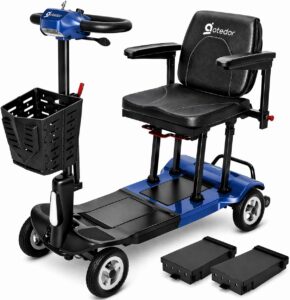
- Folds compact
- Up to 300 lb
- ★ 4.5 rating (277)
- Lightest here
We pick for the reader in front of us, and in Arkansas that reader is often paying for this themselves, because coverage in this state has been demonstrably precarious, and because the discount bus is 65 cents while the van is $5.40 a round trip. So the job is not a twenty-mile expedition; it is getting to the stop and back, affordably, for years. This is the cheapest and lightest of the four, has by far the most owner ratings, and folds to go indoors. If you need a bigger seat or more capacity, the Buzzaround below is the upgrade worth saving for.
On Medicare or Arkansas Medicaid? Read the funding section before you pay out of pocket.
The state that ran the experiment
Now the part that should matter to you, and it is not the politics. A 2019 study found the requirement “did not achieve the goal of promoting employment among low-income Arkansans”. And when researchers looked at why people lost coverage, the reasons were not defiance. They were “difficulties the state encountered in contacting the enrollees, enrollees’ confusion over what was required of them, and challenges that enrollees encountered in navigating the state’s online portal”: alongside limited broadband access, unclear communication and transportation problems.
Why we are telling you this in 2026 rather than as history. Arkansas’s rule is not in force, the courts ended it. But the idea did not die with it. Utah had a community engagement requirement approved and then withdrawn by CMS in August 2021. Kentucky is going the other way right now, writing community engagement requirements into state law over its governor’s veto. If you live in a state that adopts one, Arkansas is the only place that has run the experiment on real people, and the lesson from it is administrative, not moral: whatever the rule says, keep your address current, open every letter, and get help with the portal before the deadline rather than after it.
Sixty-five cents, and a van at four times the price
| Fare | Standard | Discount |
|---|---|---|
| One way (fixed route) | $1.35 | $0.65 |
| 10-ride pass | $11.50 | $5.75 |
| 31-day pass | $36.00 | $18.00 |
| Day pass | $3.75 | |
| METRO Links paratransit | $2.70 one way · $5.40 round trip · 10-ride $25 | |
The discount is generous and the list of who gets it is wide: “persons with disabilities, persons 65 and older, Medicare recipients, students… and instructors who provide transit training to riders”. At $18.00, the discount 31-day pass pays for itself in about fourteen rides: a return trip a week and a half (Rock Region METRO).
- Where it goes: METRO Links serves origins and destinations within three-quarters of a mile of a non-express fixed bus route. Outside that band, the answer is no.
- Getting on it: eligibility is determined by Rock Region METRO through a confidential application process. Start it before you need it.
- The discount needs paperwork too: discount applications are required, so sort the card out on a good day rather than at the farebox on a bad one.
Renting vs. buying a mobility scooter in Little Rock
Run this against the van, not the bus. That is the honest comparison for anyone who cannot walk to a stop.
- Keeps costing you. A travel scooter runs roughly $100 to $200 a week depending on model and city (Scootaround), so a month of regular use is several hundred dollars.
- You hand it back, and it never becomes yours.
- Not fitted or sized to you; you take whatever model is free.
- Delivery windows, deposits and return deadlines to plan around.
- Pays for itself fast. A one-time purchase; after a few weeks of what renting costs you are ahead, and you keep the scooter.
- It turns a $5.40 round trip into a 65-cent one, because it gets you to the stop.
- No application, no certification, no three-quarter-mile corridor, and no exact change.
- Spread the cost. Many scooters offer monthly payments at checkout or through your card.
Bottom line: buy if you live here, and do not over-buy. In a state where nearly one person in five reports a disability and coverage has been proven to be fragile, the sensible machine is the affordable one that will still be working in three years, not the one with specifications you will never use.
How to pay: Medicare and Arkansas Medicaid
If you are 65 or older, Medicare is your route. Part B may cover a scooter if a doctor confirms you need it to move around your home and you can operate one safely, through a supplier that accepts Medicare (Medicare.gov). Medicare is not affected by any of the state history above: that fight was about Medicaid expansion for adults under 65.
If you are under 65 on a low income, Arkansas covers people through a premium-assistance model: the state uses Medicaid funding to buy coverage for low-income adults through the Health Insurance Marketplace, rather than enrolling them in a conventional Medicaid plan. Medicaid programs generally can pay for medically necessary equipment such as a power wheelchair or scooter when a doctor documents the need and an enrolled provider supplies it, but because Arkansas routes people through marketplace plans, what your plan covers and which suppliers it authorizes is a question for your plan, not for us. Ask specifically about durable medical equipment.
Because these programs work through approved suppliers, a scooter bought on Amazon is a separate out-of-pocket purchase: which, in this state, is exactly the position a great many people find themselves in. Confirm current criteria directly, as they change.
Comparing options across the state? Our Arkansas mobility scooter guide covers statewide Medicaid and Medicare details, the best models for the local climate and terrain, and how the picture changes from city to city.
Who needs mobility support in Little Rock
Little Rock itself looks ordinary. 15.2% of residents are 65 or older (30,778 people out of 202,739) against a national 16.8%, and 13.9% report a disability, close to the national 13.0% (U.S. Census Bureau, ACS 2023, 5-year).
The state around it does not look ordinary at all. 17.3% of Arkansans are 65 or older, and 17.8% report a disability: nearly one person in five, and almost five points above the national rate. Little Rock is the young, comparatively healthy exception inside a state carrying one of the heaviest disability burdens in the country. That gap is the whole story of this page: the city has the buses and the paratransit vans and the 65-cent fare; the rest of Arkansas has the disability. And it was the rest of Arkansas (the people the state could not reach, who could not work the portal, who had no broadband) who lost coverage in 2018.
Best mobility scooters for Little Rock (2026)
Picks weighted for short trips to a cheap bus, Arkansas humidity, and a budget that is often your own. Specs are per manufacturer listings; confirm current details and price on Amazon.
| Model | Wheels | Max rider | Top speed | Owner rating |
|---|---|---|---|---|
| Aotedor Lightweight ★ Top pick | 7″ | 300 lb | 3.7 mph | 4.5★ (277) |
| Golden Buzzaround EX The upgrade | 9″ (4-wheel) | 330 lb | 5.0 mph | 4.7★ (verified) |
| Pride Go-Go Sport | 3-wheel | 325 lb | 4.7 mph | 4.4★ (109) |
| Glashow S1 Folding | 10″ (4-wheel) | 265 lb | 6.2 mph | 4.4★ (46) |
4.5★ (277 ratings) · folds compact · up to 300 lb
Why Little Rock: the cheapest of the four and the most owner-reviewed by a distance, and it folds to go indoors. The job here is getting to a 65-cent bus, not crossing the county, buy accordingly.
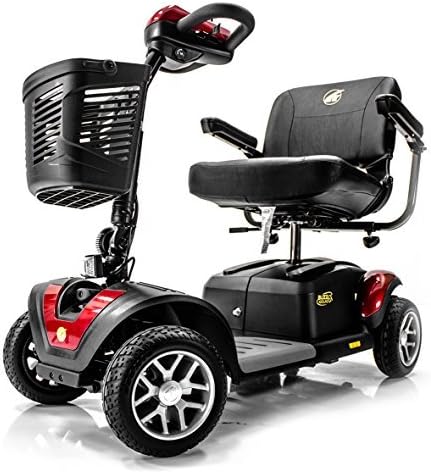
4.7★ (verified owners) · 9″ wheels · up to 330 lb
Why Little Rock: the highest owner rating and 330 lb of capacity, with a real service network and a seat built for humid afternoons. The one to save for if the Aotedor is too small.
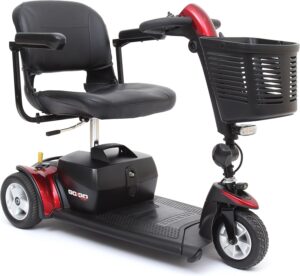
4.4★ (109 ratings) · compact · up to 325 lb
Why Little Rock: 325 lb and it breaks down for a car trunk, from a well-established maker. A sensible middle if the Aotedor is too small but the Buzzaround is too much.
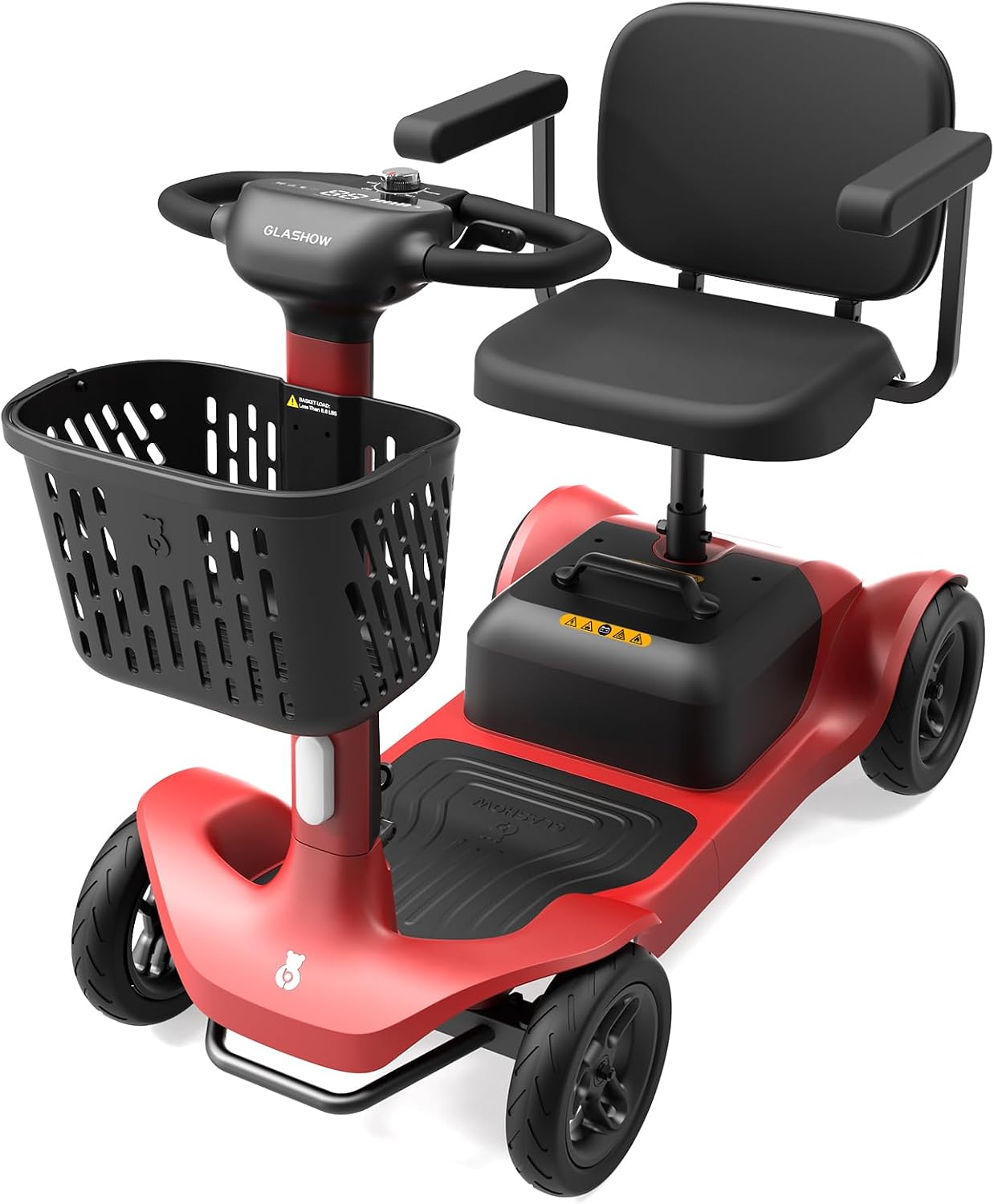
4.4★ (46 ratings) · 10″ wheels · rated ~25 mi range · 265 lb limit
Why Little Rock: the longest range and biggest wheels if you live away from a bus route and must cover the distance yourself. Check the 265 lb limit, the lowest here.
Watch: the Pride Go-Go Sport reviewed
An independent walkthrough of the Pride Go-Go Sport, the compact middle option in the comparison above: showing how a travel scooter comes apart to transport.
Video: Pride Go-Go Sport review (YouTube). Polaris Mobility is not affiliated with the reviewer.
Compare more 4-wheel models · full catalog
Little Rock mobility scooter FAQ
How much is the bus for seniors in Little Rock?
Sixty-five cents. Rock Region METRO charges $0.65 for a discount one-way fare against a standard $1.35, and the discount list is wide: “persons with disabilities, persons 65 and older, Medicare recipients, students… and instructors who provide transit training to riders.” A discount 10-ride pass is $5.75 against $11.50, and a discount 31-day pass is $18.00 against $36.00, which pays for itself in about fourteen rides. Discount applications are required, so sort the card out in advance.
How much does METRO Links paratransit cost?
$2.70 one way and $5.40 for a round trip, with a 10-ride pass at $25: more than four times the 65-cent discount bus fare, charged to people whose disability prevents them using the fixed-route bus. Two round trips a week is roughly $43 a month against $18 for the discount bus pass. METRO Links serves origins and destinations within three-quarters of a mile of a non-express fixed route, eligibility is decided through a confidential application process, and exact change is required on the vans.
What happened with Arkansas’s Medicaid work requirement?
Arkansas is the only state that actually took coverage away from people under a work-reporting requirement before a court stopped it. It began phasing the rule in during June 2018, and “by the end of 2018, more than 18,000 people had been disenrolled from Arkansas’ Medicaid expansion program for noncompliance.” In March 2019 a federal judge ruled the requirement did not promote the objectives of the Medicaid program and it was halted; the US Court of Appeals for the DC Circuit later upheld that ruling. A 2019 study found it “did not achieve the goal of promoting employment among low-income Arkansans.”
Why did people actually lose coverage in Arkansas?
Mostly paperwork, not refusal to work. Researchers pointed to “difficulties the state encountered in contacting the enrollees, enrollees’ confusion over what was required of them, and challenges that enrollees encountered in navigating the state’s online portal,” together with limited broadband access, unclear communication and transportation problems. That list describes an older person with a disability in a rural state, which is why the practical lesson, wherever you live, is administrative: keep your address current with the agency, open every letter, and get help with any online portal before the deadline rather than after it.
What is the best mobility scooter for Little Rock?
Our top pick is the Aotedor Ultra Lightweight. In a state where nearly one person in five reports a disability and coverage has proved fragile, a lot of people here are buying a scooter with their own money, and the job in Little Rock is getting to a 65-cent bus and back, not crossing the county. The Aotedor is the cheapest and lightest of the four, has by far the most owner ratings, and folds to go indoors. If you need a bigger seat or more capacity, the Golden Buzzaround EX at 330 lb is the upgrade worth saving for.