
Mobility Scooters in Memphis

Looking for a mobility scooter in Memphis, to buy or to rent? Memphis is the rare American city where public transport is currently free: MATA has run a Zero Fare pilot since 16 November 2025, and it covers buses, the trolley and MATAplus paratransit. That is genuinely good news, and this guide will tell you how to use it. But it comes with two honest catches, and no guide worth reading would bury them. The free fare has no end date and gets re-decided every 45 to 90 days. And MATA’s own most recent published figure puts peak on-time performance at 71%. A free ride that does not turn up is not a bargain. This guide gives you the fares as they stand, what waits behind the pilot, how MATAplus actually works, the funding routes in Tennessee, and the models that suit Memphis. Polaris Mobility earns a commission on qualifying Amazon purchases through links on this page.
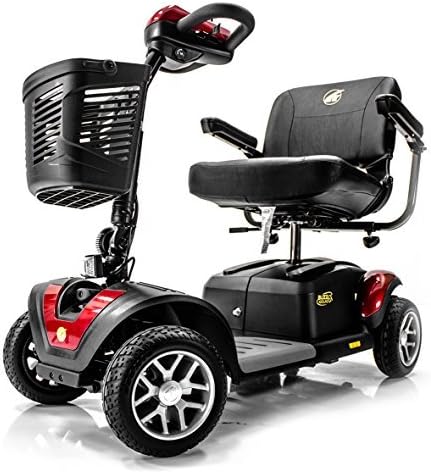
- Up to 330 lb
- Real brand service network
- Stable 4-wheel base
- ★ 4.7 rating
Pick a scooter for the job it actually has here. In a city where the transit agency’s own peak on-time figure is 71%, your scooter is not a convenience that supplements the bus: it is the thing you fall back on when the bus does not come. That changes the buying question from “which is cheapest” to “which one will still be working in two years, and who fixes it”. This has the highest owner rating here, the highest weight capacity, and a real manufacturer service network behind it. Riding mostly downtown and on the trolley? The lighter Aotedor below is a fair alternative.
On Medicare or TennCare? Read the funding section before you pay out of pocket.
The fare is zero, and it is re-decided every few weeks
Now the honest part. This is a pilot, not a policy. It began as a 90-day experiment and has been extended repeatedly in short increments: first to mid-February 2026, then by 45 days to 31 March 2026, then by a further 90 days to 29 June 2026. MATA’s own page currently gives no end date at all, saying only that once its evaluation is complete it “will make a determination on the future of Zero Fare and will communicate any changes clearly and well in advance”.
It is worth saying what the pilot has actually done, because it is not nothing: MATA reports more than 1.5 million trips taken under Zero Fare, saving riders nearly $2.5 million.
What waits behind the pilot
If and when fares resume, these are the prices MATA still posts. They are modest, and the senior rate is a straight halving.
| Fare | Standard | Senior 65+ / disabled |
|---|---|---|
| Base fare (bus) | $1.00 | $0.50 |
| Daily Fast Pass | $2.00 | $1.00 |
| MATAplus paratransit base fare | $2.00 (in the fixed-route service area) | |
| 21-Ride MATAplus Pass | $45.00 | |
| Main Street Trolley | $1.00 each way | |
- Medicare card = no application. MATA states that people with a Medicare card and valid photo ID may be approved immediately for half-price fares without completing a disability application. If you are on Medicare, that is the shortest paperwork route on this page.
- 7-day and 31-day passes are currently not available, per MATA’s fares page. Do not plan around a monthly pass here.
The part nobody advertises: will it turn up?
This is the single most useful thing to understand about getting around Memphis on wheels, so let us be plain about what it means rather than tutting at it. A fare of zero is a real saving. But a trip that does not run costs you the appointment, not the dollar. If roughly three in ten buses are outside their on-time window even at peak, then the bus is something you use when it works, not something you depend on when it matters.
That is not an argument for despair, and it is not an argument for a car you cannot afford. It is a specific, practical argument for the thing this site is about: in Memphis, your own scooter is not a luxury layered on top of good transit, it is the layer underneath it. The free bus becomes a bonus you take when it shows, rather than the plan that collapses when it does not.
MATAplus: how it actually works
MATAplus is the door-to-door paratransit service, and it is free right now under Zero Fare. Getting on it is the slow part. Start the application before you need it, not the week you do.
- Three eligibility categories, in MATA’s own wording. Category I: “Applicants who cannot independently use MATA bus or trolley service, even with training.” Category II: “Applicants who can use or learn to use an accessible public transit system, but the system is not fully accessible.” Category III: “Applicants who have a specific impairment that prevents them from getting to or from a bus stop or trolley station.” Category III is the one people most often assume does not apply to them and it does: it covers the gap between your door and the stop.
- Four steps to certify. Complete the MATAplus Certification Application and Medical Verification form; call 901.322.4080 to schedule an interview and assessment; attend a face-to-face interview (a Compliance Specialist takes your photo); and complete a functional assessment. MATA states you may be granted certification within twenty-one (21) days following the interview and assessment.
- Booking window. Reservations run from three days ahead up to the day before you travel. This is not a same-day service.
- Service area. MATA states paratransit is only available in Memphis and Shelby County.
- General enquiries: (901) 274-MATA (6282).
The Main Street Trolley: plan for the hour
An hourly headway is the fact to plan around. On a sixty-minute frequency, a missed trolley is not an inconvenience, it is the rest of your morning, and it means the trolley is best treated as a scenic way to cover Main Street when the timing happens to suit you, not as the spine of your day. On your own scooter, Main Street is simply rideable, on your schedule.
Renting vs. buying a mobility scooter in Memphis
The reliability picture pushes this decision harder than it does in most places. What you are really buying is a trip that happens when you say it happens.
- Keeps costing you. A travel scooter runs roughly $100 to $200 a week depending on model and city (Scootaround), so a month of regular use is several hundred dollars.
- You hand it back, and it never becomes yours.
- Not fitted or sized to you; you take whatever model is free.
- Delivery windows, deposits and return deadlines to plan around.
- Pays for itself fast. A one-time purchase; after a few weeks of what renting costs you are ahead, and you keep the scooter.
- It runs on your timetable, not a 71% one. That is the whole argument in this city.
- Spread the cost. Many scooters offer monthly payments at checkout or through your card, so it need not be one big hit.
- Comes with a manufacturer warranty and keeps resale value.
Bottom line: rent for a trip; buy if you live here. Free transit plus your own scooter is genuinely a strong combination in Memphis. Take the free ride when it turns up, and never be stranded when it does not.
How to pay: Medicare, TennCare, and the CHOICES route
If you are 65 or older, Medicare is your first route. Part B may cover a scooter if a doctor confirms you need it to move around your home and you can operate one safely, through a supplier that accepts Medicare (Medicare.gov).
The limits are strict, and you should know them before you hope. For 2026 the income limit is $2,982 per month: three times the SSI federal benefit limit, and it changes annually. The asset limit is harsher: the total value of things you own cannot be more than $2,000, and you cannot have given away or sold anything for less than it was worth in the last five years. That five-year look-back catches people who transferred a house to family and assumed it was long forgotten.
What we are not going to tell you is that CHOICES buys you a scooter. TennCare’s CHOICES page does not list its covered services in full, it points to a separate CHOICES Benefit Table, so anyone promising you a specific piece of equipment from that program is guessing. Equipment such as a power wheelchair or scooter is normally handled through TennCare’s durable medical equipment benefit, with a doctor documenting medical necessity and an enrolled supplier providing it. Ask directly, and ask about both routes.
- Area Agencies on Aging and Disability: 1-866-836-6678. Call from anywhere in the state and you are directed to your nearest agency. This is the right first call for most people.
- LTSS Help Desk: 1-877-224-0219.
- Already a TennCare member? Call your plan: BlueCare 888-747-8955, United Healthcare Community Plan 800-690-1606, Wellpoint 833-731-2153.
Because these programs work through approved suppliers, a scooter bought on Amazon is a separate out-of-pocket purchase: which, given a $2,000 asset limit, is exactly the position a great many Memphis buyers find themselves in. Confirm current criteria directly, as they change.
Comparing options across the state? Our Tennessee mobility scooter guide covers statewide Medicaid and Medicare details, the best models for the local climate and terrain, and how the picture changes from city to city.
Who needs mobility support in Memphis
14.1% of Memphis residents are 65 or older (88,932 people out of 629,063) against 16.8% across Tennessee and 16.8% nationally (U.S. Census Bureau, ACS 2023, 5-year). Memphis is a younger city than the state around it.
On disability the gap runs the same way but smaller: 13.6% of Memphians report a disability, against 15.0% across Tennessee and 13.0% nationally. Memphis sits close to the national rate while its state runs two points above it. The practical reading is that the demand here is not extraordinary by the numbers: what is extraordinary is the gap between that ordinary demand and a transit system running at 71% on-time. Roughly 89,000 older Memphians and a comparable number of residents with disabilities are relying on a network its own operator describes as rebuilding.
Best mobility scooters for Memphis (2026)
Picks that suit a rider who cannot fully rely on the bus, long flat riverfront distances and Mid-South heat, durability and support first. Specs are per manufacturer listings; confirm current details and price on Amazon.
| Model | Wheels | Max rider | Top speed | Owner rating |
|---|---|---|---|---|
| Golden Buzzaround EX ★ Top pick | 9″ (4-wheel) | 330 lb | 5.0 mph | 4.7★ (verified) |
| Glashow S1 Folding Best range | 10″ (4-wheel) | 265 lb | 6.2 mph | 4.4★ (46) |
| Aotedor Lightweight | 7″ | 300 lb | 3.7 mph | 4.5★ (277) |
| Pride Go-Go Sport | 3-wheel | 325 lb | 4.7 mph | 4.4★ (109) |
4.7★ (verified owners) · 9″ wheels · up to 330 lb
Why Memphis: when the bus is the unreliable half of your plan, the scooter has to be the reliable half. Highest owner rating and highest capacity here, with a manufacturer service network behind it, and a comfortable seat for Mid-South humidity.
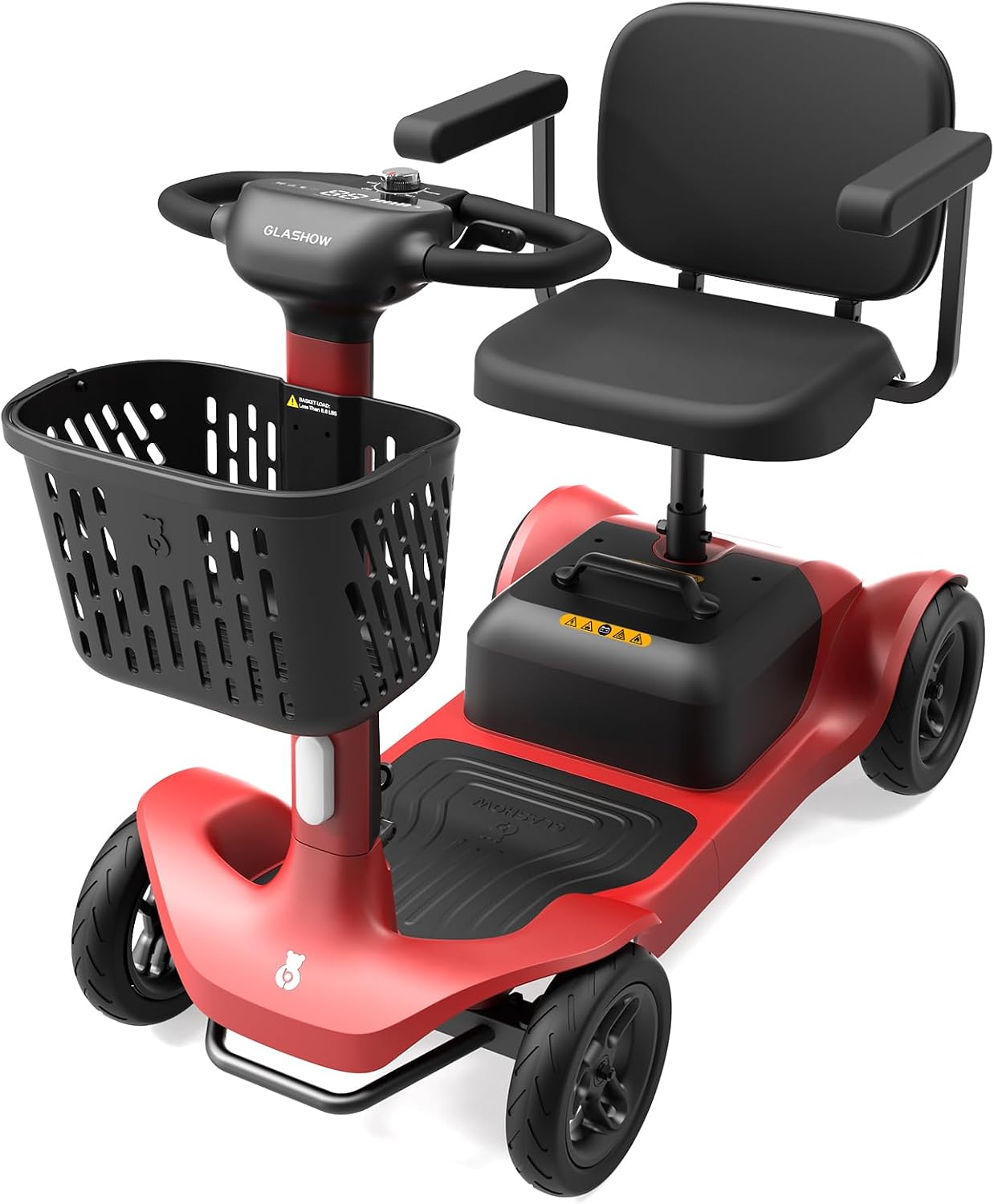
4.4★ (46 ratings) · 10″ wheels · rated ~25 mi range · 265 lb limit
Why Memphis: the longest rated range here, which is what you want if a no-show bus means riding it yourself. Big wheels suit the riverfront. Check the 265 lb limit, the lowest of the four.
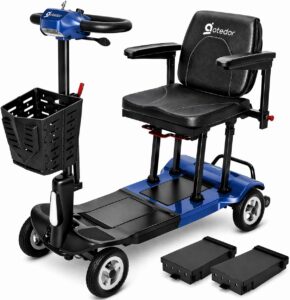
4.5★ (277 ratings) · folds compact · up to 300 lb
Why Memphis: the easiest to fold into a trunk or a friend’s car: which, when a bus does not arrive, is the lift home you actually get offered. Shortest legs of the four.
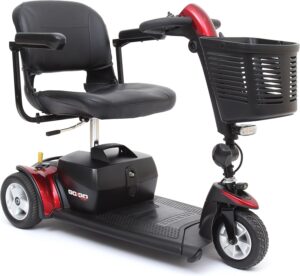
4.4★ (109 ratings) · compact · up to 325 lb
Why Memphis: a tight turning circle for Beale Street crowds and downtown corners, and it comes apart for a car. Four wheels feel steadier over long riverfront distances.
Watch: our top pick in action
An independent walkthrough of the Golden Buzzaround EX, our top pick above, showing the four-wheel frame, seat, controls and how it comes apart to transport.
Video: Golden Buzzaround EX review (YouTube). Polaris Mobility is not affiliated with the reviewer.
Compare more 4-wheel models · full catalog
Memphis mobility scooter FAQ
Is the bus really free in Memphis?
At the time of writing, yes. MATA launched a Zero Fare Pilot Program on 16 November 2025 and its own page states all rides are currently at no cost across fixed-route buses, the downtown trolleys and MATAplus paratransit: free door-to-door paratransit is the unusual part. But it is a pilot, not a policy: it began as a 90-day experiment and has been extended in short increments, to 31 March 2026 and then by a further 90 days to 29 June 2026. MATA’s page currently names no end date, saying only that it will make a determination once its evaluation is complete and communicate changes well in advance. Confirm on (901) 274-MATA (6282) before you travel.
How much is the bus for seniors in Memphis if fares come back?
MATA still posts a $1.00 adult base fare and a $0.50 fare for seniors aged 65 and over and people with disabilities, a straight halving. The Daily Fast Pass is $2.00, or $1.00 at the senior and disabled rate. MATAplus paratransit posts a $2.00 base fare in the fixed-route service area, with a 21-Ride MATAplus Pass at $45.00, and the Main Street Trolley is $1.00 each way. If you have a Medicare card and valid photo ID, MATA says you may be approved immediately for half-price fares without completing a disability application. Note that 7-day and 31-day passes are currently not available.
Is MATA reliable?
By its own most recent published figure, not yet. In June 2026 MATA reported a peak on-time performance of 71%, and peak is the best window rather than the average. The agency says it is rebuilding: it reported hiring 33 operators since March, leaving 86% of operator positions filled, and adding 12 new buses, along with 15 new paratransit vehicles placed into service and another 24 paratransit vans planned. The practical takeaway for a scooter rider is to treat the free bus as a bonus when it arrives rather than the plan that fails when it does not.
How do I get on MATAplus paratransit in Memphis?
Start before you need it. There are three eligibility categories: people who cannot independently use MATA bus or trolley service even with training; people who can use an accessible system but the system is not fully accessible; and people with a specific impairment that prevents them getting to or from a stop or station. Certification takes four steps: the application and medical verification form, then calling 901.322.4080 to schedule an interview and assessment, a face-to-face interview where a Compliance Specialist takes your photo, and a functional assessment. MATA says you may be certified within 21 days after the interview and assessment. Reservations run from three days ahead up to the day before travel, and service is only available in Memphis and Shelby County.
Does TennCare pay for a mobility scooter in Tennessee?
Equipment such as a power wheelchair or scooter is normally handled through TennCare’s durable medical equipment benefit, with a doctor documenting medical necessity and an enrolled supplier providing it. Tennessee also runs CHOICES, its long-term services and supports program for adults 65 and over and adults 21 and over with physical disabilities, in three groups: including Group 3 for people who do not qualify for nursing home care but still need care. The limits are strict: for 2026 the income limit is $2,982 a month and the asset limit is $2,000, with a five-year look-back on anything you gave away or sold for less than its worth. TennCare’s CHOICES page does not publish its full service list, so ask directly rather than assuming a scooter is included. Call the Area Agencies on Aging and Disability on 1-866-836-6678.
What is the best mobility scooter for Memphis?
Our top pick is the Golden Buzzaround EX. In a city where the transit agency’s own peak on-time figure is 71%, your scooter is the reliable half of the plan rather than a supplement to it, so buy for durability and support, not the lowest price. It has the highest owner rating here, the highest weight capacity at 330 lb, a real manufacturer service network, and a comfortable seat for Mid-South humidity. If your range matters more than capacity, the Glashow S1 is rated to about 25 miles, though its 265 lb limit is the lowest of the four.