
Mobility Scooters in New Orleans

Looking for a mobility scooter in New Orleans, to buy or to rent? Two things here are as good as it gets. The ground is flat, much of the city sitting at or below sea level, so climbing is simply not the problem it is in San Francisco or Pittsburgh. And the fare is 40 cents if you are 65 or older or have a disability, with no application, no means test and no photo card, just your ID shown to the driver. The catch is the thing on the postcards: the historic green St. Charles streetcar was never built for wheelchairs, and there are only twelve stops on that whole line where you can get on or off. This guide gives you those twelve stops by name, plus our top pick, the fares, the funding, and the models that fit New Orleans. Polaris Mobility earns a commission on qualifying Amazon purchases through links on this page.
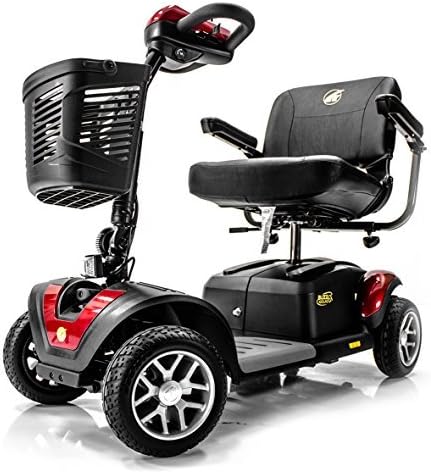
- Up to 330 lb
- Stable 4-wheel base
- Real brand service network
- ★ 4.7 rating
On flat ground, range and wheel size stop being the deciding specs: you are not climbing anything here, and you are rarely far from a bus. What you are doing is sitting on a scooter in Gulf Coast heat and humidity for hours, which makes the seat the thing that matters, and this is the most comfortable one here, with the highest weight capacity and the highest owner rating. Doing the French Quarter and the streetcar? Look hard at the Aotedor below instead: on a lift-boarded streetcar and a narrow crowded pavement, light and compact beats comfortable.
On Medicare or Louisiana Medicaid? Read the funding section before you pay out of pocket.
The St. Charles streetcar: the twelve stops that will take you
ADA-accessible inbound stops
- S. Claiborne Ave. & S. Carrollton Ave. (Stop 204)
- S. Carrollton Ave. & St. Charles Ave. (Stop 213)
- Napoleon Ave. & St. Charles Ave. (Stop 233)
- Louisiana Ave. & St. Charles Ave. (Stop 238)
- Jackson Ave. & St. Charles Ave. (Stop 244)
- Canal St. & Carondelet St. (Stop 256)
ADA-accessible outbound stops
- Canal St. & Carondelet St. (Stop 963)
- Jackson Ave. & St. Charles Ave. (Stop 3607)
- Louisiana Ave. & St. Charles Ave. (Stop 8468)
- Napoleon Ave. & St. Charles Ave. (Stop 8471)
- S. Carrollton Ave. & St. Charles Ave. (Stop 299)
- S. Claiborne Ave. & S. Carrollton Ave. (Stop 204)
- The good news is everything else. All other streetcar lines and all bus lines are ADA-accessible. The red cars on the Canal Street, Riverfront and Rampart lines have motorized lifts and a designated area where a mobility device is secured. If the St. Charles line is not working for your plan, those are.
- Plan the car, not just the stop. With three accessible cars running roughly hourly, turning up and hoping is how you lose an afternoon. RTA’s Trip Planner at norta.com lets you filter to wheelchair-accessible streetcar stops: pick Routes & Schedules, then Streetcar, then 12 St. Charles Streetcar. The accessible icon shows blue.
- Ask for help. RTA’s Rideline is 504-248-3900 for questions or assistance while you are traveling.
Forty cents, and no paperwork
That last part deserves a moment. In most cities in this guide the reduced fare costs you an application, a means test, a photo card and a fee: ten dollars and two years in Providence, a mailed form and a $2 card in Buffalo, three dollars and a trip to one office in Nashville. In New Orleans you show your driving license to the driver and pay forty cents. If you are visiting, that matters even more: there is nothing to apply for.
- Passes (called Jazzy Passes) run $3.00 for a day, $8.00 for three days, $15.00 for a week and $45.00 for 31 days at the adult rate. At 40 cents a ride, most Priority Riders will not need one.
- Paratransit is The Lift. Note that its eligibility is written categorically rather than functionally: you qualify if you are registered legally blind, registered disabled by the Social Security Administration, certified 100% disabled by the Veterans Administration, or assessed as temporarily or permanently disabled under RTA’s Paratransit Service Eligibility Criteria. The fare is not published on RTA’s fares page, so call the Rideline on 504-248-3900 for current pricing and to start an application.
Flat ground, and the weather that comes with it
- Heat and humidity are the limit, not the terrain. Ride the early morning and the evening, carry water, and plan routes past air-conditioned stops. Gulf humidity makes a moderate temperature feel far worse and gives you no relief overnight.
- Hurricane season: prepare, do not improvise. Keep the scooter fully charged when a storm is being watched: it is your mobility if the power goes and the lifts stop. Never ride through flooded streets: you cannot see what is under the water, and the motor and battery will not survive it. Store the scooter somewhere it stays dry and above any water that gets in.
- Register before you need to. If you would need help evacuating, get on your parish’s special-needs registry now rather than during a warning. Ask at your parish emergency office.
- The Quarter is its own thing. Old buildings, narrow pavements and crowds. Go early in the day, take it slowly, and ring ahead to any venue that matters to you rather than assuming.
Renting vs. buying a mobility scooter in New Orleans
New Orleans has a big visitor rental market, so renting for a trip is easy here. For regular use, it adds up quickly and buying is usually cheaper within a season.
- Keeps costing you. A travel scooter runs roughly $100 to $200 a week depending on model and city (Scootaround), so a month of regular use is several hundred dollars.
- You hand it back, and it never becomes yours.
- Not fitted or sized to you; you take whatever model is free.
- Delivery windows, deposits and return deadlines to plan around.
- Pays for itself fast. A one-time purchase; after a few weeks of what renting costs you are ahead, and you keep the scooter.
- Always charged, sized to you and ready by the door, which in hurricane season is not a small thing.
- Spread the cost. Many scooters offer monthly payments at checkout or through your card, so it need not be one big hit.
- Comes with a manufacturer warranty and keeps resale value.
Bottom line: rent for a festival; buy if you live here. On flat ground with 40-cent buses, an owned scooter plus a bus pass covers almost everything, and it is charged and in your hallway when a storm is coming.
How to pay: Medicare, and the first Deep South state to expand
If you are 65 or older, Medicare is your route. Part B may cover a scooter if a doctor confirms you need it to move around your home and you can operate one safely, through a supplier that accepts Medicare (Medicare.gov).
Louisiana Medicaid can pay for medically necessary equipment such as a power wheelchair or scooter when a doctor documents the need and it is supplied through an enrolled provider. Start with your primary care provider or your health plan.
Because these programs work through approved suppliers, a scooter bought on Amazon is a separate out-of-pocket purchase, which is why many New Orleans buyers who do not qualify choose one for the lower price and immediate delivery. Confirm current criteria directly, as they change.
Comparing options across the state? Our Louisiana mobility scooter guide covers statewide Medicaid and Medicare details, the best models for the local climate and terrain, and how the picture changes from city to city.
Who needs mobility support in New Orleans
New Orleans breaks the pattern that runs through most of this guide. Usually the city is younger than its state; here it is slightly older: 16.5% of residents are 65 or older, about 61,900 people out of 376,000, against Louisiana’s 16.3% and the national 16.8% (U.S. Census Bureau, ACS 2023).
Disability breaks the pattern too, and in the more revealing direction. 14.1% of New Orleanians report a disability, but across Louisiana it is 16.1%, well above the national 13.0%. The city is not the outlier here; the state is. Louisiana carries one of the heavier disability burdens in the country, and the parishes outside the city have far less of the transit, the paratransit and the flat pavement that New Orleans takes for granted.
Best mobility scooters for New Orleans (2026)
Picks that suit flat ground, heavy heat, a narrow historic quarter and a streetcar you board by lift: comfort first, with light and compact a genuine alternative here rather than a compromise. Specs are per manufacturer listings; confirm current details and price on Amazon.
| Model | Wheels | Max rider | Top speed | Owner rating |
|---|---|---|---|---|
| Golden Buzzaround EX ★ Top pick | 9″ (4-wheel) | 330 lb | 5.0 mph | 4.7★ (verified) |
| Aotedor Lightweight Best for the Quarter | 7″ | 300 lb | 3.7 mph | 4.5★ (277) |
| Glashow S1 Folding | 10″ (4-wheel) | 265 lb | 6.2 mph | 4.4★ (46) |
| Pride Go-Go Sport | 3-wheel | 325 lb | 4.7 mph | 4.4★ (109) |
4.7★ (verified owners) · 9″ wheels · up to 330 lb
Why New Orleans: on flat ground the seat is what matters, and this is the most comfortable one here for long humid afternoons, with the highest capacity and a real service network.
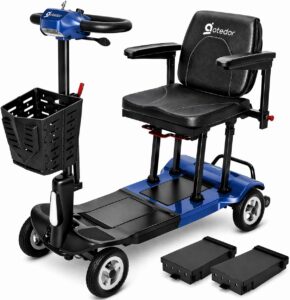
4.5★ (277 ratings) · folds compact · up to 300 lb
Why New Orleans: this is the city where light and compact stops being a compromise. Flat ground means you never miss the bigger wheels, and a narrow crowded Quarter, a streetcar lift and a car trunk all reward the smallest, lightest thing you can ride.
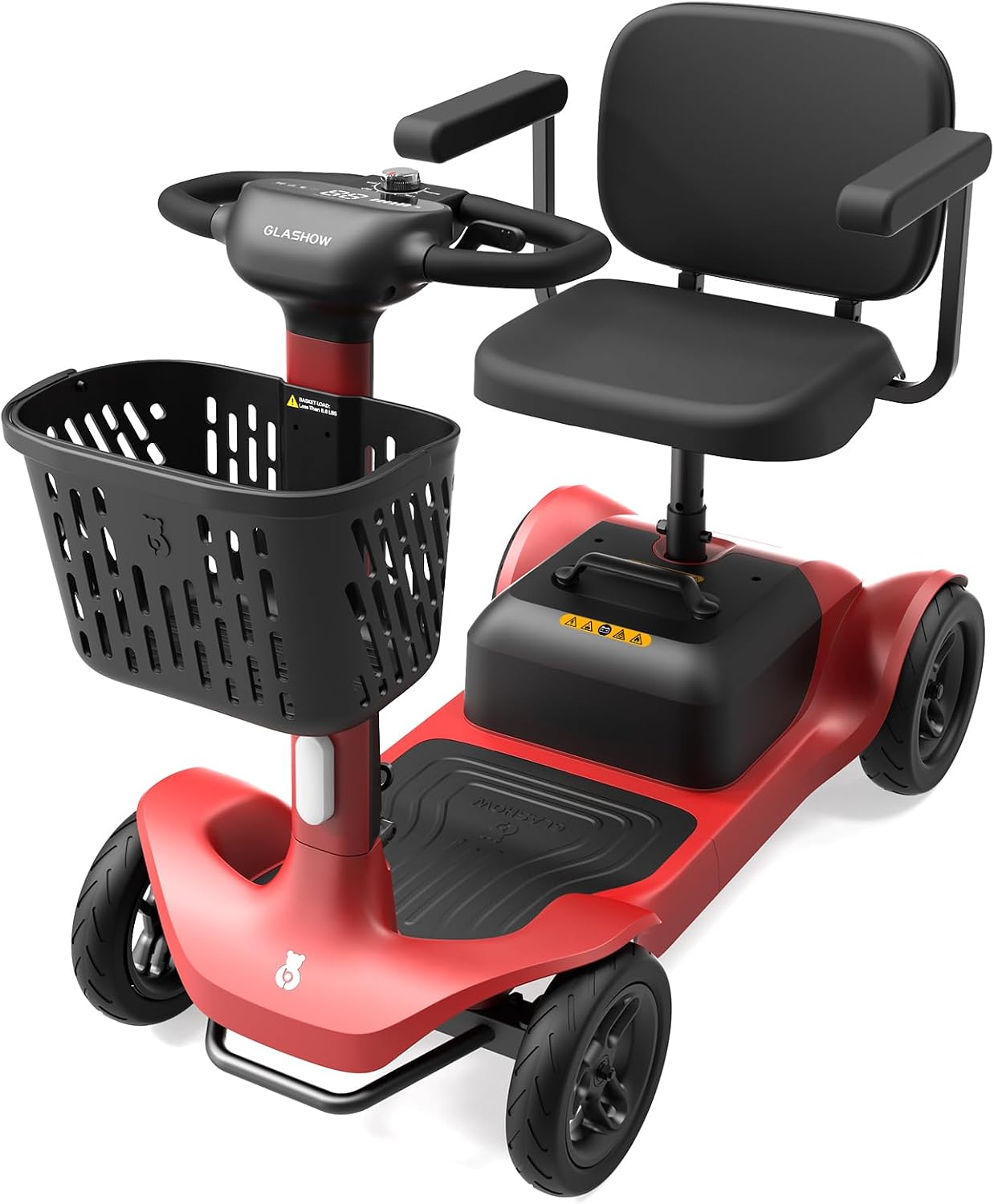
4.4★ (46 ratings) · 10″ wheels · rated ~25 mi range · 265 lb limit
Why New Orleans: the longest range and biggest wheels if you want to cover distance along the riverfront and the avenues. On flat ground, though, it is buying capability you may not need. Check the 265 lb limit.
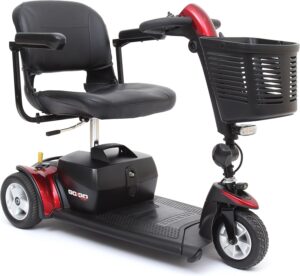
4.4★ (109 ratings) · compact · up to 325 lb
Why New Orleans: a tight turning circle for the Quarter’s corners, markets and a busy streetcar. Four wheels feel steadier over distance and on older pavement.
Watch: our top pick in action
An independent walkthrough of the Golden Buzzaround EX, our top pick above, showing the four-wheel frame, seat, controls and how it comes apart to transport.
Video: Golden Buzzaround EX review (YouTube). Polaris Mobility is not affiliated with the reviewer.
Compare more 4-wheel models · full catalog
New Orleans mobility scooter FAQ
Is New Orleans a good city for a mobility scooter?
The ground is about as easy as an American city gets: New Orleans is flat, much of it at or below sea level, so there are no grades to plan around. The fare is 40 cents if you are 65 or older or have a disability, with no application needed. The two things to plan around are the heat and humidity, and the historic St. Charles streetcar, which has only twelve stops where a mobility device can board.
Can you take a mobility scooter on the St. Charles streetcar?
Only on specific cars at specific stops. The green Perley Thomas cars are National Historic Landmarks and were never built for wheelchairs, so RTA runs three ADA-accessible streetcars on the line instead, marked with an ADA symbol on the front and side, roughly once an hour. There are twelve accessible stops, six inbound and six outbound, and RTA states that riders using mobility devices cannot enter or exit at any other stop. All other streetcar lines (Canal, Riverfront and Rampart), and all bus lines are accessible, with motorized lifts on the red cars.
Which St. Charles streetcar stops are wheelchair accessible?
Inbound: S. Claiborne & S. Carrollton (204), S. Carrollton & St. Charles (213), Napoleon & St. Charles (233), Louisiana & St. Charles (238), Jackson & St. Charles (244), and Canal & Carondelet (256). Outbound: Canal & Carondelet (963), Jackson & St. Charles (3607), Louisiana & St. Charles (8468), Napoleon & St. Charles (8471), S. Carrollton & St. Charles (299), and S. Claiborne & S. Carrollton (204). Use RTA’s Trip Planner at norta.com to filter to accessible stops, or call the Rideline on 504-248-3900.
How much is the bus for seniors in New Orleans?
Forty cents. The standard one-way fare is $1.25, but the Priority Rider fare for seniors and riders with disabilities is $0.40, and riders 65 and older qualify simply by showing the driver a valid ID or passport: no application, means test or photo card. Jazzy Passes run $3.00 a day up to $45.00 for 31 days at the adult rate, though at 40 cents a ride most Priority Riders will not need one.
What is the best mobility scooter for New Orleans?
On flat ground the seat matters more than the wheels, so our top pick is the Golden Buzzaround EX for comfort through Gulf heat, a 330 lb capacity and a real service network. But New Orleans is the one city where the lightweight option is a genuine first choice rather than a compromise: if your days involve the French Quarter, streetcar lifts and lifting the scooter into a car, the Aotedor’s small size and low weight are worth more than an extra inch of wheel you will never need.