
Mobility Scooters in Newark

Looking for a mobility scooter in Newark, to buy or to rent? Newark is the opposite of the spread-out cities in much of this guide. It is flat, dense, and threaded with rail: the Newark Light Rail, NJ Transit trains, and buses, most of it built to be boarded without a step. NJ Transit is blunt about it, at accessible light rail stations, “the gap between the platform and the light rail vehicle is very small, so customers using mobility devices may board without assistance”. And the fare is half price from age 62, on everything, at any time. So the good news is real. The catch is a card rule that changed on 1 January 2026 and will quietly strand anyone who has not caught up. This guide covers all of it. Polaris Mobility earns a commission on qualifying Amazon purchases through links on this page.
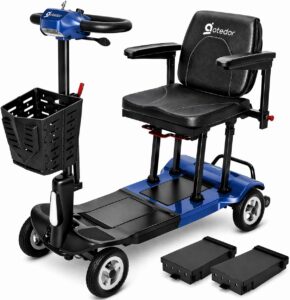
- Folds compact
- Up to 300 lb
- ★ 4.5 rating (277)
- Lightest here
In a rail city, the deciding specs are not range and wheel size: they are whether you fit an elevator, a light rail car and a bus lift, and whether you can get on and off dozens of times a week without a fight. Newark is flat, so you are not climbing anything, and the trains do the distance. That makes the light, compact, folding scooter the right one here, not a compromise. This is the lightest of the four, folds smallest, and has the most owner ratings by a distance. If you want a bigger seat for long sits, the Buzzaround is the upgrade, but on a transit-first grid, small and light wins.
On Medicare or NJ FamilyCare? Read the funding section before you pay out of pocket.
The card rule that changed on 1 January 2026
This is the kind of change that does not announce itself at the fare gate. You tap or show your old card, it is refused, and suddenly you are paying full fare on a fixed income. If you have held a Reduced Fare card for years, the safe move is to assume yours needs replacing and check now, not at the platform.
- Apply online at reducedfare.njtransit.com, by mail, or in person at local banks, county Offices on Aging, or NJ Transit Customer Service offices: the Reduced Fare Program office is at 2 Gateway, 283–299 Market St., Newark.
- Give it time. Processing takes about four weeks, so this is a do-it-now task, not a do-it-when-refused one.
Half price from 62, on everything, any time
Two details are worth pausing on. First, the age is 62, not 65: three years earlier than the usual 65 threshold, which for a lot of people is three years of half-price travel they did not know they could claim. Second, “any time” matters: many cities restrict cheap senior travel to off-peak hours, and NJ Transit does not.
- The base fares. A one-zone local bus or Newark Light Rail trip is a flat fare that rose with NJ Transit’s July 2026 adjustment to roughly $1.85–$1.90: reporting varies slightly on the exact figure, so confirm the current price on njtransit.com/adjustedfares or in the app before you budget. At half fare, that is well under a dollar a ride.
- Trains are distance-based, so a rail fare depends on where you are going; the 50% reduction applies just the same.
- Paratransit is Access Link. NJ Transit runs Access Link for people who cannot use the local bus because of a disability. Apply and interview by phone on 973-491-4224, or at accesslink.njtransit.com. We could not verify the current Access Link fare, so ask when you apply rather than trusting a figure we have not seen.
The rail is built to be boarded, mostly
“Board without assistance” is a big deal, and it is the reason a scooter changes everything in Newark. You are not waiting for a driver to deploy a lift, not asking anyone for help, not planning your day around who is on shift. You roll on. In a city this dense, that turns the whole rail network into something you can use on your own terms.
- Plan both ends. An accessible origin and an inaccessible destination is still a trip you cannot finish. Check the pair, not just the nearer one.
- Learn the elevator you depend on, and a backup. In a rail city the elevator is the accessible entrance; when it fails, you need a plan that is not “carry the scooter down the stairs”.
Renting vs. buying a mobility scooter in Newark
In a flat, transit-first city, a scooter is not your transport, the trains are. The scooter is what gets you to and from them, and lets you use them alone.
- Keeps costing you. A travel scooter runs roughly $100 to $200 a week depending on model and city (Scootaround), so a month of regular use is several hundred dollars.
- You hand it back, and it never becomes yours.
- Not fitted or sized to you; you take whatever model is free, which in a transit city may mean one too big for the trains.
- Reasonable for a short visit.
- Pays for itself fast. A one-time purchase; after a few weeks of what renting costs you are ahead, and you keep the scooter.
- Sized for the trains. Owning lets you pick something light and compact that boards a light rail car and fits an elevator every time.
- It pairs with a half-price network: the cheapest way to move around this region once your photo card is sorted.
- Spread the cost. Many scooters offer monthly payments at checkout or through your card.
Bottom line: buy if you live here, and buy small. A light, folding scooter that boards a light rail car without help, plus a half-price fare from 62, is about as independent as a scooter-and-transit life gets, just get the photo card first.
How to pay: Medicare and NJ FamilyCare
If you are 65 or older, Medicare is your route. Part B may cover a scooter if a doctor confirms you need it to move around your home and you can operate one safely, through a supplier that accepts Medicare (Medicare.gov).
New Jersey expanded Medicaid, and its program is NJ FamilyCare, covering adults up to 138% of the federal poverty level, so unlike some states in this guide there is no coverage gap. NJ FamilyCare can pay for medically necessary equipment such as a power wheelchair or scooter when a doctor documents the need and it is supplied through an enrolled provider. Start with your primary care provider or your health plan and ask specifically about durable medical equipment and which suppliers they will authorize.
Because these programs work through approved suppliers, a scooter bought on Amazon is a separate out-of-pocket purchase, which is why many buyers who do not qualify, or cannot wait out an authorization, choose one for the lower price and immediate delivery. Confirm current criteria directly, as they change.
Comparing options across the state? Our New Jersey mobility scooter guide covers statewide Medicaid and Medicare details, the best models for the local climate and terrain, and how the picture changes from city to city.
Who needs mobility support in Newark
Newark turns the usual pattern in this guide on its head. It is a young city: only 10.9% of residents are 65 or older, 33,493 people out of 307,188, well below New Jersey’s 16.8% and the national 16.8%. On age alone you would expect modest demand.
Disability tells the opposite story, and loudly. 16.7% of Newark residents report a disability, against just 10.6% across New Jersey and 13.0% nationally. That is a gap of more than six points the other way: a young city with a strikingly high disability rate. This is not an ageing population; it is a working-age one carrying a heavy burden of disability, in a dense, lower-income city. The practical reading is that a great many people who need a scooter here are not retirees planning leisure rides: they are working-age adults for whom a light scooter, a level-boarding train and a half-price fare are the difference between getting to work, to the clinic, to family, and not. Newark’s rail network is a genuinely strong answer to that need; the job of this page is to make sure the card in your wallet lets you use it.
Best mobility scooters for Newark (2026)
Picks weighted for a flat, dense, transit-first city where fitting an elevator and a light rail car matters more than range. Specs are per manufacturer listings; confirm current details and price on Amazon.
| Model | Wheels | Max rider | Folds? | Owner rating |
|---|---|---|---|---|
| Aotedor Lightweight ★ Top pick | 7″ | 300 lb | Yes, compact | 4.5★ (277) |
| Golden Buzzaround EX Most comfortable | 9″ (4-wheel) | 330 lb | Comes apart | 4.7★ (verified) |
| Pride Go-Go Sport | 3-wheel | 325 lb | Comes apart | 4.4★ (109) |
| Glashow S1 Folding | 10″ (4-wheel) | 265 lb | Yes | 4.4★ (46) |
4.5★ (277 ratings) · folds compact · up to 300 lb
Why Newark: the lightest and most compact here, which is exactly what a rail-first, elevator-dependent city rewards. Flat ground means you never miss the bigger wheels, and the trains do the distance.
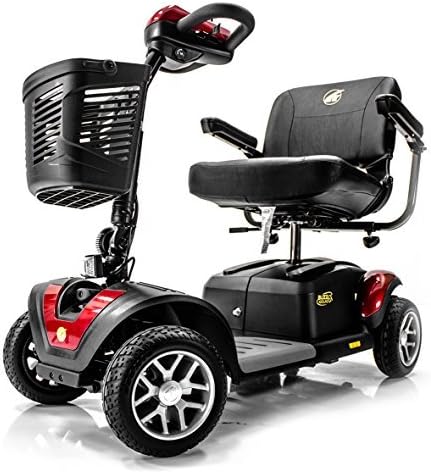
4.7★ (verified owners) · 9″ wheels · up to 330 lb
Why Newark: the comfortable, higher-capacity choice if you want a better seat and 330 lb, and the highest owner rating. Bulkier to get on a crowded light rail car, which is the trade in a transit city.
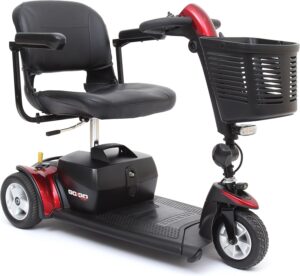
4.4★ (109 ratings) · compact · up to 325 lb
Why Newark: a tight turning circle for a busy platform and a narrow shop, from a well-established maker, and it breaks down for a car trunk. Three wheels turn sharper in a crowd.
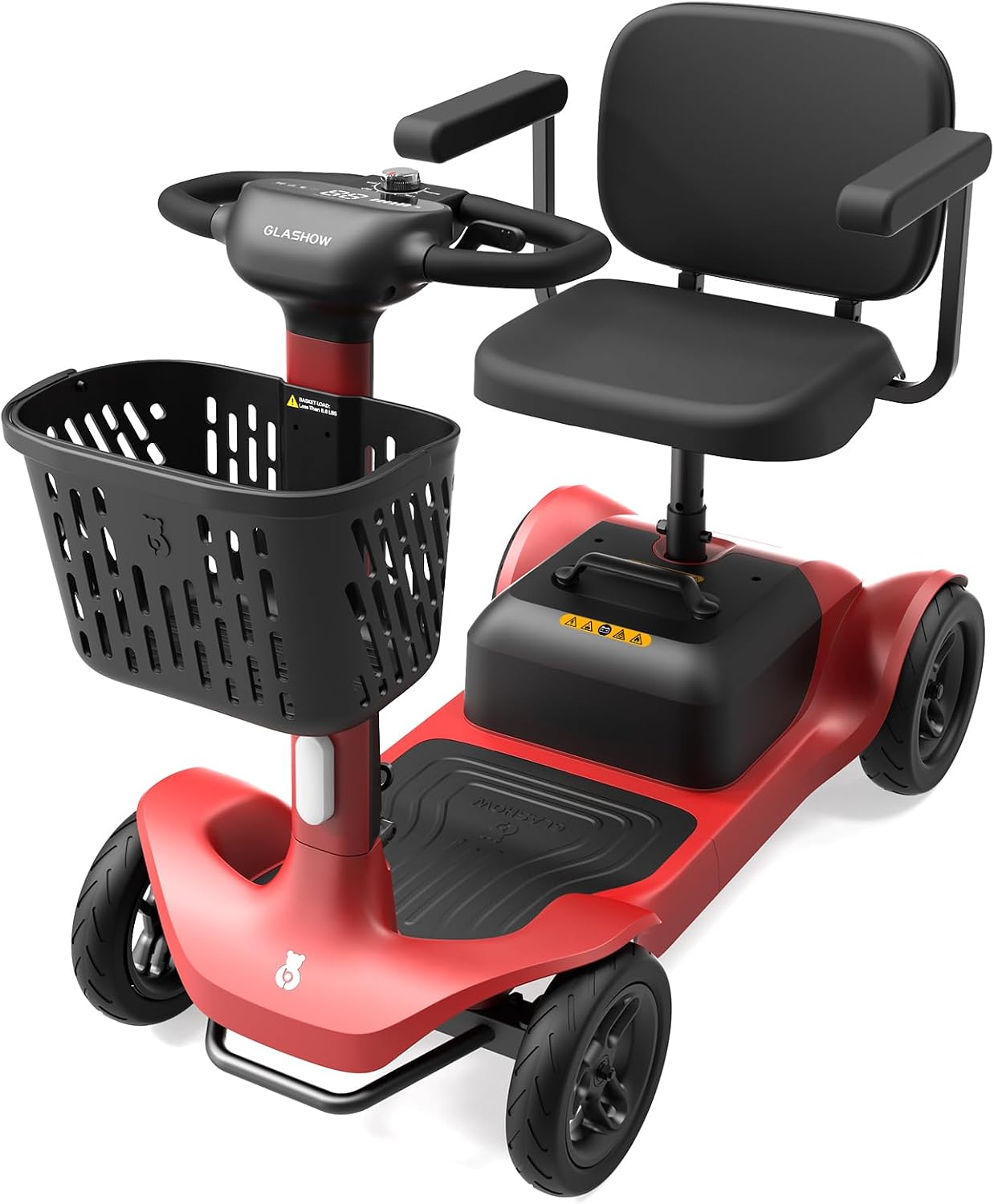
4.4★ (46 ratings) · 10″ wheels · rated ~25 mi range · 265 lb limit
Why Newark: folds and has the longest range, though in a compact transit city you rarely need it. The heaviest to lift if an elevator is down; check the 265 lb limit.
Watch: the Pride Go-Go Sport reviewed
An independent walkthrough of the Pride Go-Go Sport, the compact three-wheel option in the comparison above: showing how a travel scooter comes apart to transport.
Video: Pride Go-Go Sport review (YouTube). Polaris Mobility is not affiliated with the reviewer.
Compare more 4-wheel models · full catalog
Newark mobility scooter FAQ
Does my old NJ Transit reduced-fare card still work in 2026?
Only if it has a photo. NJ Transit states that “Beginning January 1, 2026, Reduced Fare ID cards without a photo are no longer accepted for discounted travel on NJ TRANSIT.” If your Reduced Fare ID card has no photo, it no longer works and you must apply for a new photo ID. Apply online at reducedfare.njtransit.com, by mail, or in person at local banks, county Offices on Aging or NJ Transit Customer Service; the Reduced Fare Program office is at 2 Gateway, 283–299 Market St., Newark. Processing takes about four weeks, so do it now rather than waiting to be refused at the fare gate.
How much is the bus and light rail for seniors in Newark?
NJ Transit’s Reduced Fare gives seniors aged 62 and over, people with disabilities and military personnel 50% or more off a regular one-way fare, at any time on all trains, buses and light rail: note the age is 62, not 65. A one-zone local bus or Newark Light Rail trip is a flat fare that rose with NJ Transit’s July 2026 adjustment to roughly $1.85 to $1.90, so at half fare it is well under a dollar; confirm the exact current figure on njtransit.com/adjustedfares. Rail fares are distance-based, with the same 50% reduction. For paratransit, NJ Transit runs Access Link, apply on 973-491-4224.
Is the Newark Light Rail accessible for a mobility scooter?
Mostly, and well. NJ Transit says accessible stations “offer level boarding between the platform and light rail vehicles,” reached “by elevator or ramp,” and that “the gap between the platform and the light rail vehicle is very small, so customers using mobility devices may board without assistance.” The important caveat is that it is “most” stations, not all, and elevators do go out of service. Before you rely on a station, confirm that both ends of your trip are accessible, and have a backup station or route for the day an elevator is down.
What is the best mobility scooter for Newark?
Our top pick is the Aotedor Ultra Lightweight. In a flat, dense, rail-first city, the deciding specs are not range or wheel size but whether the scooter fits an elevator and a light rail car and can board dozens of times a week without a struggle, and this is the lightest and most compact of the four, with the most owner ratings. The trains do the distance, so you never miss the bigger wheels. If you want a better seat and more capacity, the Golden Buzzaround EX is the comfortable upgrade, at the cost of being bulkier to get onto a crowded train.