
Mobility Scooters in Oklahoma City
Looking for a mobility scooter in Oklahoma City, to buy or to rent? Start with the fact that shapes everything else here: Oklahoma City covers 601 square miles of land (U.S. Census Bureau). That is not a statistic, it is your budget. On EMBARK’s door-to-door paratransit, a one-way trip costs $2.00 in Zone 1a and $10.50 in Zone 3: same city, same agency, same day. A round trip is either four dollars or twenty-one. This guide gives you the zones and what they cost, the days the whole system is free, the one piece of transit here that removes the biggest hassle a scooter rider usually faces, an honest word about tornado season, and the models that suit a city this spread out. Polaris Mobility earns a commission on qualifying Amazon purchases through links on this page.
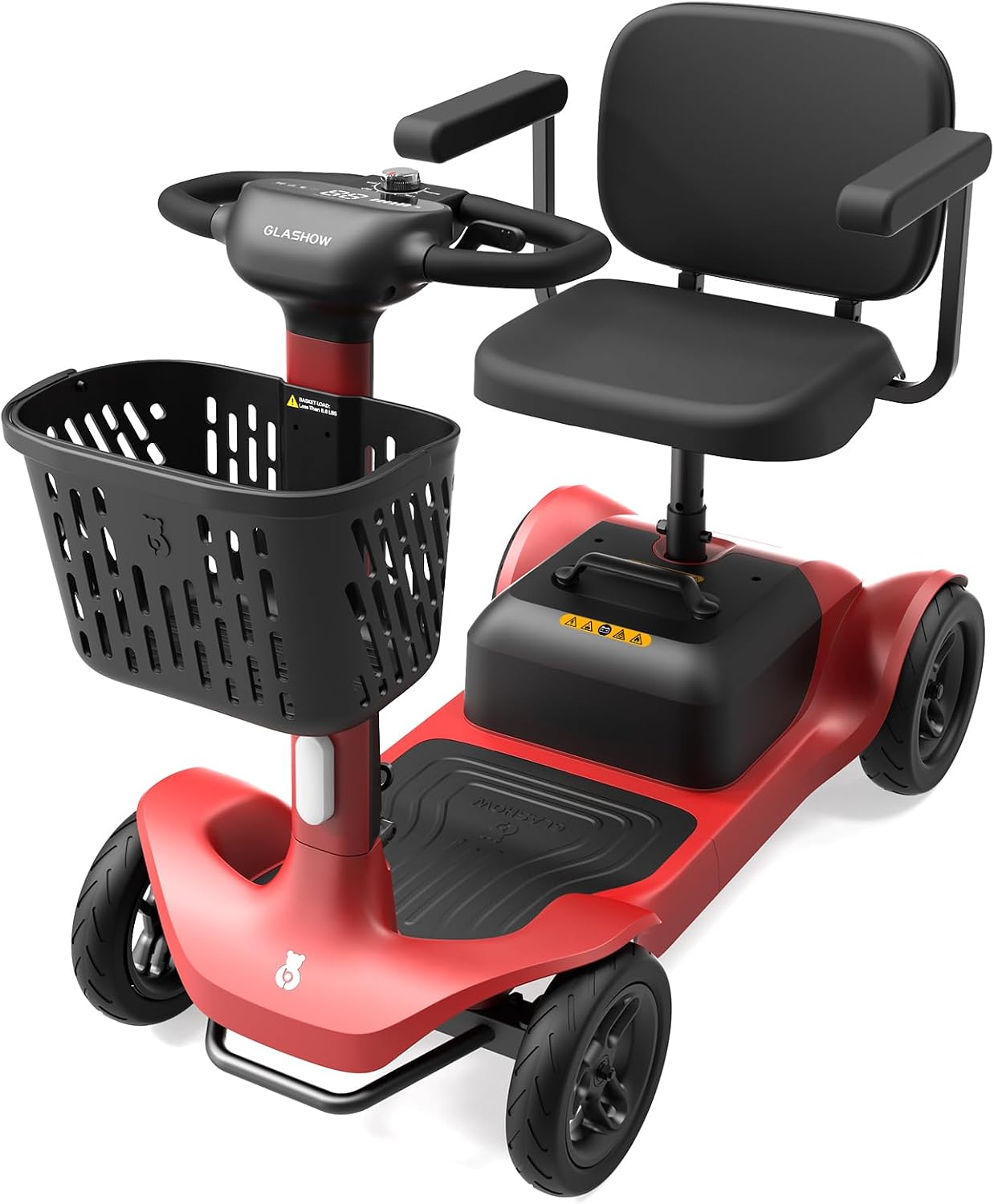
- Rated ~25 mi range
- 10″ wheels
- 6.2 mph
- 265 lb limit
In a city of this size, distance is the constraint, and this has the longest rated range and the biggest wheels of the four here. The usual argument against a scooter this substantial is that you have to wrestle it onto transit, but the OKC Streetcar has 100% level boarding at every platform, so downtown you roll straight on with nothing to lift and no ramp to climb. That removes the penalty. The one thing to check first is the weight limit: at 265 lb it is the lowest of the four. If that is close for you, the Buzzaround below takes 330 lb and is the better buy.
On Medicare or SoonerCare? Read the funding section before you pay out of pocket.
601 square miles: why your address sets your fare
A single flat paratransit fare is how plenty of cities do it: $1.25 whatever the distance in Milwaukee, nothing at all in Richmond. Oklahoma City does not, because Oklahoma City is enormous. The Census Bureau puts the city at 601.11 square miles of land (620.79 including water). That is deliberate: the city launched a “Great Annexation Drive” in 1959 and grew from roughly 80 square miles to 475.55 square miles by the end of 1961. Sixty-five years later, that decision is what you pay for a ride.
| Zone | One-way fare | Round trip | Availability |
|---|---|---|---|
| Zone 1a | $2.00 | $4.00 | Scheduled service |
| Zone 1 | $3.50 | $7.00 | Scheduled service |
| Zone 2 | $7.00 | $14.00 | Not guaranteed |
| Zone 3 | $10.50 | $21.00 | Not guaranteed |
- Booking is not same-day. Reservations are required and accepted one to seven days in advance of your travel date, by calling 405-235-PLUS (7587).
- You have to qualify first. Eligibility needs an application and a functional assessment, with documentation from a licensed physician or other certified healthcare professional. You are then classified as conditional, unconditional or temporary, so a “yes” can be a partial yes, covering only some trips.
- This is the argument for owning a scooter here. A scooter in your hallway has no zones, no fare, no seven-day notice and no availability caveat. The bigger the city, the more that independence is worth, and this one is 601 square miles.
The fixed-route fares, and the days it is all free
If you can use the regular bus and streetcar, EMBARK is inexpensive, and the senior rate is a straight halving.
- Reduced Universal 24-Hour Pass: $2.00, for riders 65 and older, Medicare cardholders, and people with a qualifying disability. The adult version of the same pass is $4.00.
- Youth (0–18) ride free on an Annual Haul Pass: useful if a grandchild travels with you.
- A note on single rides. EMBARK’s fares page lists passes rather than a single-ride fare, and points to a separate fee schedule for the full list. We have not verified a current single-ride price, so do not assume one. Call (405) 235-RIDE (7433) and ask (EMBARK).
The streetcar: roll straight on
It is worth spelling out what that means, because riders who have used older systems will not believe it. There is no lift to deploy. There is no ramp to ask the driver for. There is no step. You do not wait while a mechanism cycles and a line forms behind you. The platform is at car floor height and you drive on, at every platform on the line, not at a handful of designated ones. New Orleans riders get twelve accessible stops on their historic line and a car roughly every hour; here it is all of them.
This is also why our top pick is a full-size four-wheel scooter rather than the lightest thing available. Level boarding means the usual downtown penalty for a larger machine (the lifting, the folding, the trunk of a car) simply does not apply on the streetcar.
Tornado season: the shelter problem nobody says out loud
That is the honest tension, and no guide should skate past it. A below-ground cellar reached by steps is not a shelter you can use if you cannot manage steps. This is worth solving on a calm day in advance, not during a warning, and there are two specific Oklahoma City programs for it.
- Register your storm shelter with the City, it is free. Oklahoma City runs a Storm Shelter Registry. You give your address, the type of shelter, where it is located, and optionally an emergency contact. The City states the information is used by first responders (police, fire and EMS) to help with emergency response if your home or neighborhood is hit. Register at okc.gov under the Action Center, or call the Action Center on (405) 297-2535, Monday to Friday, 8:00 a.m. to 5:00 p.m. Only shelters inside the Oklahoma City limits can be registered: which, given the 601 square miles above, covers more ground than you might assume (City of Oklahoma City). If you use a scooter or wheelchair, this registry is how someone knows to come and find you.
- SoonerSafe is the rebate, and it is a lottery, not a line. The state’s SoonerSafe Safe Room Rebate Program helps homeowners pay for a residential safe room, awarded by random selection drawing rather than first-come. Registration is online at soonersafe.ok.gov. Timing matters: at the time of writing, the state’s own page says “The 2026 Rebate Program is not open at this time”, so check the current cycle status rather than assuming you can register today (Oklahoma OEM).
- An above-ground safe room is the accessible answer. If steps are the barrier, a reinforced above-ground safe room at ground level is the version of this you can actually reach in ninety seconds. Discuss the door width and threshold with the installer with your scooter in mind, not the brochure’s assumptions.
- Keep it charged in season. March to May, treat a full battery as part of your weather routine. If the power goes down for days, your scooter is your mobility.
Where to actually ride: Scissortail Park
The free golf cart tour deserves a mention on its own terms. It is aimed at people who cannot walk the park, which means that if you are visiting Oklahoma City without your scooter, or you are still deciding whether a scooter is for you, there is a way to see the whole park anyway. If you do have your own machine, the wide paths are what you want and the tour is not needed. Either way, nobody is stuck at the entrance.
Renting vs. buying a mobility scooter in Oklahoma City
The zone fares change this calculation in a way they do not in a compact city. If you live in Zone 2 or Zone 3, every trip you can make under your own power is a fare you did not pay and a booking you did not have to make seven days early.
- Keeps costing you. A travel scooter runs roughly $100 to $200 a week depending on model and city (Scootaround), so a month of regular use is several hundred dollars.
- You hand it back, and it never becomes yours.
- Not fitted or sized to you; you take whatever model is free.
- Delivery windows, deposits and return deadlines to plan around.
- Pays for itself fast. A one-time purchase; after a few weeks of what renting costs you are ahead, and you keep the scooter.
- No zones, no fare, no seven-day notice. In a city this spread out, that is the whole point.
- Spread the cost. Many scooters offer monthly payments at checkout or through your card, so it need not be one big hit.
- Charged and by the door, which in storm season is not a small thing.
Bottom line: rent for a visit; buy if you live here, and the further out you live, the more obvious that gets. A $2.00 senior day pass plus your own scooter covers the parts of Oklahoma City that transit reaches well, and your scooter covers the parts it does not.
How to pay: Medicare, and the expansion Oklahomans voted into their own constitution
If you are 65 or older, Medicare is your route. Part B may cover a scooter if a doctor confirms you need it to move around your home and you can operate one safely, through a supplier that accepts Medicare (Medicare.gov).
Two consequences follow for anyone reading this page. The first is practical: because it sits in the constitution rather than in statute, expansion here cannot be undone by an ordinary vote of the Legislature: it would take another vote of the people. Oklahomans have a more durable version of this coverage than residents of states where it was enacted by lawmakers. The second is about you: if you are under 65 and on a low income in Oklahoma City, SoonerCare is a genuine route to covered equipment, and roughly one in twenty Oklahomans became eligible on a single day in 2021. It is worth checking whether you are one of them before you reach for a card.
SoonerCare can pay for medically necessary equipment such as a power wheelchair or scooter when a doctor documents the need and it is supplied through an enrolled provider. Start with your primary care provider or your health plan. Because these programs work through approved suppliers, a scooter bought on Amazon is a separate out-of-pocket purchase, which is why many buyers who do not qualify choose one for the lower price and immediate delivery. Confirm current criteria directly, as they change.
Comparing options across the state? Our Oklahoma mobility scooter guide covers statewide Medicaid and Medicare details, the best models for the local climate and terrain, and how the picture changes from city to city.
Who needs mobility support in Oklahoma City
Oklahoma City is a young city in an old state. 13.3% of residents are 65 or older (91,352 people out of 688,693) against 16.1% across Oklahoma and 16.8% nationally (U.S. Census Bureau, ACS 2023, 5-year). By age alone, you would expect fewer scooter riders here than in the state around it.
Disability tells the more important story. 13.9% of Oklahoma City residents report a disability, close to the national 13.0%. But across Oklahoma it is 16.8%, one of the heavier burdens in the country and nearly four points above the national rate. The city is not the outlier; the state around it is. And the practical reading of that is geography: a disabled Oklahoman outside the city limits has no EMBARK, no level-boarding streetcar and no paratransit zone at any price, while inside those 601 square miles, at least there is a fare to argue about.
Best mobility scooters for Oklahoma City (2026)
Picks that suit long distances, wide park paths, a streetcar you roll straight onto, and a car trunk, because in a city this size, some of your journey is going to be driven. Specs are per manufacturer listings; confirm current details and price on Amazon.
| Model | Wheels | Max rider | Top speed | Owner rating |
|---|---|---|---|---|
| Glashow S1 Folding ★ Top pick | 10″ (4-wheel) | 265 lb | 6.2 mph | 4.4★ (46) |
| Golden Buzzaround EX If 265 lb is close | 9″ (4-wheel) | 330 lb | 5.0 mph | 4.7★ (verified) |
| Pride Go-Go Sport | 3-wheel | 325 lb | 4.7 mph | 4.4★ (109) |
| Aotedor Lightweight | 7″ | 300 lb | 3.7 mph | 4.5★ (277) |
4.4★ (46 ratings) · 10″ wheels · rated ~25 mi range · 265 lb limit
Why Oklahoma City: the longest rated range and biggest wheels here, which is what a 601-square-mile city asks for, and the streetcar’s level boarding means its size costs you nothing downtown. Check the 265 lb limit before anything else.
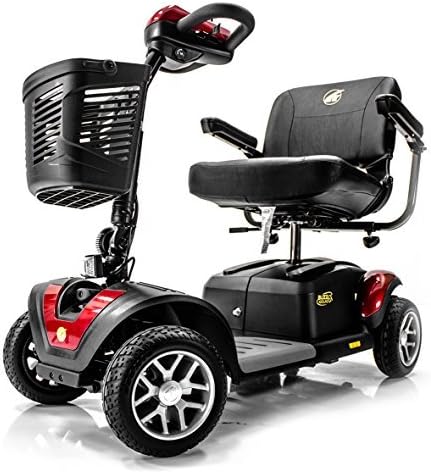
4.7★ (verified owners) · 9″ wheels · up to 330 lb
Why Oklahoma City: the highest weight capacity and the highest owner rating here, plus a real brand service network, which matters more when your nearest dealer is a long drive across a very large city.
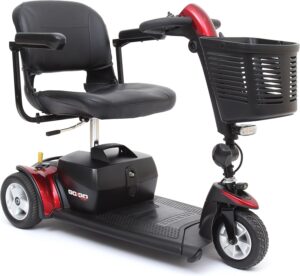
4.4★ (109 ratings) · compact · up to 325 lb
Why Oklahoma City: comes apart into pieces for a car trunk, which is the honest reality of getting around a city this size: you will drive to the park before you ride it. Four wheels feel steadier over long distances.
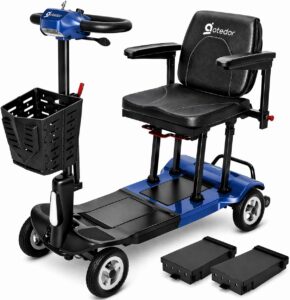
4.5★ (277 ratings) · folds compact · up to 300 lb
Why Oklahoma City: the easiest to lift, but the shortest legs: the one place it wins here is if your days are downtown and on the streetcar rather than out across the city.
Watch: the Golden Buzzaround EX reviewed
An independent walkthrough of the Golden Buzzaround EX, the higher-capacity alternative in the comparison above, showing the four-wheel frame, seat, controls and how it comes apart to transport.
Video: Golden Buzzaround EX review (YouTube). Polaris Mobility is not affiliated with the reviewer.
Compare more 4-wheel models · full catalog
Oklahoma City mobility scooter FAQ
How much does paratransit cost in Oklahoma City?
It depends on your zone, and the spread is wide. EMBARK PLUS one-way fares are $2.00 in Zone 1a, $3.50 in Zone 1, $7.00 in Zone 2 and $10.50 in Zone 3, so a round trip ranges from $4.00 to $21.00 within the same city. EMBARK also states that availability is not guaranteed in Zone 2 and Zone 3. Reservations are required one to seven days in advance on 405-235-PLUS (7587), and you must first qualify through an application and functional assessment.
Is the OKC Streetcar wheelchair and scooter accessible?
Yes, and unusually well. EMBARK states that the OKC Streetcar offers 100% level boarding at all of its platforms, intended to make boarding easier for customers using strollers, bikes and mobility devices such as wheelchairs and walkers. There is no lift to deploy and no ramp to request: the platform is at car floor height and you roll straight on, at every platform on the line. Reader boards and audio announcements indicate the next stop.
How much is the bus for seniors in Oklahoma City?
A Reduced Universal 24-Hour Pass is $2.00 for riders 65 and older, Medicare cardholders and people with a qualifying disability, half the $4.00 adult rate. Riders aged 0 to 18 ride free on an Annual Haul Pass. EMBARK also runs Free Fare Days on which buses, the OKC Streetcar, RAPID and Zone 1 ADA Paratransit are free, including the third Friday of every month and voting days. EMBARK’s fares page lists passes rather than a single-ride fare, so call (405) 235-RIDE (7433) to confirm current single-ride pricing.
What should a mobility scooter user do about tornado season in Oklahoma City?
Plan it on a calm day, because the standard advice, shelter underground, is exactly what a scooter cannot do. Register your shelter free with the City of Oklahoma City Storm Shelter Registry, which first responders use to locate people after a storm; only shelters inside the city limits qualify, and the Action Center number is (405) 297-2535. If steps are your barrier, an above-ground reinforced safe room at ground level is the accessible version, and the state’s SoonerSafe rebate can help pay for one, though it is awarded by random drawing, and the state’s page says the 2026 program is not open at this time, so check the current cycle. Keep the battery charged from March to May.
Does Oklahoma Medicaid cover a mobility scooter?
SoonerCare can pay for medically necessary equipment such as a power wheelchair or scooter when a doctor documents the need and it is supplied through an enrolled provider. Oklahoma expanded Medicaid by State Question 802, which passed on 30 June 2020 with 50.45% of the vote (a margin of roughly 6,000 votes) writing expansion into the Oklahoma Constitution over the opposition of the Governor and a majority of the Legislature. It covers adults aged 18 to 64 at or below 133% of the federal poverty level, took effect on 1 July 2021, and more than 150,000 additional Oklahomans enrolled within about a month.
What is the best mobility scooter for Oklahoma City?
Our top pick is the Glashow S1 Folding, because Oklahoma City covers 601 square miles of land and distance is the real constraint: it has the longest rated range and the biggest wheels of the four here, and the streetcar’s 100% level boarding means its size costs you nothing downtown. The one caveat is its 265 lb weight limit, the lowest of the four; if that is close for you, the Golden Buzzaround EX takes 330 lb and has the highest owner rating.