
Mobility Scooters in Omaha

Looking for a mobility scooter in Omaha, to buy or to rent? Omaha does something quietly unusual, and almost nobody who needs it knows about it. Metro’s paratransit service states, in its own words, that “Clients may be ADA paratransit eligible on a seasonal basis”. Read that again. You do not have to be permanently unable to use the bus. If you can walk to the stop in June and cannot cross the ice to it in January, that counts, and most people never apply because they assume paratransit is all-or-nothing. There is a catch, and it is the reason this page leads with it: applications take 21 business days to review. That is about a month. If you wait for the first ice to apply, you have already missed the season. Polaris Mobility earns a commission on qualifying Amazon purchases through links on this page.
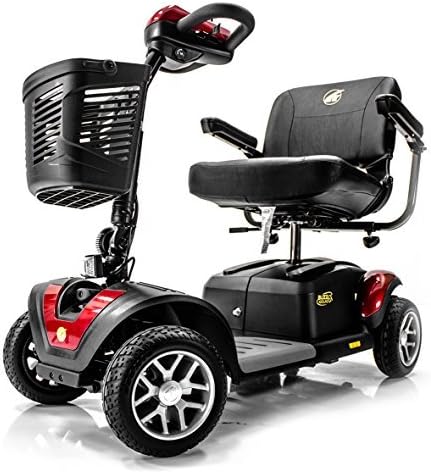
- Up to 330 lb
- Stable 4-wheel base
- Real brand service network
- ★ 4.7 rating
Omaha’s paratransit runs within three-quarters of a mile of each bus route, which tells you the job your scooter actually has: short, repeated trips to a stop and back, in weather. Range is not the constraint here, you are not crossing the county. What matters is that it works every single day for years, on a footway that is slush in February. So buy the one with the highest owner rating, the most capacity for a winter coat, four wheels under you, and a manufacturer that still exists when something breaks. If you regularly cross broken ice, the Glashow below has bigger wheels.
On Medicare or Nebraska Medicaid? Read the funding section before you pay out of pocket.
“Eligible on a seasonal basis”, the sentence worth knowing
Most people read “paratransit” and hear “for people who can never use a bus”. That is not what the rule says, and it is not what Omaha says. The test is functional and situational: can you make this trip, in these conditions? A person who manages a four-block roll to the stop on a dry September afternoon and cannot do it over rutted ice in January is not exaggerating: they are describing exactly the case MOBY’s own page provides for.
- Where to send it: MOBY Certification: email [email protected], fax 402-342-3395, or post to 2222 Cuming St, Attn: MOBY Certification, Omaha, NE 68102.
- What it costs: “MOBY costs $2.50 to ride. A MOBY client’s Personal Care Attendant (PCA) rides for free, and a Companion pays the full MOBY fare.” That distinction matters: an attendant is free, a friend is $2.50.
- Booking: ring 402-341-0800. “Reservations for next-day trips must be made no later than 4:30 p.m. the day before and can be made up to 14 days in advance.” So the 4:30 p.m. deadline is the one to write on the fridge.
- Where it goes: “corridors with a width of three-fourths of a mile on each side/end of each fixed route”. If your destination sits outside that band, MOBY does not have to take you there.
Sixty cents, and the service that will not take it
Omaha’s fixed-route fares are among the gentler ones you will find.
| Fare | Standard | Half-fare |
|---|---|---|
| Single ride (bus and ORBT) | $1.25 | $0.60 |
| Transfer (buy when you pay) | $0.25: valid 90 minutes on weekdays, 120 at weekends | |
| 10-ride pass | $12.50 | $6.00 |
| 30-day pass | $55.00 | $27.50 |
| MOBY paratransit | $2.50 · PCA free · companion pays full | |
| Microtransit (Metro Flex) | $3.00 · no half-fare, no passes, no cash | |
- The half-fare needs paperwork and a photo. You must complete a half-fare application (there are separate forms for the age/Medicare route and the disability route), and then “Metro-issued photo IDs must be shown to the operator when you pay your fare”, obtainable at Metro’s office. It is 60 cents once you have the card and full fare until you do (Omaha Metro).
- Do the monthly sum. At $27.50, the half-fare 30-day pass pays for itself at about 23 rides, roughly a return trip every weekday. If you go out most days, buy the pass and stop counting.
Renting vs. buying a mobility scooter in Omaha
Frame this around the sentence at the top of the page. Your scooter is the thing that decides which side of “conditional” you are on.
- Keeps costing you. A travel scooter runs roughly $100 to $200 a week depending on model and city (Scootaround), so a month of regular use is several hundred dollars, against a $27.50 half-fare bus pass.
- You hand it back, and it never becomes yours.
- Not fitted or sized to you; you take whatever model is free.
- No help at all in the season you actually need it, unless you rent all winter.
- Pays for itself fast. A one-time purchase; after a few weeks of what renting costs you are ahead, and you keep the scooter.
- It is what gets you to the stop, and a 60-cent bus is waiting there.
- It is charged and indoors on the morning the pavement is glass.
- Spread the cost. Many scooters offer monthly payments at checkout or through your card.
Bottom line: buy, apply for the half-fare card, and (if winter is the part that beats you) get the MOBY application in during the fall, because 21 business days is a month you do not have in January.
How to pay: Medicare and Nebraska Medicaid
If you are 65 or older, Medicare is your route. Part B may cover a scooter if a doctor confirms you need it to move around your home and you can operate one safely, through a supplier that accepts Medicare (Medicare.gov).
What that page does not say is whether it will buy you a scooter. Its list of covered services runs to doctors, hospitals, prescriptions, dental, vision and over-the-counter drugs, durable medical equipment is not mentioned. Medicaid programs generally can pay for medically necessary equipment such as a power wheelchair or scooter when a doctor documents the need and an enrolled provider supplies it, but we are not going to promise you Nebraska’s answer from a page that does not give it. Ask directly: questions go to [email protected], and the department’s general line is (402) 471-3121.
Because these programs work through approved suppliers, a scooter bought on Amazon is a separate out-of-pocket purchase, which is why many buyers who do not qualify, or who cannot wait out an authorization, choose one for the lower price and immediate delivery. Confirm current criteria directly, as they change.
Comparing options across the state? Our Nebraska mobility scooter guide covers statewide Medicaid and Medicare details, the best models for the local climate and terrain, and how the picture changes from city to city.
Who needs mobility support in Omaha
Omaha inverts a pattern that runs through most of this guide. Usually the city reports more disability than the state around it: people who need services move to where the services are. Here it is the other way round. 11.1% of Omaha residents report a disability, against 12.1% across Nebraska and 13.0% nationally (U.S. Census Bureau, ACS 2023, 5-year). Omaha is below its state and below the country.
Age says the same thing louder. 14.1% of Omaha residents are 65 or older (68,760 people out of 488,197) against Nebraska’s 16.4%. The old people are in the rest of Nebraska: on farms, in small towns, an hour from a hospital and a very long way from a bus route with a three-quarter-mile paratransit corridor around it. If you are reading this in Omaha, you are in the part of the state that has the buses, the ORBT line, the trails and MOBY. That is worth knowing when a relative in a town of 900 asks you what their options are, because the honest answer is: fewer than yours.
Best mobility scooters for Omaha (2026)
Picks weighted for short repeated trips to a bus stop, four real seasons and a February footway. Specs are per manufacturer listings; confirm current details and price on Amazon.
| Model | Wheels | Max rider | Top speed | Owner rating |
|---|---|---|---|---|
| Golden Buzzaround EX ★ Top pick | 9″ (4-wheel) | 330 lb | 5.0 mph | 4.7★ (verified) |
| Glashow S1 Folding Biggest wheels | 10″ (4-wheel) | 265 lb | 6.2 mph | 4.4★ (46) |
| Pride Go-Go Sport | 3-wheel | 325 lb | 4.7 mph | 4.4★ (109) |
| Aotedor Lightweight | 7″ | 300 lb | 3.7 mph | 4.5★ (277) |
4.7★ (verified owners) · 9″ wheels · up to 330 lb
Why Omaha: the trips here are short by design, a three-quarter-mile corridor around each route, so range is not the question. Reliability is. Highest owner rating, 330 lb for a winter coat, four wheels, and a manufacturer with a service network.
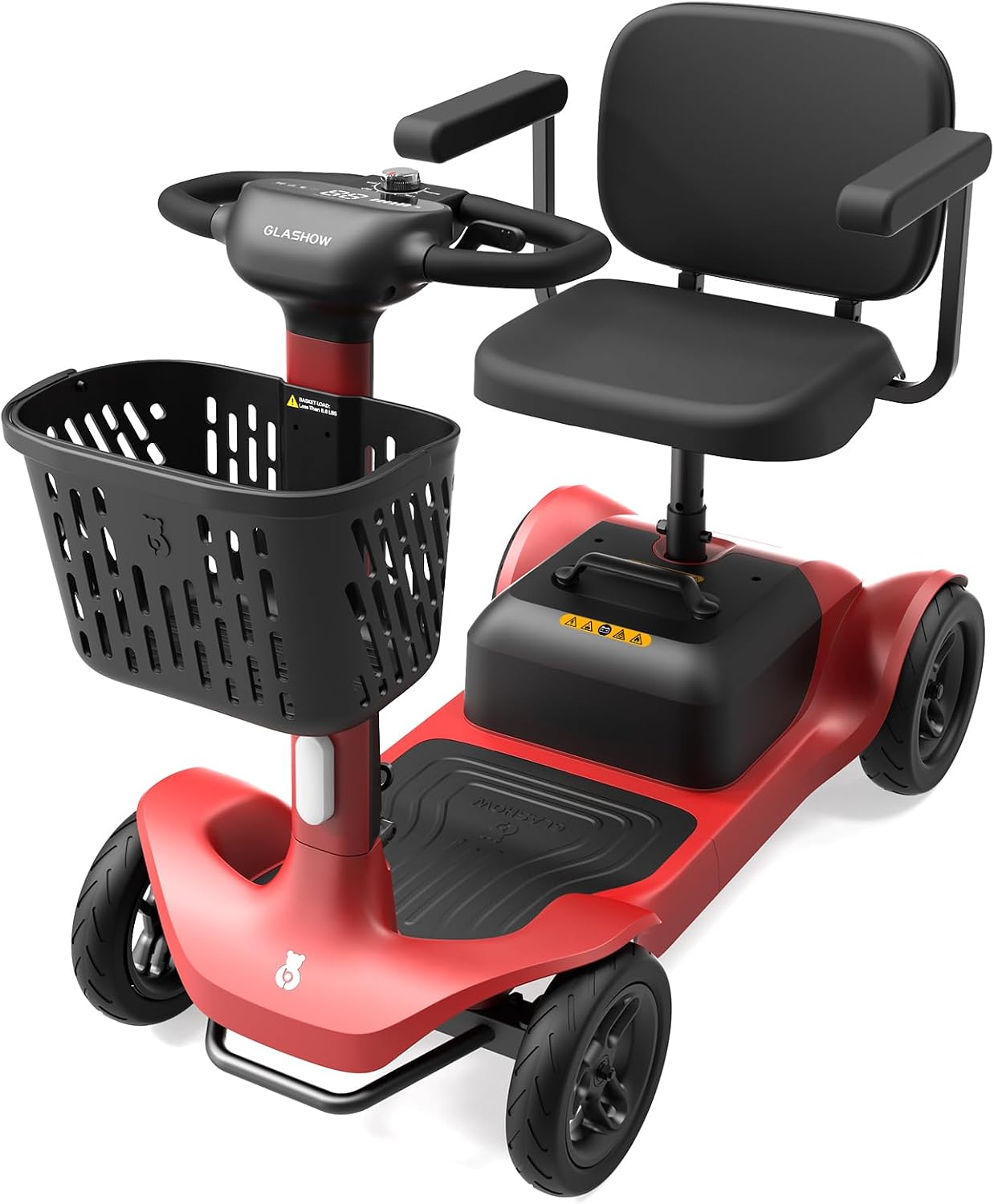
4.4★ (46 ratings) · 10″ wheels · rated ~25 mi range · 265 lb limit
Why Omaha: 10″ wheels are the biggest of the four, which is what you want over rutted ice and a curb the plough built. Check the 265 lb limit, a parka and boots count.
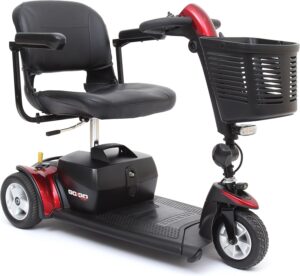
4.4★ (109 ratings) · compact · up to 325 lb
Why Omaha: 325 lb and it comes apart to go indoors, which is where a battery should spend a Nebraska January. Three wheels are less sure-footed than four on ice, that is the trade.
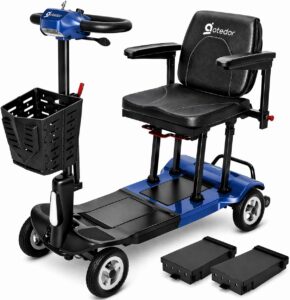
4.5★ (277 ratings) · folds compact · up to 300 lb
Why Omaha: the most owner ratings and the easiest to fold onto a bus or carry indoors. The smallest wheels of the four, though, which is the wrong end of an Omaha winter: best as a fair-weather and indoor machine.
Watch: our top pick in action
An independent walkthrough of the Golden Buzzaround EX, our top pick above, showing the four-wheel frame, seat, controls and how it comes apart to transport.
Video: Golden Buzzaround EX review (YouTube). Polaris Mobility is not affiliated with the reviewer.
Compare more 4-wheel models · full catalog
Omaha mobility scooter FAQ
Can you get MOBY paratransit in Omaha just for the winter?
Omaha Metro’s own page says: “Clients may be ADA paratransit eligible on a seasonal basis or on the basis of a permanent or temporary disability.” It also says “Clients may meet the ADA eligibility criteria with respect to some trips but not others. In that case, clients would be ADA paratransit eligible only for those trips for which they meet the criteria.” So you do not have to be permanently unable to use the bus, the test is functional and situational. The catch is timing: “Completed applications will be reviewed in 21 business days,” which is roughly a calendar month, so apply in the fall rather than waiting for the first ice. Send applications to MOBY Certification at [email protected], fax 402-342-3395, or 2222 Cuming St, Attn: MOBY Certification, Omaha, NE 68102.
How much does MOBY cost, and does someone traveling with me pay?
MOBY costs $2.50 to ride. Metro states that “A MOBY client’s Personal Care Attendant (PCA) rides for free, and a Companion pays the full MOBY fare”, so an attendant travels free but a friend pays $2.50. Book on 402-341-0800; reservations for next-day trips must be made no later than 4:30 p.m. the day before, and can be made up to 14 days in advance. MOBY serves corridors three-quarters of a mile on each side of each fixed route.
How much is the bus for seniors in Omaha?
Sixty cents. Metro’s half-fare is $0.60 against a standard $1.25, with transfers at $0.25: valid 90 minutes on weekdays and 120 minutes at weekends. A 10-ride pass is $6.00 at the half-fare rate against $12.50 standard, and a 30-day pass is $27.50 against $55.00. You must complete a half-fare application, separate forms exist for the age/Medicare route and the disability route, and Metro-issued photo IDs “must be shown to the operator when you pay your fare.”
Does the half-fare work on Omaha’s microtransit?
No. Metro states that “Pass programs and half-fare programs do not apply to microtransit services.” Microtransit costs $3.00 per ride including a transfer to or from the bus, or $4.25 for a microtransit plus MOBY trip, and it does not accept cash: you need the Umo app, a Umo card, paper tokens or the Metro Flex OMA app. So the most flexible service is the one that costs $3.00 rather than 60 cents, refuses your discount, and asks for a smartphone or a card.
What is the best mobility scooter for Omaha?
Our top pick is the Golden Buzzaround EX. Omaha’s paratransit runs within three-quarters of a mile of each bus route, which tells you the real job: short, repeated trips to a stop and back, in weather. Range is not the constraint, reliability is. This has the highest owner rating of the four, 330 lb of capacity for a winter coat, a stable four-wheel base and a manufacturer with a real service network. If you regularly cross broken ice, the Glashow S1’s 10-inch wheels are the biggest here, though its 265 lb limit is the lowest.