
Mobility Scooters in Wichita

Looking for a mobility scooter in Wichita, to buy or to rent? Two things about this city shape the answer. It is flat (genuinely, prairie flat), so hills never enter the conversation, which is a real gift to a scooter rider. And it is spread out and built around the car, with a modest bus network, so the thing you plan around is distance, not gradient. The bus itself is cheap: 85 cents at the half fare if you are 65 or over. This guide covers the fares and the ID you need to claim them, the Q-Line paratransit, an honest word about Kansas and Medicaid, tornado season, and the models that suit a flat city where you cover real ground. Polaris Mobility earns a commission on qualifying Amazon purchases through links on this page.
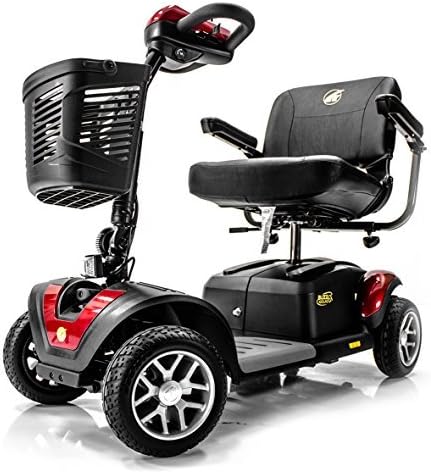
- Up to 330 lb
- Real brand service network
- Comes apart for a car trunk
- ★ 4.7 rating
Flat ground removes the case for big wheels, and modest transit means your scooter does real work rather than just the last block. In a car-built city, a lot of trips look the same: someone drives you, and you ride at the other end, so a scooter that comes apart for a trunk, with a comfortable seat for a hot afternoon and a maker whose parts you can get in a city far from the next one, is the sensible all-rounder. This has the highest owner rating here and the most capacity. On a tight budget, the Aotedor below is much cheaper and a genuinely good choice in Wichita.
On Medicare or Kansas Medicaid? Read the funding section, the honest version, before you pay out of pocket.
Eighty-five cents, and the ID you need for it
The half fare is genuinely cheap, but there is a step to it worth knowing, especially if your claim is disability rather than age.
- If you are 65 or over, this is simple: bring a driver’s license, photo ID or birth certificate. If you claim on disability, you also need the physician verification, so sort that with your doctor before you go.
- Where: apply at The Hub, 207 S Sycamore, Wichita, KS 67213. The first ID card is free; a replacement is $2, and further replacements $5, so look after it.
- The Q-Line is $3.50, four times the half-fare bus, and it is the ADA paratransit service for people who cannot use the fixed-route bus because of a disability or health condition. Certification is separate; start it before you need it.
Kansas and Medicaid: the honest, useful version
That reads like a wall, and for one group it is. But a page about mobility scooters owes you the precise version, because whether it affects you depends on which person you are, and for two of the three, it barely does.
- If you are 65 or older, none of this touches you: you are on Medicare, which is federal and unaffected by what Kansas chose.
- If you are under 65 with a disability, Kansas Medicaid, KanCare, covers aged, blind and disabled people through separate pathways with income and asset limits. Expansion was never your route in, so a disabled adult may qualify despite Kansas’s stance. Apply; do not assume the headlines describe you.
- The person the gap traps is the third one: an adult under 65, on a low income, not yet determined disabled and without dependent children. If that is you and a mobility condition is developing, the practical move is to pursue a formal disability determination, because in Kansas, as in the other non-expansion states, the disability pathway, not expansion, is the door that opens.
If you do qualify, KanCare can pay for medically necessary equipment such as a power wheelchair or scooter when a doctor documents the need and an enrolled provider supplies it. Ask your plan specifically about durable medical equipment.
Comparing options across the state? Our Kansas mobility scooter guide covers statewide Medicaid and Medicare details, the best models for the local climate and terrain, and how the picture changes from city to city.
Tornado season, on a scooter
- Sort your shelter plan now. If your safe place is a basement or cellar reached by steps, it is not a shelter you can use on a scooter. An above-ground reinforced safe room at ground level is the version you can actually reach; ask an installer about door width and threshold with your scooter in mind.
- Register if your county offers it. Many Kansas counties keep a special-needs or functional-needs registry so first responders can find people after a storm. Ask your county emergency management office.
- Keep the battery charged in season. Spring is the peak; a full battery is part of your weather kit, because if the power goes, the scooter is your mobility.
Renting vs. buying a mobility scooter in Wichita
In a flat, spread-out, car-built city, the scooter does more of the work than in a transit-rich one, which makes owning easier to justify, and buying within a season usually cheaper than renting.
- Keeps costing you. A travel scooter runs roughly $100 to $200 a week depending on model and city (Scootaround), so a month of regular use is several hundred dollars.
- You hand it back, and it never becomes yours.
- Not fitted or sized to you; you take whatever model is free.
- Reasonable for a visit.
- Pays for itself fast. A one-time purchase; after a few weeks of what renting costs you are ahead, and you keep the scooter.
- It comes apart for the car, in a city where family often drives you, a scooter that fits a trunk rides at the other end.
- It pairs with an 85-cent bus for the routes the network does cover.
- The budget model is a real answer in a lower-income city; a cheaper, folding scooter is not a compromise here.
Bottom line: buy if you live here, and buy the one that fits your car and your budget. On flat ground, even a modest scooter plus the odd 85-cent bus covers Wichita, and it is charged and ready when a storm is coming.
How to pay: Medicare, and Kansas Medicaid for those it covers
If you are 65 or older, Medicare is your route, and nothing in the expansion debate changes it. Part B may cover a scooter if a doctor confirms you need it to move around your home and you can operate one safely, through a supplier that accepts Medicare (Medicare.gov).
If you are under 65 with a disability, KanCare can cover you through its aged, blind and disabled pathways (the route Kansas’s non-expansion did not close), and can pay for medically necessary equipment when a doctor documents the need through an enrolled provider. If a mobility condition qualifies you, apply, and ask specifically about durable medical equipment. Start with your primary care provider.
Because these programs work through approved suppliers, a scooter bought on Amazon is a separate out-of-pocket purchase: which, in a non-expansion state, is exactly the position a great many people here are in. The cheapest scooter that fits you and lasts is the right one. Confirm current criteria directly, as they change.
Who needs mobility support in Wichita
15.4% of Wichita residents are 65 or older (61,117 people out of 396,488) a shade below the national 16.8%. On disability, Wichita reports 14.9%, above the national 13.0% and above Kansas’s 13.4% (U.S. Census Bureau, ACS 2023, 5-year).
That disability figure is the one to sit with. Nearly one Wichitan in seven reports a disability, a higher share than the state or the country, in a city that is flat and cheap to ride but spread out and car-dependent, and in a state that has chosen not to close its coverage gap. The people this page is for are not a small group here, and the combination they face is specific: the terrain is easy, the bus is cheap, the distances are long, and the help paying for a scooter depends on which side of a disability determination you fall. The flat ground and the 85-cent fare are the good news; the scooter is what turns them into independence.
Best mobility scooters for Wichita (2026)
Picks weighted for flat ground, long distances, a car trunk, prairie heat and a budget that often decides it. Specs are per manufacturer listings; confirm current details and price on Amazon.
| Model | Wheels | Max rider | Top speed | Owner rating |
|---|---|---|---|---|
| Golden Buzzaround EX ★ Top pick | 9″ (4-wheel) | 330 lb | 5.0 mph | 4.7★ (verified) |
| Aotedor Lightweight Best on a budget | 7″ | 300 lb | 3.7 mph | 4.5★ (277) |
| Pride Go-Go Sport | 3-wheel | 325 lb | 4.7 mph | 4.4★ (109) |
| Glashow S1 Folding | 10″ (4-wheel) | 265 lb | 6.2 mph | 4.4★ (46) |
4.7★ (verified owners) · 9″ wheels · up to 330 lb
Why Wichita: the comfortable all-rounder for a flat, spread-out city: highest rating and capacity, comes apart for a car trunk, and an established maker’s service network far from the next big city.
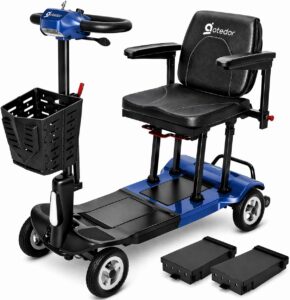
4.5★ (277 ratings) · folds compact · up to 300 lb
Why Wichita: the cheapest and most owner-reviewed here, and it folds into a trunk. On flat ground you never miss the bigger wheels, in a lower-income city, this is a genuine first choice, not a compromise.
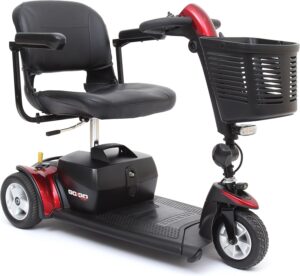
4.4★ (109 ratings) · compact · up to 325 lb
Why Wichita: 325 lb and it breaks into pieces for a trunk, from a well-established maker, ideal for a drive-and-ride city. A tight turning circle for shops and markets.
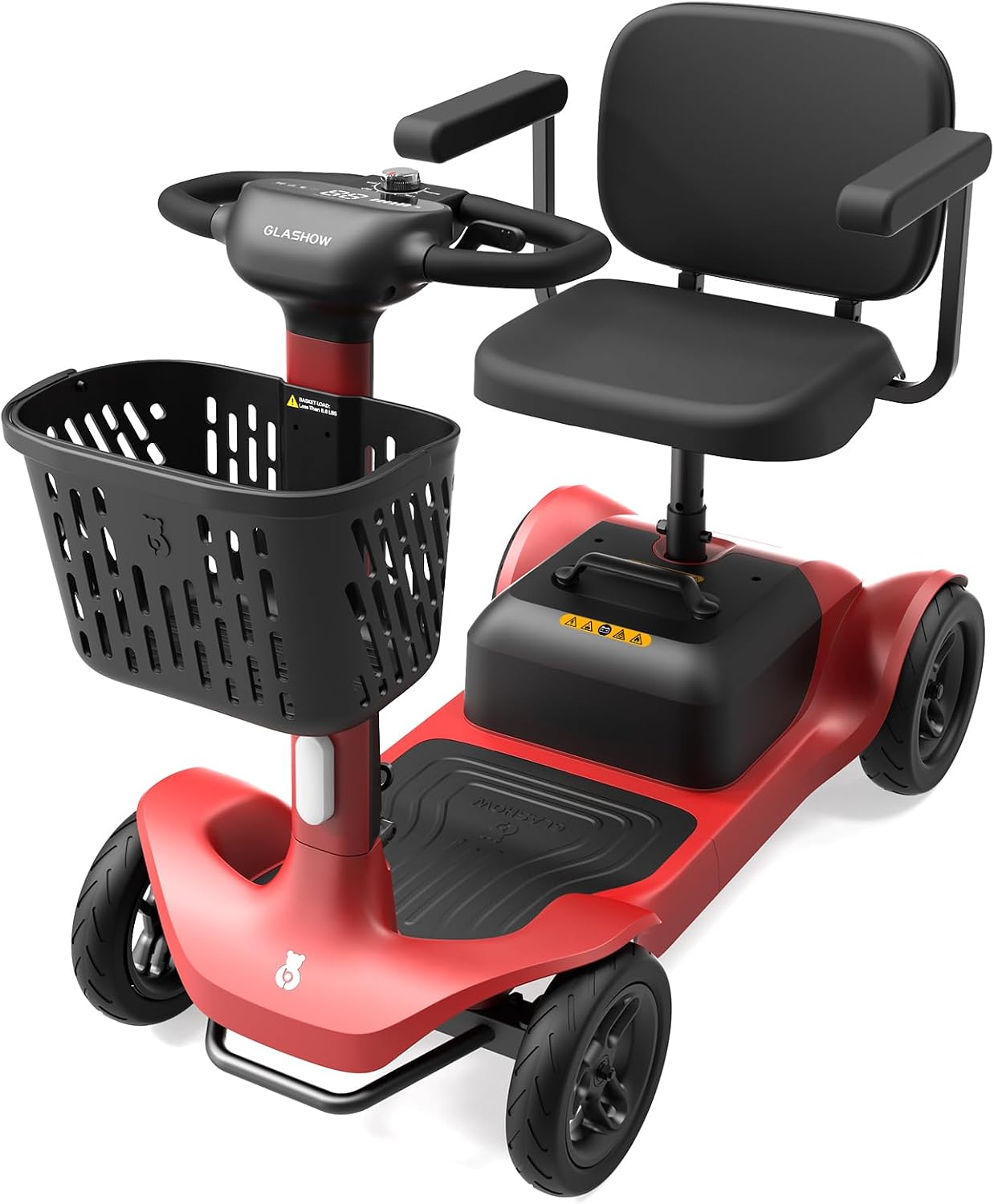
4.4★ (46 ratings) · 10″ wheels · rated ~25 mi range · 265 lb limit
Why Wichita: the longest range for the days you cover real distance yourself, and it folds. On flat ground the big wheels are less critical. Check the 265 lb limit, the lowest here.
Watch: our top pick in action
An independent walkthrough of the Golden Buzzaround EX, our top pick above, showing the four-wheel frame, seat, controls and how it comes apart to transport.
Video: Golden Buzzaround EX review (YouTube). Polaris Mobility is not affiliated with the reviewer.
Compare more 4-wheel models · full catalog
Wichita mobility scooter FAQ
How much is the bus for seniors in Wichita?
Eighty-five cents. Wichita Transit’s half fare is $0.85 against a standard $1.75 single ride, with a half-fare day pass at $2.50 versus $5.00. The Half-Fare Program covers people 65 and over, Medicare card recipients, and those with a physical or mental disability verified by a licensed physician: the disability route needs a doctor’s sign-off. You must carry a Wichita Transit ID card and show it when boarding; apply at The Hub, 207 S Sycamore. The first ID is free, a replacement is $2 and further replacements $5.
How much is Q-Line paratransit in Wichita?
$3.50 one way, four times the 85-cent half fare, for the ADA paratransit service, which serves people who cannot get to a stop, board the bus, or ride the fixed route by themselves because of a disability or health condition. Certification is separate from the half-fare ID, so start it before you need it.
Does Kansas Medicaid cover a mobility scooter if the state hasn’t expanded?
It can, for the people it covers. Kansas has not expanded Medicaid, so childless non-disabled adults under 65 generally cannot get it and parents qualify only around 38% of the federal poverty level, leaving an estimated 28,000 Kansans in the coverage gap. But KanCare covers aged, blind and disabled people through separate pathways with income and asset limits, and can pay for medically necessary equipment such as a power wheelchair or scooter when a doctor documents the need through an enrolled provider. So a disabled adult may qualify despite the state’s non-expansion; the gap mainly traps non-disabled low-income adults. If you are 65 or older, Medicare covers you regardless.
What is the best mobility scooter for Wichita?
Our top pick is the Golden Buzzaround EX. Wichita is flat, so big wheels earn little, and it is spread out and car-built, so the sensible scooter is a comfortable all-rounder that comes apart for a trunk: this has the highest owner rating of the four, 330 lb of capacity and a real service network in a city far from the next. But Wichita is also a lower-income city, and there the Aotedor Ultra Lightweight is a genuine first choice rather than a compromise: the cheapest and most owner-reviewed here, folding into a trunk, and on flat ground you never miss the bigger wheels.