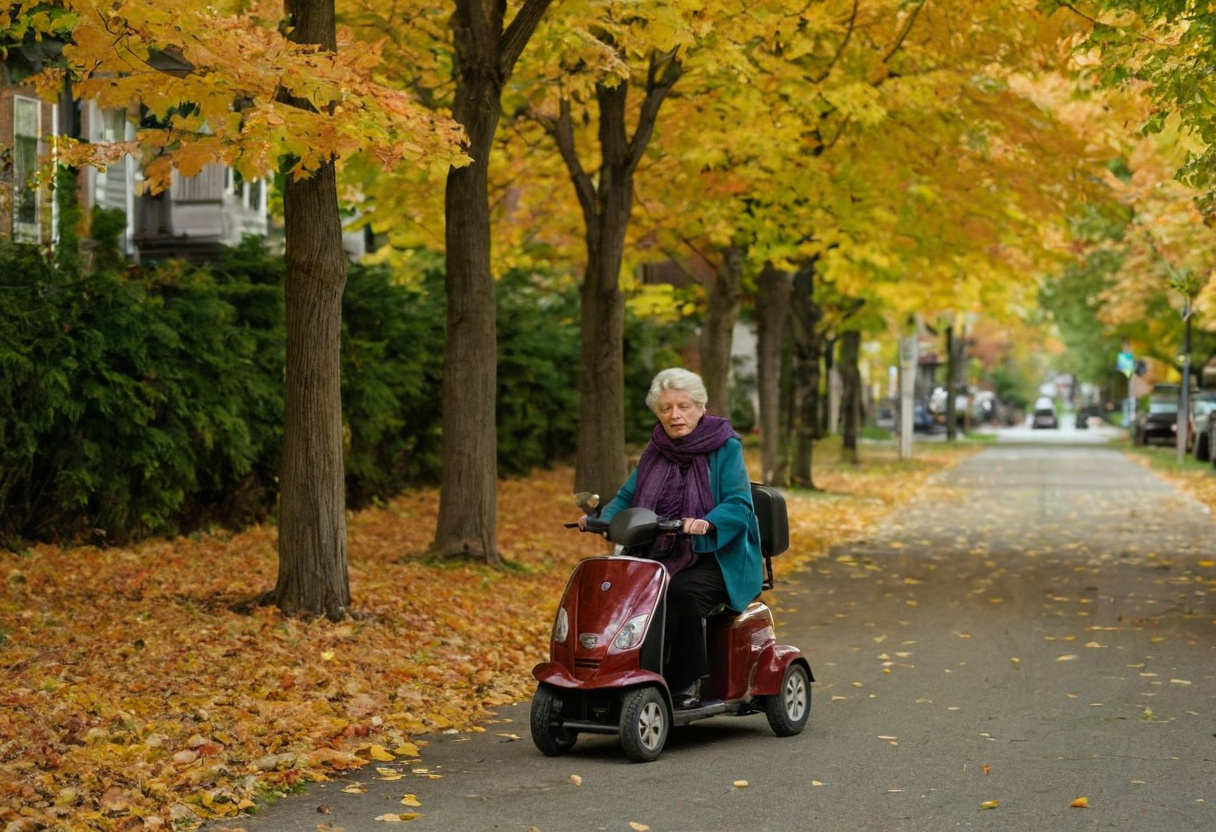
A lightweight mobility scooter in a Canadian winter is a cleared-sidewalk machine. In the KITE Research Institute test, half of the 8 scooter models could not climb a 4.8 degree snow-covered slope, and all but 1 failed the same slope on ice, and that grade is what a curb ramp is built to. Add a lithium pack that Pride tells owners to charge only between 0 and 40 C, and the real questions become how many cleared days your city gives you and which piece you can lift in gloves.
Mobility scooter for a Canadian winter: what a lightweight model can and cannot do
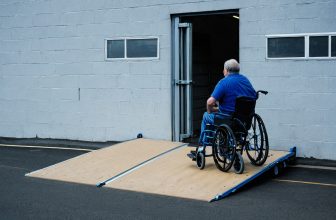
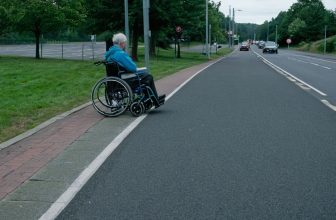
In the KITE Research Institute winter lab at the University of Toronto, two drivers weighing 50 and 100 kg ran 8 scooter models over concrete, 2.5 cm of snow and bare ice, and half of the models lost traction on a 1:12 (4.8 degree) snow-covered slope while all but 1 failed the same slope on ice. The paper’s own warning, published in Archives of Physical Medicine and Rehabilitation in October 2021, is the useful part: curb ramps built to a 1:12 slope, the grade the Americans with Disabilities Act allows, become treacherous or impassable once snow or ice covers them. The U.S. Access Board guide confirms it: a curb ramp’s running slope is 1:12 maximum, so the lab slope is every curb cut on your route.
Cornering went the same way: on concrete every scooter rounded corners almost perfectly, but on ice and snow around two out of three scooters failed. Prototype winter tires permitted the 4.8 degree ice ascent, but no source sells such a tire for a lightweight scooter.
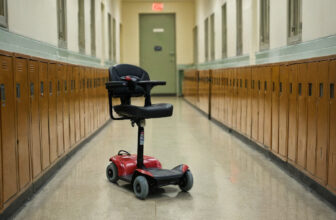
The lightweight class rides on small solid tires, which is why the KITE numbers bite harder here than on a heavy-duty machine: Pride lists the Go-Go Ultra X on 2 x 8 in front and 2.5 x 8 in rear solid tires with 1.25 in of ground clearance at the motor; the Go-Go Sport runs 3 x 8 in front and 3 x 9 in rear solid tires with 1.5 in of clearance. The lab’s 2.5 cm of snow is not far under the Ultra X’s clearance, and Pride’s Go-Go owner’s manual settles the rest: operating in rain, snow, salt, mist or spray and on icy slippery surfaces is listed as prohibited.
Verified data
- Half of 8 scooter models failed a 4.8 degree snow slope; all but 1 failed the same slope on ice. Montgomery et al., Arch Phys Med Rehabil, 2021
- Curb ramp running slope: 1:12 maximum, the grade the lab used. U.S. Access Board, ADA guide
- Pride lithium battery: charge at 0 to 40 C, store at -5 to 25 C, operate at -20 to 50 C. Pride Mobility lithium FAQ, 2026
- Montreal: 101.3 days a year with 1 cm or more of snow on the ground; Vancouver: 8.2. ECCC climate normals 1991-2020
- Ontario ADP pays 75 percent of the Approved Price; the client pays 25 percent. Ontario ADP mobility devices manual, 2023
How much range a mobility scooter battery loses in the cold
A lithium-ion cell delivers 80 percent of its 25 C capacity at 0 C and 50 percent at -10 C on the manufacturer’s datasheet (0.2C discharge after a standard charge), so plan any rated range as materially shorter on a morning below freezing.
Charging has a hard floor at freezing, because a sub-freezing charge plates metallic lithium on the anode and the damage is permanent. Pride prints the same limits for its lithium packs: charge at 0 to 40 C (optimal 20 C), store at -5 to 25 C, operate at -20 to 50 C. A Winnipeg garage, with lows below -20 C on 51.9 days a year, sits outside Pride’s storage band all January.
On a spec sheet that limit sits under operating temperature as two separate ranges, one for charging and a wider one for discharging. Two of the scooters on this page run sealed lead-acid rather than lithium: the Go-Go Ultra X on two 12 Ah batteries at 9 lb each, the Go-Go Sport on batteries of 14 lb each. No per-temperature capacity table for sealed lead-acid could be verified (the manuals publish a curve, not numbers), so the only sourced lead-acid rule is Pride’s: protect the batteries from freezing and never charge a frozen battery.
Lightweight mobility scooter Canada: how many days a year the sidewalks are yours, city by city
Montreal averages 101.3 days a year with at least 1 cm of snow on the ground and 60.4 days with a minimum below -10 C, while Vancouver averages 8.2 snow-cover days and 0.85 days below -10 C, so the same small-wheel scooter is a year-round ride on the coast and a two-season ride in Quebec. Environment and Climate Change Canada’s 1991-2020 normals give two columns that map onto the lab result: snow-cover days (the KITE scooters slipped on 2.5 cm) and days below -10 C (half the cell capacity gone). Toronto’s downtown station publishes no snow-depth days, so both stations appear.
| City (ECCC station) | Days with snow depth 1 cm or more | Days with snow depth 5 cm or more | Days with minimum below -10 C | Days with maximum at or below 0 C | January mean |
|---|---|---|---|---|---|
| Vancouver | 8.2 | 4.4 | 0.85 | 2.8 | 4.1 C |
| Toronto (Pearson) | 68.6 | 37.4 | 34.2 | 49.5 | not published |
| Toronto (City, downtown) | not published | not published | 22.0 | 43.9 | -3.5 C |
| Calgary | 92.5 | 48.6 | 72.3 | 61.2 | -7.6 C |
| Montreal | 101.3 | 77.9 | 60.4 | 72.8 | -9.2 C |
| Winnipeg | not published | not published | 104.5 | 114.7 | -16.3 C |
Calgary gets fewer snow-cover days than Montreal (92.5 against 101.3) but more days below -10 C (72.3 against 60.4), so a Calgary buyer’s problem is battery capacity on a cleared sidewalk, while a Montreal buyer’s problem is the sidewalk itself. Winnipeg’s 104.5 days below -10 C keep the scooter indoors for a third of the year regardless of plowing. City pages with transit and retailer detail sit in the mobility scooter city guides.
Lightweight folding mobility scooter Canada: the heaviest piece you lift in gloves
The heaviest single lift runs from 29.5 lb for the Go-Go Ultra X front section to 35.75 lb for the Go-Go Sport front section. In winter that piece comes over an icy trunk sill or a plowed windrow at the curb, in gloves, so the take-apart models with a sub-30 lb heaviest piece earn their assembly steps.
| Model | How it packs | Heaviest lift | Total weight | Tires | Rider capacity | Rated range (warm) |
|---|---|---|---|---|---|---|
| Pride Go-Go Ultra X 3-wheel | disassembles | 29.5 lb front section | 95.75 lb with batteries, 76.25 lb without | 8 in solid | 300 lb (brochure); 260 lb on the Amazon listing | up to 8 mi at 200 lb rider, 6.2 mi at 300 lb |
| Pride Go-Go Sport 3-wheel | disassembles | 35.75 lb front section | 122.25 lb with batteries, 92.75 lb without | 8 in front, 9 in rear, solid | 325 lb | up to 12.75 mi |
| Hoverfly T4 | folds; battery removes | 21 lb battery, then the folded scooter | 100.86 lb net (maker); 96 lb on the Amazon listing | 9 in PU solid | 330 lb | 12.4 mi |
| Aotedor folding 4-wheel | folds as one piece | whole scooter: 37.58 lb (maker), 36 lb (Amazon) | same as the lift | 7 in | 275 lb (maker); 300 lb on the Amazon listing | up to 20 mi (maker); 22 mi on the Amazon listing |
The Go-Go Sport at 122.25 lb is a take-apart scooter, not a lightweight one. The other 4-wheel folding scooter linked at the end of this page is sold as a 37.5 lb model, yet the Amazon listing’s item weight read 52.91 lb with a 275.57 lb capacity in June 2026, so weigh the box, not the headline. No verified spec exists for the Ecomobi folding scooter. For a longer list sorted by lift, see lightweight mobility scooters one person can lift, and for folded dimensions against trunk openings, mobility scooters that fit in a car trunk.
Best mobility scooter Canada: price in CAD and what the province pays
The Amazon.com listings captured for this site in June 2026 ran from $599.99 USD for the Hoverfly T4 to $1,601 USD for the Go-Go Sport, with the Go-Go Ultra X at $1,193, the Aotedor at $1,299 and the 37.5 lb folding scooter at $999. Amazon.ca prices in CAD and ship-to-Canada status could not be verified, so the USD figures are the only dated prices given.
Provincial help exists, but the online-bought lightweight class mostly sits outside it: Ontario’s Assistive Devices Program pays 75 percent of the cost of a mobility aid, billed directly by an ADP-registered business, and 100 percent for people on Ontario Works, ODSP or Assistance for Children with Severe Disabilities, for a resident with a valid health card, a disability lasting 6 months or longer, and an ADP-registered therapist’s assessment. The ADP mobility devices manual adds the scooter conditions: 75 percent of the Approved Price, the vendor charges the client the other 25 percent, the scooter must not be intended as a replacement for a car, and applicants who need postural seating are not eligible for a scooter. Because the ADP pages describe billing only through a registered vendor, a scooter bought on Amazon has no vendor to bill through (an inference from the program text; confirm with an ADP-registered vendor).
- Quebec runs a loaner scooter program with no fees or deductibles, for a persistent inability to walk 30 m or significant difficulty using a manual wheelchair over 150 m, on a certificate from a doctor or specialized nurse practitioner; the page says nothing about reimbursing a private purchase.
- British Columbia’s medical equipment policy for income and disability assistance recipients caps a conventional scooter with accessories at $3,500 ($4,500 bariatric), after a therapist assessment, with a 5-year replacement period.
- Alberta’s AADL power mobility manual puts scooters on the exclusion list: not funded.
- Veterans Affairs Canada, under its POC 13 equipment policy effective June 4, 2025, authorizes power mobility devices, an electric wheelchair or scooter, primarily for activities of daily living.
- Manitoba and the remaining provinces: no government scooter-funding statement was verified for this page; ask the provincial health ministry directly.
Sidewalk rules and snow clearing: when a winter trip can actually happen
Under Ontario’s Highway Traffic Act a person on a motorized wheelchair or medical scooter is treated the same as a pedestrian, with no registration, licence plate, driver’s licence or insurance required, and the City of Toronto’s crews start clearing all public sidewalks once 2 cm has fallen and the snow has stopped, a pass that takes approximately 12 hours. Those two facts set the earliest safe trip in Toronto: the sidewalk is the legal place to ride (the notice makes it the first choice, then the left shoulder facing traffic), and the sidewalk is not yours until roughly half a day after the snow ends; under 2 cm, residents clear their own frontage within 12 hours.
Calgary’s Street Bylaw requires occupants to clear public sidewalks bordering their property to the bare surface within 24 hours of a snowfall ending, with fines of $250, $500 and $750 for first, second and third offences, while City crews spend the first 18 hours on the busiest routes. Winnipeg’s policy starts sidewalk plowing after 5 cm of accumulation and completes it within 36 hours after an average storm, and the standard for priority sidewalks is a compacted snow surface, not bare pavement, the surface the KITE scooters cornered worst on. Montreal plows once 2.5 cm is on the ground, salts as soon as surfaces turn slippery, and hauls snow away at 10 to 15 cm; no official Montreal page states an hours-after-snowfall sidewalk standard. Salt is the variable nobody budgets for: Pride’s manual lists it with snow and ice as a prohibited condition, so a scooter on salted Toronto or Montreal sidewalks in January runs outside its manual every trip.
Frequently asked questions
Will a lightweight mobility scooter get me through a Canadian winter?
On cleared, dry sidewalks, yes; on snow or ice, plan on failure. In the KITE lab test half of 8 scooter models could not climb a 4.8 degree snow slope and all but 1 failed it on ice, the grade of a curb ramp. Pride’s manual lists snow, salt and ice as prohibited.
How much range does a mobility scooter lose in the cold?
A lithium-ion cell datasheet shows 80 percent of rated capacity at 0 C and 50 percent at -10 C; Battery University’s general figure is 50 percent at -18 C. Plan the Aotedor’s 20 mi maker rating as roughly half on a -10 C day. No numeric table for the lead-acid packs in the Go-Go models and the T4 was verified.
Can I charge a lithium scooter battery in a cold garage?
Not below freezing. Battery University permits no charge below 0 C because lithium plates onto the anode and the damage is permanent; Pride’s lithium FAQ sets charging at 0 to 40 C with 20 C optimal, and Hoverfly tells T4 owners to let the battery warm indoors for 1 hour first. Store within Pride’s -5 to 25 C band.
Which is the best mobility scooter for Canada if I only ride on cleared sidewalks?
Pick by the heaviest piece and your city’s cold-day count. The Go-Go Ultra X asks for a 29.5 lb front-section lift and gives up to 8 mi with a 200 lb rider; the Aotedor folds as one 36 lb unit (Amazon listing) rated 22 mi. In Calgary, with 72.3 days below -10 C, the battery decides; in Montreal, with 101.3 snow-cover days, plowing does.
Can I bring a lightweight folding scooter on a flight within Canada?
CATSA permits a lithium battery that operates a mobility device, plus one spare of up to 300 Wh, at the security checkpoint, and says to check with the carrier for checked baggage. Pride tells owners to read the watt-hours printed on the battery and call the airline first. Airline procedure lives on the travel scooter page.
Other models worth comparing: a folding travel scooter, the Ecomobi folding scooter.