For a heavier rider, weight capacity is the one specification that outranks everything else, and it has to cover whatever you carry as well as you. Choose a rating you sit comfortably under rather than one you sit at the edge of. Four wheels spread the load better than three when you lean or turn, and seat width is a separate measurement: a scooter can be rated for your weight and still be too narrow to sit in all day.
- In the U.S., 27.7% of adults 65+ and 16.8% of adults 45–64 report a mobility disability (serious difficulty walking or climbing stairs).
- In Canada, about 3.13 million adults live with a mobility-related disability, which is 63% of disabled seniors.
- Mobility disability is reported more often by women than men (13.6% vs 10.5%).
Sources: U.S. CDC Disability & Health Data System (DHDS), BRFSS 2021; Statistics Canada, Canadian Survey on Disability 2022.
For heavier riders, one spec matters above all others: weight capacity. A scooter loaded beyond its rating is unsafe, because the motor strains, the frame is stressed, and stability suffers. The job is to match a genuinely stronger scooter to your weight, with margin, and pair it with a supportive seat and a stable base.
Match capacity to your weight, with margin
Never ride a scooter at or over its rated limit, and remember that anything you carry counts too. Choose a model rated comfortably above your weight. Travel scooters typically top out around 300–330 lb; true heavy-duty and bariatric models are built for 400–500 lb or more. If you are near the top of a travel scooter’s range, step up to a heavy-duty class rather than pushing a lighter frame to its limit.
What makes a scooter genuinely heavy-duty
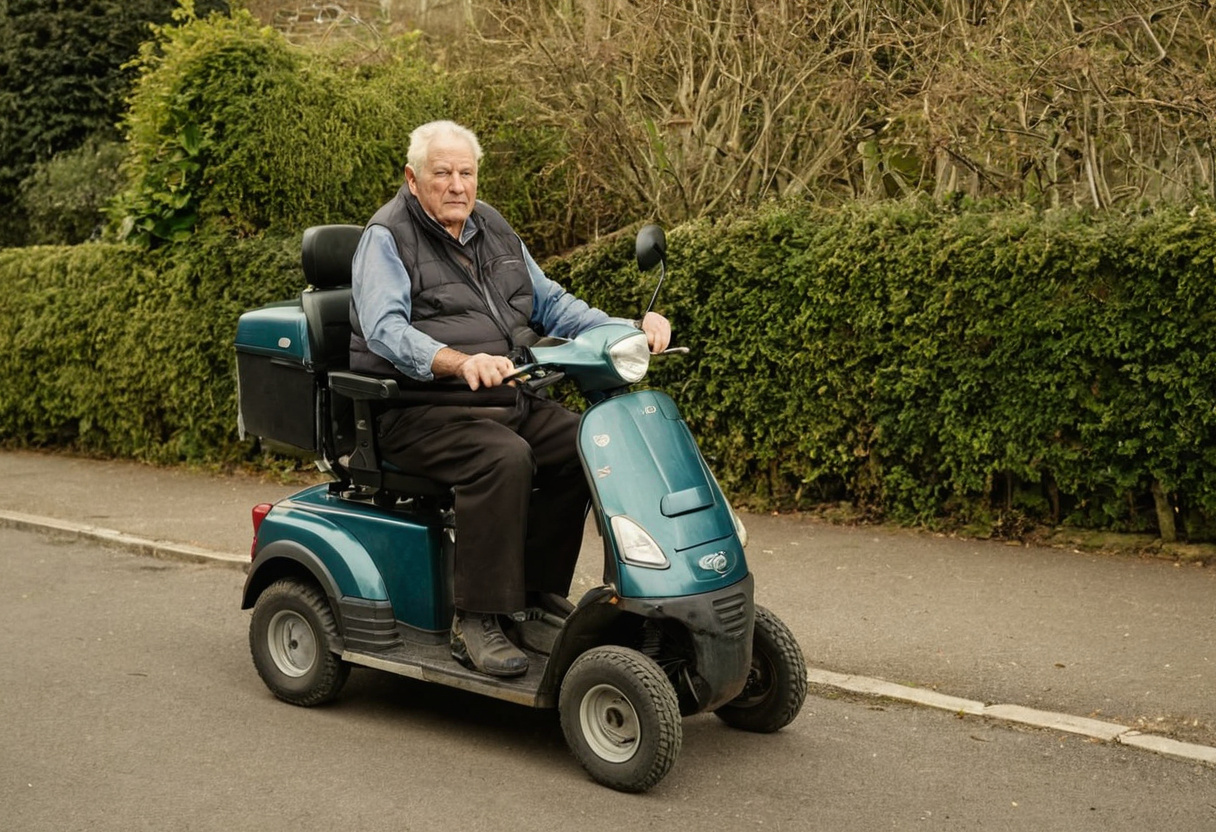
Capacity on paper is not enough. A heavy-duty scooter also needs a reinforced frame, a stronger motor for slopes under load, a stable four-wheel base, and robust tires and brakes. Four wheels spread the load and resist tipping far better than three when a heavier rider leans or turns. Our guide to the best four-wheel scooters compares the most stable models.
Seat width and comfort
Capacity keeps you safe; the seat keeps you comfortable enough to actually use the scooter. Look at the seat dimensions, not just the weight limit, because a scooter can be rated for your weight and still feel narrow. Aim for a wide, firmly padded seat (around 18–22 inches) with width-adjustable armrests, and a supplier can fit a wider aftermarket seat if you need one.
Range, batteries and transport
A heavier load draws more from the battery, so real-world range will be shorter than the headline number. Keep it charged and plan trips with margin. Heavy-duty models are also larger and less portable; if you need something you can fold for a car while still carrying a solid load, a model like the Ecomobi folding scooter (up to ~300 lb) bridges the gap, though it is not a true bariatric machine.
Heavy-duty FAQ
What weight capacity do I need?
Pick a rating comfortably above your weight, counting anything you carry. Exceeding the limit is a safety issue, since the motor, frame and brakes are all rated to it. If you are near 330 lb, move up to a heavy-duty model rated 400 lb or more.
Are three or four wheels better for heavier riders?
Four wheels are usually safer: they spread the load and resist tipping better when you lean or turn. A three-wheel model turns tighter indoors, but for outright stability under weight, four wheels win.