
Mobility Scooters in Raleigh

Looking for a mobility scooter in Raleigh, to buy or to rent? Raleigh is generous with fares in a way few cities are, and then does something strange at the last step. If you are 65 or over you ride free. If you are 13 to 18 you ride free. If you are 19 to 64 and on Medicaid or SNAP, or your household income is under $35,000, you ride free. If you have a disability, you pay 60 cents. And if you cannot use the bus at all and need the door-to-door van, you pay $2.50: the most expensive fare on the system. This guide walks through that ladder, a free bus pass that several hundred thousand North Carolinians won in the last two years without being told, and 27.5 miles of paved trail that the city says outright is for scooters. Polaris Mobility earns a commission on qualifying Amazon purchases through links on this page.
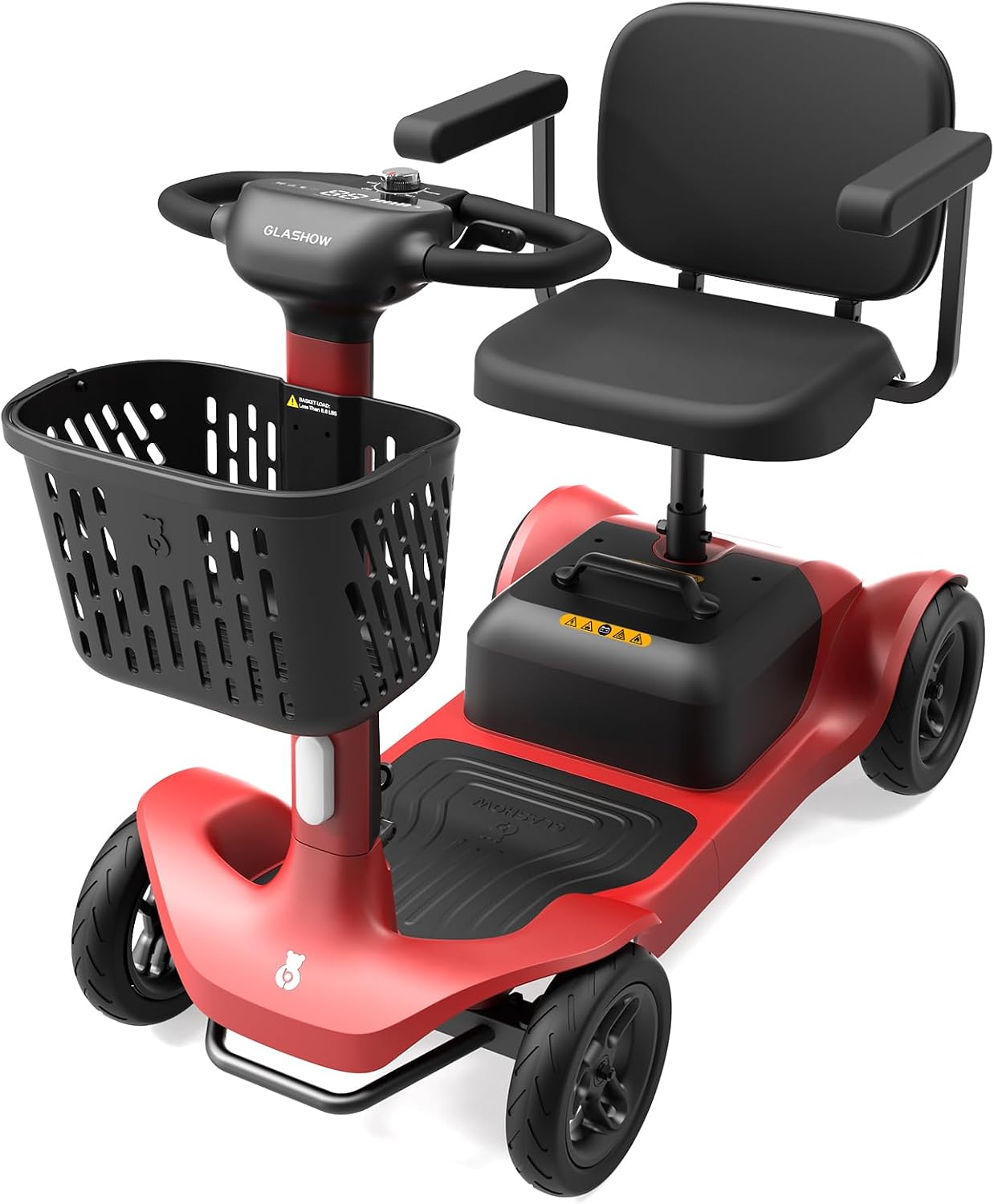
- Rated ~25 mi range
- 10″ wheels
- 6.2 mph
- 265 lb limit
Here is a fact that decides this pick. The Neuse River Greenway Trail is 27.5 miles of paved trail. The longest-range scooter on this page is rated at about 25 miles. Even the best of these cannot ride the Neuse one-way, which is not a criticism, it is a planning instruction: you go out and come back, and you turn round on the battery, not the scenery. So buy the longest range you can, and the biggest wheels for boardwalk joints and crushed granite. Check the 265 lb limit first: it is the lowest of the four.
On Medicare or NC Medicaid? Read the funding section: it may also get you a free bus pass.
The fare ladder, and the rung at the top of it
Set GoRaleigh’s fares side by side and the shape is hard to miss.
| Who you are | What you pay |
|---|---|
| Adult 65 or older (with a Senior ID) | Free |
| Youth 13–18 (with GoPass) | Free |
| Adult 19–64 on Medicaid or SNAP/EBT, or household income under $35,000 | Free |
| Person with a disability (reduced fare ID) | $0.60 |
| Standard adult single ride | $1.25 |
| Day pass $2.50 · 7-day $12.00 · 31-day $40.00 | |
| GoRaleigh Access: the door-to-door van, for people who cannot use the bus | $2.50 per trip |
To be precise, because it matters: the free tiers stack in your favor on the bus. A disabled person who is 65 or over rides free as a senior. A disabled person aged 19–64 on Medicaid or SNAP, or under $35,000 a year, rides free on income. The 60-cent disability fare only really bites someone with a disability, aged 19–64, earning above $35,000 and not on Medicaid. But none of that reaches GoRaleigh Access, the van is $2.50 for everybody.
- The IDs are one errand. Both the Senior ID and the reduced-fare ID come from GoRaleigh Station, 214 S Blount St, Raleigh, NC 27601. If you are turning 65, that trip is worth making the week you do.
- Where the van will go: a GoRaleigh Access trip is eligible only if it begins and ends within three-quarters of a mile of a GoRaleigh bus stop. Outside that band, the answer is no at any price.
The free bus pass 690,000 North Carolinians won and were never told about
More than 600,000 people enrolled in the first year (“in half the time that was first projected”), and more than 690,000 newly eligible North Carolinians have gained coverage since (NCDHHS).
Now join them up. Every one of those people, if they live in Raleigh and are between 19 and 64, also became eligible for a free bus pass on the day their Medicaid started. Nobody sends you a letter about that. The health department signed you up for health care; the transit agency has a separate desk. If you gained Medicaid in the last two years and you are under 65, go and ask for the GoPass. It is the least-known consequence of the biggest health-policy change this state has made in a decade.
And if you are 65 or over, none of the above applies to you, because you already ride free on age alone.
27.5 miles the city says are for you
The centrepiece is the Neuse River Greenway Trail: “27.5 miles of paved trail”, with “winding boardwalk areas through wetlands”, connecting to Abbotts Creek Trail, Buffalo Road Athletic Park, Anderson Point Park and Milburnie Dam, and running on to Wake Forest, Knightdale and Johnston County (City of Raleigh).
- Do the battery arithmetic before the first ride. 27.5 miles of trail against a scooter rated at about 25 is not a match. Ride out and back from one of the parking areas, and turn round at a third of your range, not a half: a greenway has no bus stop on it.
- Boardwalks are lovely and they are joints. Wetland boardwalk sections mean regular small ridges. Bigger wheels ride them better; small ones find every one.
- Plan the practical bit, because the city does not. Raleigh lists parking across five segments of the Neuse trail: Horseshoe Farm Rd., Buffaloe Rd., Anderson Point Dr. and others, but its page does not mention restrooms anywhere. That is not proof there are none; it is a reason to check before you commit to a long ride rather than find out at mile nine.
- Summer is the constraint, not the surface. Go early. Carry water. Wetlands in a Carolina July are humid in a way that a photograph never conveys.
Renting vs. buying a mobility scooter in Raleigh
With the bus free at 65, the scooter is not your transport budget: it is what turns a free bus and a hundred miles of greenway into somewhere you can actually go.
- Keeps costing you. A travel scooter runs roughly $100 to $200 a week depending on model and city (Scootaround), so a month of regular use is several hundred dollars.
- You hand it back, and it never becomes yours.
- Not fitted or sized to you; you take whatever model is free, and whatever range is free.
- Delivery windows, deposits and return deadlines to plan around.
- Pays for itself fast. A one-time purchase; after a few weeks of what renting costs you are ahead, and you keep the scooter.
- It rides a free bus with you and then rides the greenway when you get off it.
- It is the alternative to a $2.50 van: the one fare on this system nobody gets free.
- Spread the cost. Many scooters offer monthly payments at checkout or through your card.
Bottom line: buy if you live here. Get the Senior ID the week you turn 65, ask about the GoPass if you are under 65 and on Medicaid, and keep the van for the days the weather beats you.
How to pay: Medicare and NC Medicaid
If you are 65 or older, Medicare is your route. Part B may cover a scooter if a doctor confirms you need it to move around your home and you can operate one safely, through a supplier that accepts Medicare (Medicare.gov).
If you are under 65, North Carolina is a different state than it was three years ago. Expansion launched on 1 December 2023 and covers adults 19–64 up to 138% of the federal poverty level. Medicaid can pay for medically necessary equipment such as a power wheelchair or scooter when a doctor documents the need and it is supplied through an enrolled provider. Start with your primary care provider or your health plan, and ask specifically about durable medical equipment and which suppliers they will authorize.
Because these programs work through approved suppliers, a scooter bought on Amazon is a separate out-of-pocket purchase, which is why many buyers who do not qualify, or cannot wait out an authorization, choose one for the lower price and immediate delivery. Confirm current criteria directly, as they change.
Comparing options across the state? Our North Carolina mobility scooter guide covers statewide Medicaid and Medicare details, the best models for the local climate and terrain, and how the picture changes from city to city.
Who needs mobility support in Raleigh
Raleigh is young and, by these measures, remarkably well, and the gap with its own state is one of the widest on this site. 11.7% of Raleigh residents are 65 or older (55,029 people out of 470,763) against North Carolina’s 16.9% and a national 16.8%. On disability the distance is starker still: 9.6% of Raleigh residents report one, against 13.4% across North Carolina and 13.0% nationally (U.S. Census Bureau, ACS 2023, 5-year).
Fewer than one Raleigh resident in ten reports a disability. That is the Research Triangle in a number: a city that pulls in young, working, healthy people and exports the rest of the demographic to everywhere else in the state. It has a comfortable consequence and an uncomfortable one. Comfortable: the fare policy here is generous partly because the bill is small. Uncomfortable: if you are the one in ten, you are a minority inside a minority, and services designed around a young median are not designed around you. The $2.50 van at the bottom of that fare table is what that looks like in practice.
Best mobility scooters for Raleigh (2026)
Picks weighted for long paved greenway, wetland boardwalk joints, Carolina humidity and a free bus to ride with. Specs are per manufacturer listings; confirm current details and price on Amazon.
| Model | Wheels | Max rider | Rated range | Owner rating |
|---|---|---|---|---|
| Glashow S1 Folding ★ Top pick | 10″ (4-wheel) | 265 lb | ~25 mi | 4.4★ (46) |
| Golden Buzzaround EX If 265 lb is close | 9″ (4-wheel) | 330 lb | Shorter | 4.7★ (verified) |
| Pride Go-Go Sport | 3-wheel | 325 lb | Shorter | 4.4★ (109) |
| Aotedor Lightweight | 7″ | 300 lb | Shortest | 4.5★ (277) |
4.4★ (46 ratings) · 10″ wheels · rated ~25 mi range · 265 lb limit
Why Raleigh: the greenway is longer than any of these can ride, so buy the most range and the biggest wheels for boardwalk joints. Check the 265 lb limit, the lowest of the four.
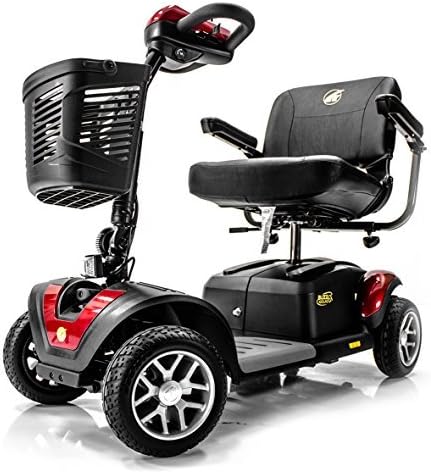
4.7★ (verified owners) · 9″ wheels · up to 330 lb
Why Raleigh: 330 lb, the highest owner rating here and a real service network, with a seat built for a long humid morning. Less range than the Glashow, which on a 27.5-mile trail you will notice.
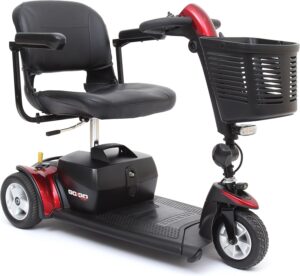
4.4★ (109 ratings) · compact · up to 325 lb
Why Raleigh: 325 lb and it breaks down for a trunk, which is how you reach a Neuse trailhead. Four wheels feel steadier over boardwalk ridges.
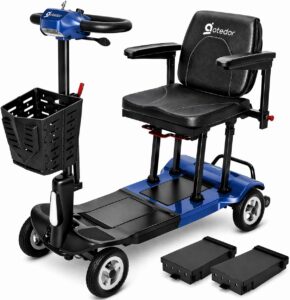
4.5★ (277 ratings) · folds compact · up to 300 lb
Why Raleigh: the most owner ratings and the easiest to fold onto a free bus. The shortest legs and smallest wheels, though: a good errands machine rather than a greenway one.
Watch: the Golden Buzzaround EX reviewed
An independent walkthrough of the Golden Buzzaround EX, the higher-capacity alternative in the comparison above, showing the four-wheel frame, seat, controls and how it comes apart to transport.
Video: Golden Buzzaround EX review (YouTube). Polaris Mobility is not affiliated with the reviewer.
Compare more 4-wheel models · full catalog
Raleigh mobility scooter FAQ
Do seniors ride the bus free in Raleigh?
Yes. GoRaleigh states: “Are you an adult age 65 or older? You can ride GoRaleigh and GoTriangle buses for free with a Senior ID!” You collect the Senior ID from GoRaleigh Station, 214 S Blount St, Raleigh, NC 27601. Youth aged 13–18 also ride free with a GoPass, and adults aged 19–64 who qualify for Medicaid or SNAP/EBT, or whose household income is below $35,000, ride free too. People with a disability get discounted fares rather than free travel, $0.60 against a standard $1.25.
How much is GoRaleigh Access paratransit?
$2.50 per trip: the most expensive fare on the system, and the one nobody rides free. A trip is eligible only if it begins and ends within three-quarters of a mile of a GoRaleigh bus stop. The pattern is worth naming: a 70-year-old rides the fixed-route bus for nothing, but if they cannot reach that bus (which is why paratransit exists) every trip costs $2.50. The free fare is attached to the vehicle you can manage, not to you.
Does being on Medicaid get you a free bus pass in Raleigh?
Yes, and it is the least-advertised consequence of North Carolina’s Medicaid expansion. GoRaleigh gives a free GoPass to adults aged 19–64 who qualify for Medicaid or SNAP/EBT, or whose household income is below $35,000. North Carolina became the 40th state to expand Medicaid: signed into law on 27 March 2023 and launched on 1 December 2023, covering adults 19–64 up to 138% of the federal poverty level, or single people earning under about $20,000. More than 600,000 people enrolled in the first year and more than 690,000 have gained coverage since. If you are one of them and under 65, go and ask for the GoPass: nobody sends a letter about it.
Can you ride a mobility scooter on Raleigh’s greenways?
The city says so in as many words. Describing the Capital Area Greenway, Raleigh writes that it is “perfect for walking, cycling, or using a wheelchair or scooter.” The Neuse River Greenway Trail is “27.5 miles of paved trail” with winding boardwalk areas through wetlands, connecting to Abbotts Creek Trail, Buffalo Road Athletic Park, Anderson Point Park and Milburnie Dam. One planning note: the city lists parking across five segments of the Neuse trail but does not mention restrooms on that page, so check before committing to a long ride.
What is the best mobility scooter for Raleigh?
Our top pick is the Glashow S1 Folding, and one number decides it: the Neuse River Greenway Trail is 27.5 miles of paved trail, while the longest-range scooter here is rated at about 25 miles. Even the best of these cannot ride it one-way, so buy the most range you can and plan to turn round on the battery rather than the scenery: a greenway has no bus stop on it. Its 10-inch wheels also handle boardwalk joints better than smaller ones. Check the 265 lb limit first, the lowest of the four; if you are near it, the Golden Buzzaround EX takes 330 lb and has the highest owner rating.