There are three ways to take a mobility scooter by car: an exterior carrier on a trailer hitch, an interior boom hoist inside a van or SUV, and loading ramps. The choice turns on two numbers rather than preference. Your scooter’s actual weight including the battery has to sit under the lift’s rated capacity, and an exterior carrier needs a hitch rated for the loaded weight of carrier and scooter together.
- In the U.S., 27.7% of adults 65+ and 16.8% of adults 45–64 report a mobility disability (serious difficulty walking or climbing stairs).
- In Canada, about 3.13 million adults live with a mobility-related disability, which is 63% of disabled seniors.
- Mobility disability is reported more often by women than men (13.6% vs 10.5%).
Sources: U.S. CDC Disability & Health Data System (DHDS), BRFSS 2021; Statistics Canada, Canadian Survey on Disability 2022.
The three main ways to bring your scooter along
Getting your mobility scooter into or onto a vehicle usually comes down to three approaches: an exterior lift that rides on your vehicle’s trailer hitch, an interior lift that hoists the scooter inside a van or SUV, and a set of loading ramps you drive or push the scooter up. Each suits a different mix of vehicle, scooter weight, and how much lifting you can comfortably do yourself.
Exterior hitch-mounted carriers and swing-away lifts
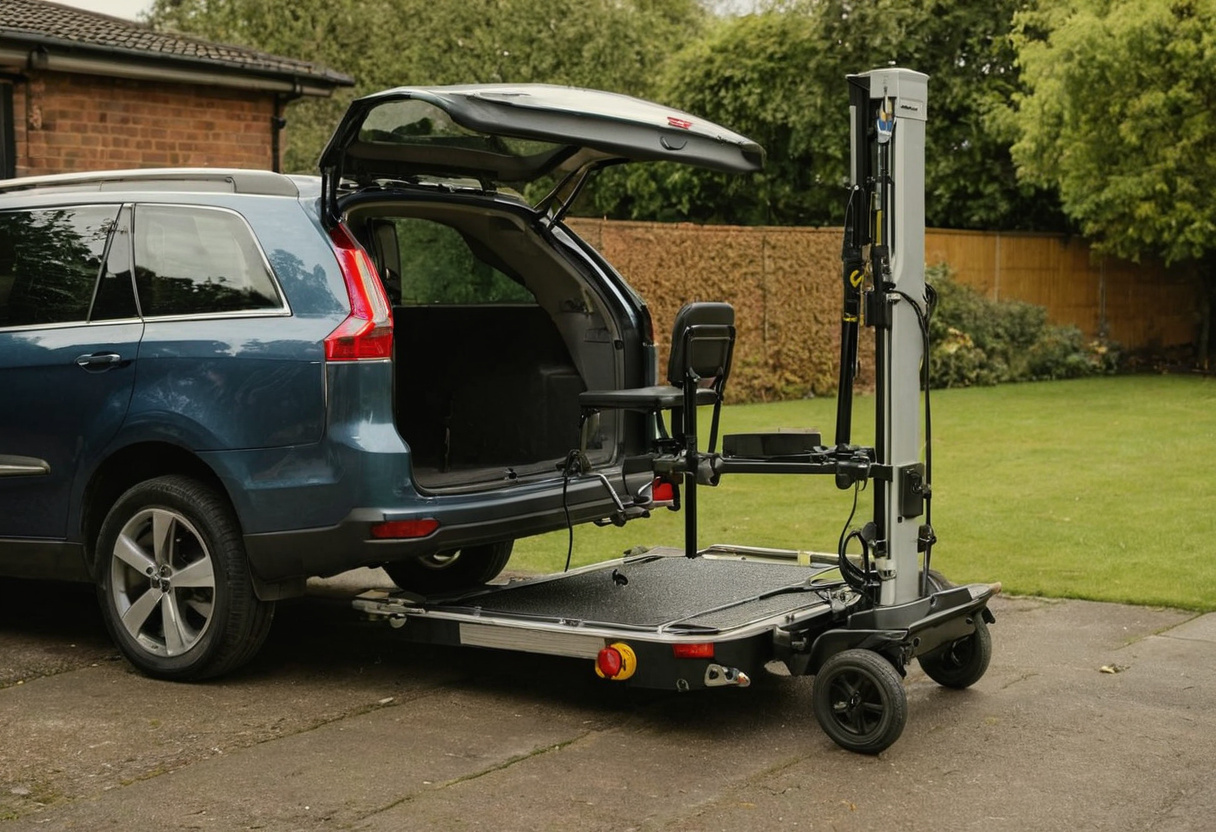
An exterior carrier attaches to a receiver hitch at the back of your car, SUV, or minivan and holds the scooter outside the vehicle. There are two common styles. A platform (or ramp) carrier is a flat tray you roll the scooter onto; some are fully powered, raising and lowering the scooter with the push of a button so you never lift it. A swing-away or boom-style lift uses a powered arm to pick the scooter up and set it on a small platform.
- Pros: Keeps your passenger seats and cargo space free, works with many vehicle types, and powered versions require little or no lifting from you.
- Cons: The scooter is exposed to weather and road grime, it adds length behind your vehicle to watch when parking, and it may cover your license plate or lights unless the carrier provides a relocation kit.
Interior boom and hoist lifts
An interior lift mounts inside the cargo area of a van, minivan, or larger SUV. A boom arm with a hook or docking device lifts the scooter off the ground and swings it into the vehicle, where it travels protected from rain, snow, and sun. This is a good match if your scooter stays outdoors overnight in harsh weather or if you’d rather not manage an outside carrier.
- Pros: Full weather protection, the scooter is secure and out of sight, and powered hoists do the heavy lifting for you.
- Cons: It uses up interior cargo room, needs a vehicle with enough door opening and headroom, and installation is more involved. Many scooters must be partly disassembled or have a lifting bracket to hook onto.
Loading ramps
Ramps are the simplest and most affordable option. You set them from the ground up to your vehicle’s floor or a raised carrier and drive the scooter up under its own power, or push it if it’s a manual folding model. Single-piece, folding, and telescoping styles are available to suit different tailgate heights and storage space.
- Pros: Low cost, no installation, portable between vehicles, and no electrical hookup needed.
- Cons: They ask more of you physically, the incline can feel steep, and you still need room inside the vehicle for the scooter once it’s up. A longer ramp gives a gentler, safer slope.
How to choose the right lift for you
Start with three questions and confirm the details with your supplier before buying, because the right choice depends on your exact vehicle and scooter.
- Your scooter’s weight: Match the lift’s rated capacity to your scooter’s actual weight, including the battery. Ask whether the quoted weight is for the scooter assembled or broken down.
- Can you lift, or do you need power? If lifting is difficult or unsafe, choose a fully powered platform or hoist so the equipment does the work. If you have help and a lighter scooter, ramps or a manual carrier may be enough.
- Your vehicle: Exterior carriers need a properly rated trailer hitch, and the hitch class should suit the loaded weight of the carrier and scooter together. Interior lifts need enough cargo space and door clearance. Have a professional confirm your vehicle can accept the hitch or mount you need, and have the hitch installed to suit the carrier.
Installation, hitches, and weatherproofing
Powered lifts draw electricity from your vehicle’s battery, so wiring is part of the job. Professional installation is strongly recommended for both exterior and interior powered systems, so the hitch, mounting, and wiring are done safely and any plate or light relocation is handled correctly. For exterior carriers, protect your scooter from the elements: use a well-fitted, breathable weather cover, and consider removing the battery or control key in heavy rain if the maker allows it. After every trip, check that straps and locking pins are secure before you drive off.
Scooter lift FAQ
Do I need a special hitch on my car?
Exterior carriers require a receiver hitch that suits the weight of the loaded carrier. The right hitch depends on your vehicle and the carrier you choose, so ask the supplier which hitch is appropriate and have it professionally installed.
Will a lift fit my scooter?
Not every lift fits every scooter. The key factors are your scooter’s weight, its footprint, and whether it needs to be disassembled. Give the supplier your scooter’s make, model, and weight so they can confirm compatibility and the correct rated capacity before you order.
Can I use a lift if I can’t do any lifting?
Yes. Fully powered platform carriers and interior hoists raise and lower the scooter for you, so you don’t lift the weight yourself. Tell your supplier about any physical limitations so they can recommend a system you can operate comfortably and safely.
Other models worth comparing: the Ecomobi folding scooter.