You’re standing at a crossroads that thousands of mobility scooter users face every day: should you rent or buy? This decision becomes even more complex when you factor in vacation needs, trial periods, and the stark financial differences between short-term flexibility and long-term ownership. The mobility scooter rental market has exploded by 34% since 2024, yet many potential users make costly mistakes by not understanding the true economics of their choice.
Making the wrong decision could cost you thousands of dollars or leave you stranded without the mobility support you need. The key lies in understanding your specific usage patterns, financial situation, and long-term mobility goals. This comprehensive analysis will walk you through the real numbers, hidden costs, and strategic considerations that will help you make the most informed decision for your unique circumstances in 2025.
The hidden mathematics behind rental versus ownership costs
The rental versus purchase decision hinges on a critical breakeven point that most people calculate incorrectly. Based on 2025 market data, the average daily rental cost for a standard mobility scooter ranges from $35-65 in the USA and CAD $45-80 in Canada, while basic models start at $800 for purchase.
Here’s the mathematical reality: if you need a mobility scooter for more than 15-20 days per year, purchasing becomes financially advantageous. However, this simple calculation ignores several crucial factors that can dramatically shift the equation.
| Usage Period | Rental Cost (USA) | Rental Cost (Canada) | Purchase Break-Even |
|---|---|---|---|
| 1 Week | $245-455 | CAD $315-560 | No |
| 1 Month | $1,050-1,950 | CAD $1,350-2,400 | Yes |
| 3 Months | $3,150-5,850 | CAD $4,050-7,200 | Strongly Yes |
| 6 Months | $6,300-11,700 | CAD $8,100-14,400 | Absolutely |
The hidden costs of ownership include regular maintenance, which averages $300-500 annually, plus insurance coverage at $120-200 per year. Storage considerations, particularly for apartment dwellers, can add another $50-100 monthly in some urban areas.

This Photo was taken by Piers Olphin.
Short-term usage scenarios where rental wins
Rental makes perfect financial sense for specific situations. Post-surgery recovery typically lasts 4-8 weeks, making rental the clear winner. Vacation use, family visits, and trial periods before major purchases all favor the rental approach.
Consider Sarah, a Toronto resident who rented a Three Wheel Portable Mobility Scooter for Adults during her knee surgery recovery:
Three Wheel Portable Mobility Scooter for Adults
Rating: ⭐⭐⭐⭐ 4.4/5
Aircraft-grade aluminum construction with 5 mph top speed and 13-mile range. Perfect for temporary use with airline approval. Cons: Limited weight capacity, requires frequent charging for extended use.
Sarah’s 6-week rental cost CAD $420 versus CAD $1,200+ for purchasing a comparable model. The rental included delivery, pickup, and technical support, eliminating the hassle of troubleshooting technical issues during recovery.
Long-term scenarios where purchase dominates
Chronic conditions, permanent disability accommodations, and daily mobility needs make purchasing the obvious choice. The economics become overwhelming in favor of ownership when you need consistent access.
For users requiring heavy-duty models, like those with weight capacities exceeding 400 pounds, bariatric mobility scooters offer better long-term value despite higher upfront costs.
Heavy Duty Mobility Scooters for Seniors & Adults
Rating: ⭐⭐⭐⭐⭐ 4.7/5 | Price: $3,299.00
500lbs capacity with 1000W all-terrain power. Built for daily use and outdoor adventures. Cons: Heavy weight makes transport challenging, higher electricity costs for charging.
Vacation rental strategies that save thousands
Vacation rentals require a completely different strategic approach. The goal shifts from cost savings to convenience, reliability, and avoiding transportation headaches with airlines and cruise ships.

This Photo was taken by Fang.
Major vacation destinations now offer specialized mobility scooter rental services. Disney World, Las Vegas, and Canadian ski resorts have partnerships with rental companies that deliver directly to hotels. Advanced booking typically reduces costs by 15-25% compared to last-minute rentals.
Destination-specific rental considerations
Beach destinations require all-terrain models with sand-capable wheels, while city vacations benefit from compact, lightweight models for navigating crowds and public transportation. Understanding local traffic laws and speed regulations becomes crucial when traveling between states or provinces.
Cruise ship policies vary dramatically by cruise line. Royal Caribbean allows personal scooters but charges $25 per cruise for battery charging. Norwegian Cruise Line offers onboard rentals at $45 per day, often more convenient than bringing your own device.
Ultra Lightweight 36Lbs Folding Electric Powered Scooter
Rating: ⭐⭐⭐⭐ 4.4/5 | Price: $1,799.00
22-mile range with dual lithium batteries and airline approval. Ideal for vacation travel. Cons: Higher price point, requires careful handling of lithium batteries during travel.
International travel complications
Cross-border travel between USA and Canada introduces customs complications, voltage differences, and warranty service issues. Rental becomes particularly attractive for international vacation travel, eliminating customs paperwork and voltage converter needs.

This Photo was taken by Hoàng Ngọc Long.
Trial programs that eliminate buyer’s remorse
Smart manufacturers and retailers now offer trial programs that bridge the gap between rental and purchase. These programs typically allow 7-30 day trials with rental fees applied toward purchase prices.
Pride Mobility and Golden Technologies lead the industry with comprehensive trial programs. Their approach allows potential buyers to test devices in real-world conditions before committing to ownership. This eliminates the $800-1,200 loss typically associated with returning an unsuitable purchase.
How trial programs actually work
Most trial programs require a deposit equal to the full purchase price, but only charge rental rates during the trial period. If you decide to purchase, rental fees typically apply as credits toward the purchase price. If you return the device, you only pay the rental costs plus any damage fees.
The sweet spot for trial periods is 14-21 days. This provides sufficient time to test the device in various weather conditions, different terrains, and daily routines without excessive rental costs accumulating.
Pride Go-Go Sport 3 Wheel Mobility Scooter
Rating: ⭐⭐⭐⭐ 4.4/5 | Price: $1,572.00
Trusted brand with excellent trial program options. Includes free mobility accessories. Cons: Three-wheel design less stable on uneven terrain, limited cargo space.
What to test during trial periods
Focus your trial period on real-world scenarios you’ll encounter regularly. Test battery life under your usage patterns, evaluate comfort during extended sitting periods, and assess maneuverability in your home environment.
Pay special attention to home accessibility challenges that aren’t immediately obvious. Doorway widths, turning radiuses in bathrooms, and threshold navigation often surprise first-time users.
First-time user decision framework
First-time users face unique challenges that experienced users take for granted. The decision framework must account for learning curves, comfort with technology, and evolving mobility needs.

This Photo was taken by Şahin Sezer Dinçer.
The “try before you buy” approach becomes essential for first-time users. Many discover that their initial assumptions about needed features, size requirements, and usage patterns prove incorrect after real-world testing.
Common first-time user mistakes
Overbuying represents the most expensive mistake first-time users make. The assumption that “bigger is better” leads to purchases of heavy-duty models when standard devices would suffice. Conversely, underbuying based purely on price creates frustration with inadequate performance.
Understanding the difference between mobility scooters, wheelchairs, and power chairs becomes crucial for making the optimal choice for your specific disability and lifestyle needs.
The consultation advantage
Professional consultation services have emerged as valuable resources for first-time users. These services typically cost $100-200 but can save thousands in purchase mistakes. Consultants evaluate your specific mobility needs, home environment, and usage patterns to provide personalized recommendations.
Many users benefit from medical evaluations and prescription processes that help identify the most appropriate mobility solution while potentially qualifying for insurance coverage.
Financial planning and insurance considerations
The financial implications extend far beyond the initial purchase or rental decision. Insurance coverage, tax implications, and financing options dramatically impact the total cost of ownership.
Medicare Part B covers 80% of approved mobility scooter costs when medically necessary, but the approval process requires specific documentation and supplier selection. Private insurance policies vary dramatically in coverage levels and approval requirements.
MALISA Long Range Mobility Scooter
Rating: ⭐⭐⭐⭐ 4.4/5 | Price: $1,349.00
330 lbs capacity with super comfortable seating and long-range capability. Good insurance reimbursement potential. Cons: Longer charging times, limited off-road capability.
Alternative financing strategies
Creative financing options have expanded significantly in 2025. Zero-interest financing plans now extend up to 36 months for qualified buyers, making ownership more accessible.
Lease programs offer a middle ground between rental and purchase, particularly attractive for users with evolving mobility needs. Trade-in and upgrade programs provide structured pathways for adapting to changing needs over time.
Safety and liability differences between rental and ownership
The safety and liability landscape differs dramatically between rental and ownership scenarios. Rental companies typically provide comprehensive insurance coverage and handle maintenance-related safety issues, while owners bear full responsibility for device condition and accident prevention.
Rental devices undergo regular professional inspections and maintenance, potentially offering better safety records than privately owned devices that may suffer from deferred maintenance. However, unfamiliarity with rental devices can increase accident risk during the initial learning period.
Emergency support considerations
Rental companies typically offer 24/7 emergency support and replacement services, crucial advantages during vacation travel or medical recovery periods. Owners must arrange their own emergency support systems and backup transportation plans.
The importance of emergency preparedness becomes particularly evident for users in remote areas or during severe weather conditions covered in winter operation guides.
Technology and feature comparison strategies
The technology gap between rental and purchase options has widened significantly in 2025. Smart mobility scooters with GPS navigation and app control rarely appear in rental fleets due to complexity and theft concerns.
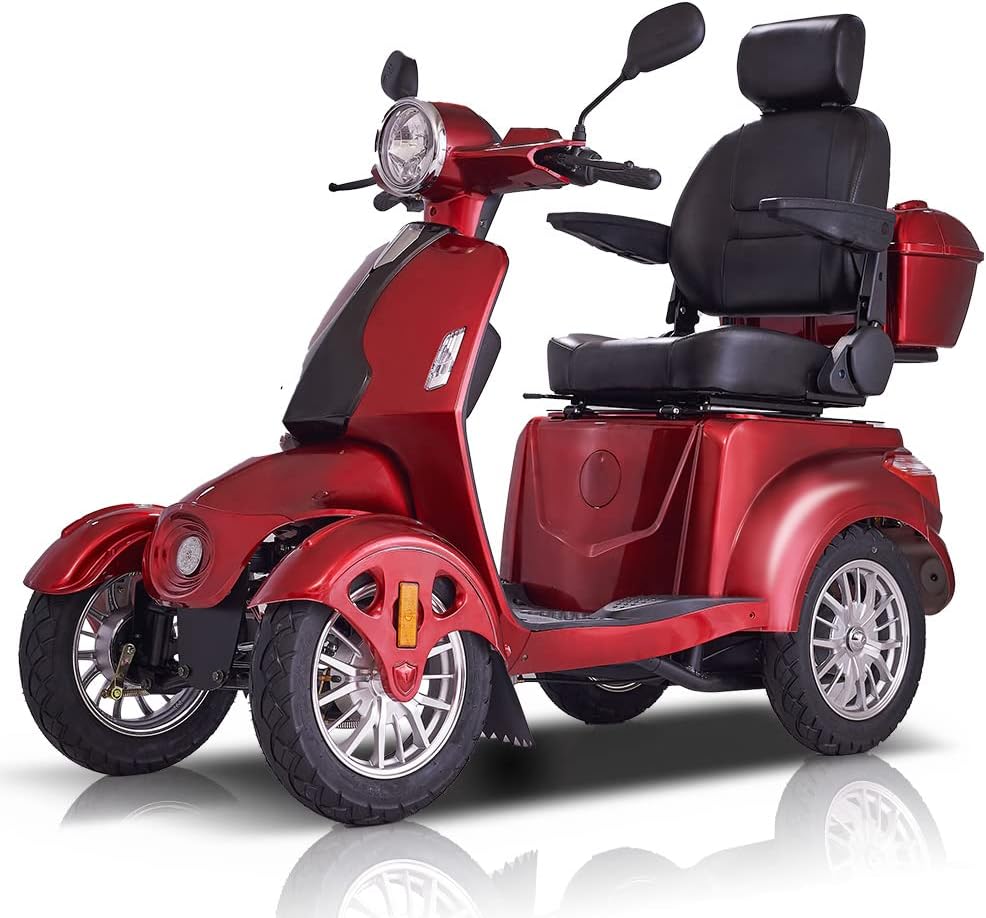
Heavy-Duty 4 Wheel Mobility Scooter 500LBS
Rating: ⭐⭐⭐⭐⭐ 4.9/5 | Price: $2,298.00
800W all-terrain power with exceptional stability and build quality. Outstanding user reviews. Cons: Significant weight makes indoor maneuvering challenging, requires dedicated storage space.
Rental fleets focus on reliability and simplicity, typically offering basic models without advanced features. This limitation affects users who want to experience cutting-edge technology before making purchase decisions.
The upgrade pathway planning
Smart buyers plan upgrade pathways from the beginning, particularly important given the rapid pace of technology advancement in mobility devices. Understanding depreciation patterns and security considerations helps optimize long-term value.
Professional and workplace integration increasingly requires advanced features and ADA compliance considerations that basic rental models may not provide.
Regional variations across USA and Canada
Significant regional differences impact the rental versus purchase decision across North America. Urban areas typically offer extensive rental networks with competitive pricing, while rural regions may have limited rental options but lower purchase prices.
Canadian provinces with universal healthcare often provide better insurance coverage for mobility device purchases, potentially tipping the scale toward ownership. Conversely, tourist-heavy regions like Florida and California offer sophisticated rental networks that make short-term use highly convenient.
Climate considerations play a crucial role in regional decision-making. Northern regions require devices capable of handling snow and ice, while desert areas demand enhanced battery performance in extreme heat conditions.
Frequently asked questions
How long can I rent a mobility scooter before buying becomes cheaper?
Generally, if you need a mobility scooter for more than 15-20 days per year, purchasing becomes more economical. However, factor in maintenance costs, storage, and insurance when calculating the true breakeven point.
Can I rent a mobility scooter for international vacation travel?
Yes, major vacation destinations worldwide offer mobility scooter rentals.