
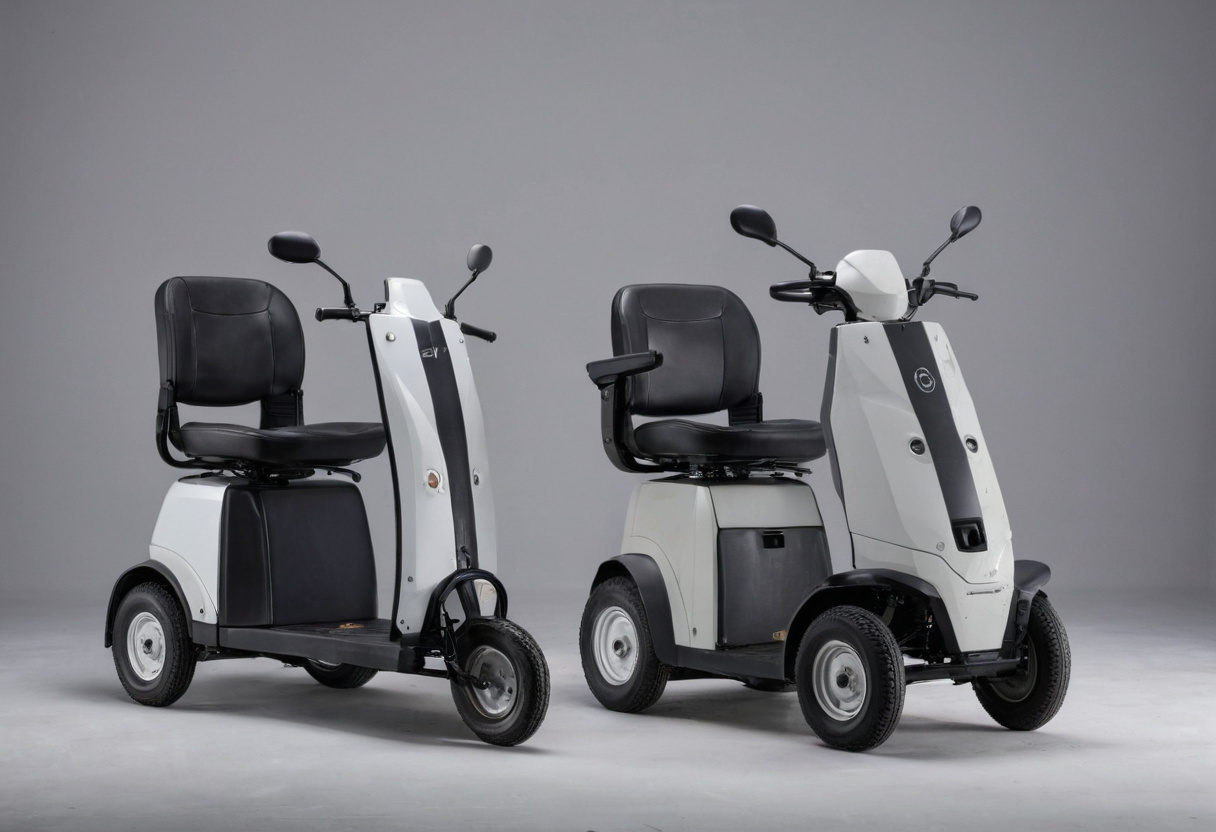
A mobility scooter loses most of its value in the first year, and the state of the battery decides most of what is left after that. A trade-in buys convenience, because the dealer removes the old machine and the paperwork is a single transaction. A private sale usually returns more money for more effort. Get any trade offer in writing, and get it before you agree to buy the replacement.
- Medicare Part B covers a power scooter as durable medical equipment when it is medically necessary for use in the home, and you typically pay 20% after the deductible.
- In one recent Medicare year, 4,236 beneficiaries received a Group 1 power scooter (HCPCS K0800).
- 27.7% of Americans 65+ report a mobility disability, which is the population these benefits serve.
Sources: U.S. CMS Medicare Part B DME data; U.S. CDC DHDS (BRFSS 2021).
The hidden truth about mobility scooter value
An old scooter in the garage still has value, and the question is whether a trade-in captures more of it than a private sale does. The answer turns on the condition of the battery and on whether the model still has a service network behind it.
This guide covers how mobility scooters lose value, what a trade-in is realistically worth against a private sale, and which questions to ask a dealer before you hand the old machine over.
Understanding mobility scooter depreciation patterns in 2025
Mobility scooters follow a unique depreciation curve that differs significantly from automobiles or other vehicles. Understanding these patterns gives you a substantial advantage when planning upgrades or evaluating trade-in offers.
First-year depreciation reality
A mobility scooter loses most of its value in the first year, the way most durable medical equipment does. Established brands with a dealer network behind them hold value better than unbranded models, because a buyer can still get parts and service for them. Ask a dealer what they are currently paying for your exact model rather than working from a percentage.
Published depreciation tables for mobility scooters are not reliable, because there is no open resale market to measure the way there is for cars. The figure that matters is what a dealer will actually put in writing for your exact model this month, alongside what comparable used units are currently listed for privately. Get both before you decide which route to take.
Factors that accelerate depreciation
Two things drive resale value down faster than age does. Storing the scooter outdoors without weather protection shows in the seat, the tiller and the connectors, and a buyer prices that in. Models whose parts have been discontinued lose value fastest of all, because the next owner cannot get them serviced.
Battery condition decides more of the offer than anything else. A scooter that needs new batteries is discounted by roughly what the replacement pack costs, so charging habits over the years you own it show up directly in what you are offered at the end.

Major manufacturer trade-in programs breakdown
Trade-in terms differ from one manufacturer and dealer to the next, and they change. Treat any figure you read online as a starting point for a conversation, not as an offer.
What to ask a manufacturer or dealer
Rather than assume any particular program exists, call an authorized dealer for your brand and ask four things: whether they take trade-ins at all, whether they accept other brands, whether they collect the old scooter or you deliver it, and whether the offer is cash or credit against a new machine. Get the answer in writing before you commit to a purchase.

Go-Go Ultra X 3-Wheel Travel Mobility Scooter
Rating: ⭐⭐⭐⭐⭐ 4.6/5 | Price: see current price on Amazon
Lightweight travel scooter perfect for everyday mobility needs. Features easy disassembly and compact design for transport convenience. Great battery life and smooth operation make it ideal for seniors seeking independence.
Cons: Limited ground clearance, not suitable for rough terrain
Buy on AmazonTrade-in against private sale
A trade-in is convenience: the dealer removes the old scooter and the paperwork is one transaction. A private sale usually returns more money and costs you the time of listing it, meeting buyers and arranging collection.
If the scooter still runs well and the batteries are healthy, that gap is often wide enough to be worth the effort. If it needs work, or if it is a heavy-duty outdoor model that is awkward to move, having a dealer take it away has real value of its own.
If Medicare paid for your scooter, the clock is at least five years
This is the rule that decides upgrade timing for anyone whose scooter came through Medicare, and it is widely misunderstood. Federal regulation sets a reasonable useful lifetime for durable medical equipment, and 42 CFR 414.210(f)(1) states that “in no case can it be less than 5 years”.
Two details in that paragraph matter more than the number. The clock runs from delivery rather than manufacture: “Computation is based on when the equipment is delivered to the beneficiary, not the age of the equipment.” A scooter that sat in a warehouse for a year does not put you a year closer to a replacement. And reaching that lifetime is not the only route to a new one. The same regulation provides that once equipment has been in continuous use for its reasonable useful lifetime, “or if the carrier determines that the item is lost, stolen, or irreparably damaged, the patient may elect to obtain a new piece of equipment”. Source: eCFR, 42 CFR 414.210.
The practical consequence for a trade-in is straightforward. If Medicare paid and you are still inside that window, a replacement generally will not be covered, so trading the scooter in means buying the next one yourself. Confirm where you stand in the cycle, and whether you own the equipment outright, with your supplier before you accept any offer.
Related buying guides: 4-Wheel Scooters, Scooters for Seniors, 3-Wheel Scooters, and the full catalog and mobility statistics.